
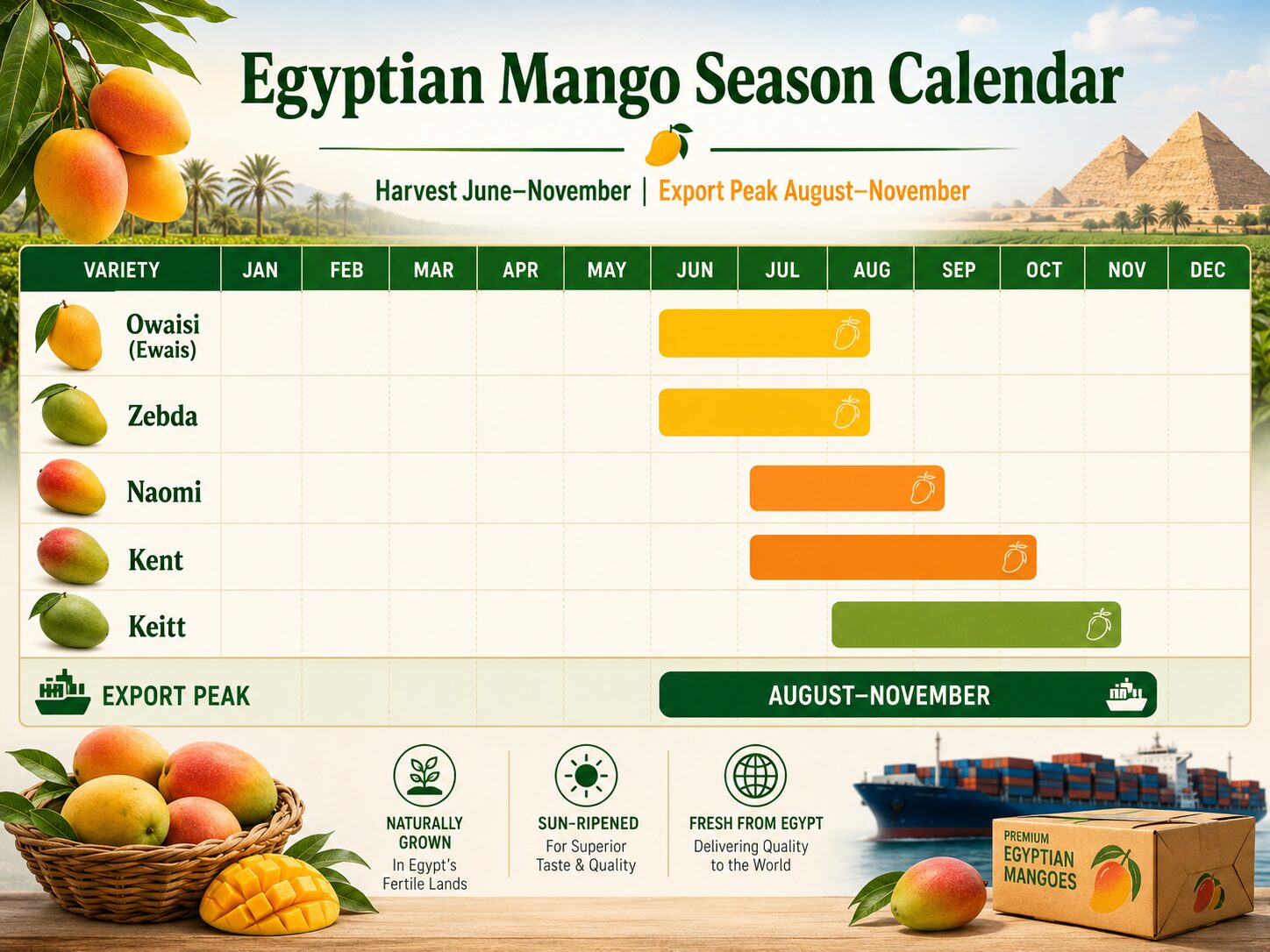
By the last week of July the Egyptian mango season is in full flow and most buyers are focused on what is loading this week. The buyers who do best in September and October are the ones having a different conversation now, because the tail of the season is where availability narrows, competition from other origins fades and pricing behaves differently.
What is actually available late
The Egyptian season runs from roughly June through October, and the varieties do not overlap evenly. Naomi opens the season and finishes early. Kent occupies the middle of the window and tapers through August. Keitt is the late variety and carries September and October on its own in most years. Anyone planning autumn arrivals is planning a Keitt programme, so the specification conversation should be built around Keitt rather than around mango in general. Sizes, counts and carton formats for the variety are set out in our Keitt mango specification note.
How late fruit behaves
Late Keitt is not simply the same fruit arriving later. Fruit harvested at the end of the season generally carries higher dry matter and firmer flesh than early-season fruit, which is useful for long sea legs but means the ripening room stage at destination needs a little more time and a little more patience. Keitt stays green-skinned when ripe, with at most a light blush, so receivers who judge readiness by colour will consistently misjudge it. Firmness and internal colour are the reliable indicators. Our guide to ripening and shelf-life management covers the room settings and the sequence.
Volume tightens as the season closes. Packhouse throughput drops, the share of larger counts falls, and the fruit that remains is committed earlier. Buyers who book late in September regularly find that the counts they want are gone and only the smaller sizes remain uncommitted.
Structuring the booking
For September and October arrivals we ask buyers to fix four things by mid-August. First, the size range, expressed as counts per carton rather than as a weight band, since count is what the packhouse actually sorts to. Second, the carton format, whether four kilogramme single layer or the standard eight kilogramme two-layer. Third, the shipment schedule, ideally as weekly or fortnightly containers rather than a single lump, so that the packhouse can plan harvest against your slots. Fourth, the delivery term and port, since a CFR quotation to Jeddah and a CFR quotation to Rotterdam behave very differently as the season closes and reefer space tightens ahead of the autumn peak.
Transit time from Alexandria and Damietta runs four to six days to Gulf ports and ten to fourteen days to Northern Europe, with Sokhna serving Red Sea and Asian lanes. Fruit set point stays at 10 to 12 degrees Celsius through the late season. Dropping below 10 degrees to buy extra shelf life produces chilling injury, which usually surfaces as grey flesh and uneven ripening after the container is opened.
Certification and inspection
Late-season loads carry the same documentation as the rest of the programme. GLOBALG.A.P certified sources, phytosanitary certificate, certificate of origin, and SGS or Intertek pre-shipment inspection on request. Where a buyer runs a retail programme with its own specification, we work to that specification and share inspection photographs before the container sails.
To hold a September or October Keitt slot, or to receive a specification sheet for late-season fruit, contact the Nile Prime export desk on WhatsApp at +20 10 9911 1918.