
Every mango season we get the same question in late July, usually from a buyer who has just lost a promotion window. Can the fruit go by air. The answer is yes, and for certain buyers it is the right call, but the pack, the maturity and the commercial logic all change. Air freight is not a faster version of the sea programme. It is a different product.
Lead time is the whole argument
From our packhouse to Cairo International Airport is a short road leg, and Borg El Arab near Alexandria serves as a second gateway for European carriers. Flight time is roughly three to four hours to the Gulf and four to five hours to most European hubs. Realistic door-to-door lead time, counting packing, trucking, acceptance cut-off, flight and customs clearance at destination, is one to three days. A sea shipment from Alexandria or Damietta runs four to six days to Jeddah and ten to fourteen days to Northern European ports, and that is before terminal and clearance time. The detail on the sea side is set out in our guide to shipping Egyptian mango by sea.
The fruit is picked and packed differently
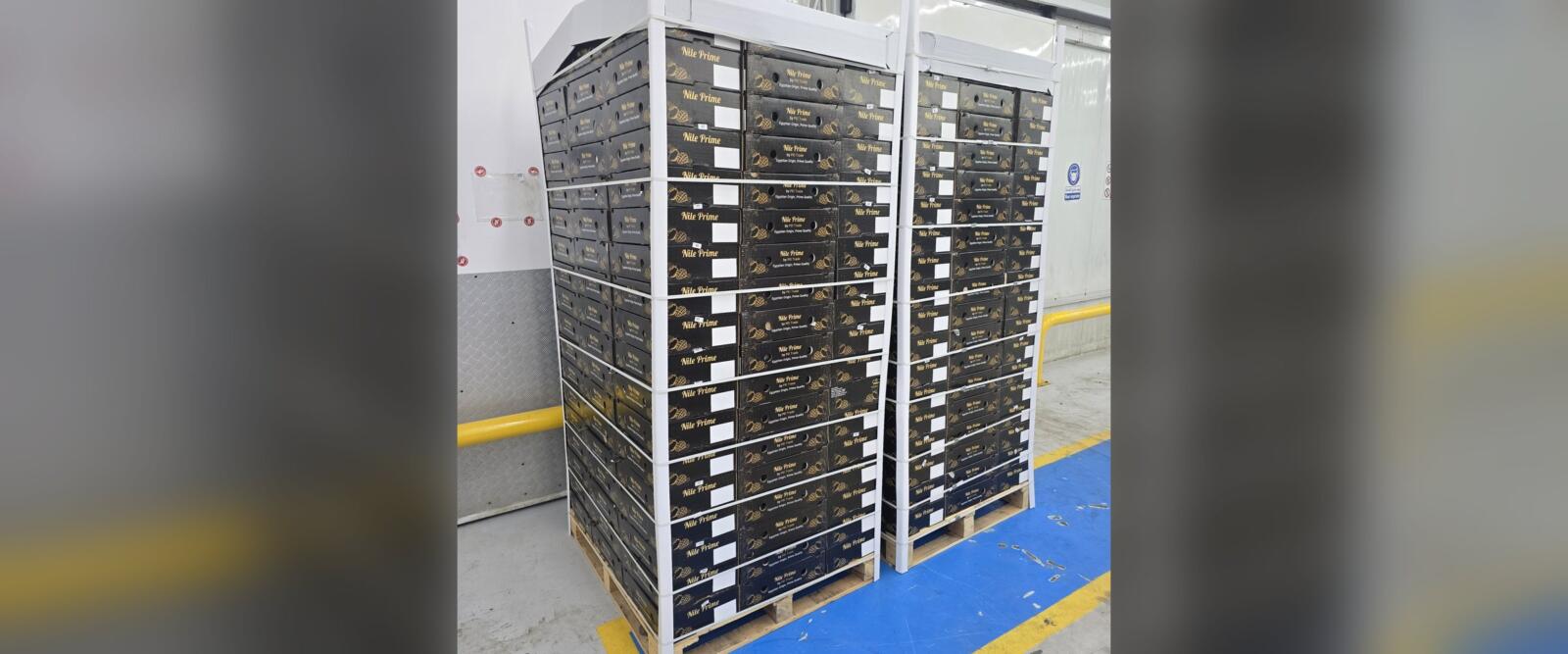
Because transit is short, air freight fruit is harvested at a more advanced maturity than sea fruit. Sea consignments of Keitt and Kent are picked mature green so they arrive firm and ripen at destination. Air consignments can be picked closer to the turn, which means higher dry matter, better flavour on arrival and a shorter ripening room stage for the receiver. That fruit is also more fragile, so it goes into single-layer four kilogramme or six kilogramme cartons rather than the eight kilogramme two-layer format used at sea, with tray liners or foam nets on every fruit.
Palletisation changes too. Air cargo moves on PMC or P6P pallets and in AKE unit load devices, which have contoured profiles and their own height limits, so carton stacks are built to the ULD rather than to a standard 120 by 100 cm export pallet. Volumetric weight applies. A light carton with a large footprint can be charged on volume rather than actual weight, which is why the carton choice affects the freight bill directly.
When the economics work
Air freight per kilogramme sits an order of magnitude above sea freight and moves week to week with belly capacity, so we quote it at the time of booking rather than for a season. It makes commercial sense in three situations. The first is the opening and closing weeks of the season, when a receiver wants fruit on the shelf before the sea programme lands. The second is high-end retail and food service where the customer is paying for eating quality on arrival and the fruit is sold at a premium. The third is sample and trial volumes, where a buyer wants to assess variety, size and flavour before committing to a container programme. For steady weekly volume at a working price, sea remains the right vehicle.
Terms and documents
Air shipments are usually contracted on FCA Cairo or CPT to the destination airport under Incoterms 2020, with the air waybill replacing the bill of lading. Phytosanitary certificate, certificate of origin and packing list are issued the same way as for sea, but the timing is tighter, since documents need to travel with or ahead of the consignment rather than by courier over the following days. Our note on buying Egyptian mango on FOB or CFR terms covers how the delivery term shifts risk and cost.
Nile Prime ships Keitt, Kent and Naomi mango by air and by sea through Alexandria, Damietta and Sokhna, with GLOBALG.A.P certified sources and third-party inspection on request. For an air freight quotation with current rates and carton options, message our export desk on WhatsApp at +20 10 9911 1918.