
LCL and groupage shipping for small produce orders answers the question that stops most would-be importers before they start: what if my market needs two pallets of Egyptian dates, not twenty-four tonnes of them? Between the full-container world and the courier-sample world sits a real middle tier — consolidated reefer cargo, mixed-product containers, and shared-space programs — with its own economics, risks, and tricks. This guide maps every option for buying Egyptian produce below full-container scale.
Table of Contents
- The Small-Buyer Problem, Honestly Stated
- The Four Sub-Container Options Compared
- The Mixed Container — The Trade’s Best-Kept Middle Path
- Where Small Shipments Go Wrong
- Worked Example: From Two Pallets to a Container of Your Own
- The Growth Path: Engineering Your Way to FCL
- FAQ
- Sources
The Small-Buyer Problem, Honestly Stated
Produce logistics is built for the container: pricing, equipment, documentation, and exporters’ attention all optimize for 20+ tonne units. Below that scale, three penalties stack: per-kilo freight rises steeply (consolidation handling, shared-space margins); cold-chain control weakens (your two pallets ride someone else’s setpoint decisions); and seller priority drops (a two-pallet buyer emails behind forty-container clients). None of this makes small importing impossible — specialty retailers, restaurant groups, island markets, and first-timers do it profitably every week — but it makes structure decisive: the small buyer’s craft is borrowing container-scale economics through the four structures below.
The Four Sub-Container Options Compared
| Structure | How It Works | Cold Chain | Best For |
|---|---|---|---|
| Reefer LCL / consolidation | Forwarder groups several shippers’ cargo in one reefer | One shared setpoint — check compatibility | 1–8 pallets on major lanes |
| Mixed container (one exporter) | Several products from one Egyptian house in your own box | You control the setpoint | Multi-product buyers below per-product FCL |
| Shared container (buyer club) | Two or three importers in one market split a box | Controlled; needs trust + paperwork | Neighboring small buyers, one clearance |
| Air freight small lots | Pallet-scale premium product by air | Excellent, brief | High-value lines per the air guide |
The Mixed Container — The Trade’s Best-Kept Middle Path
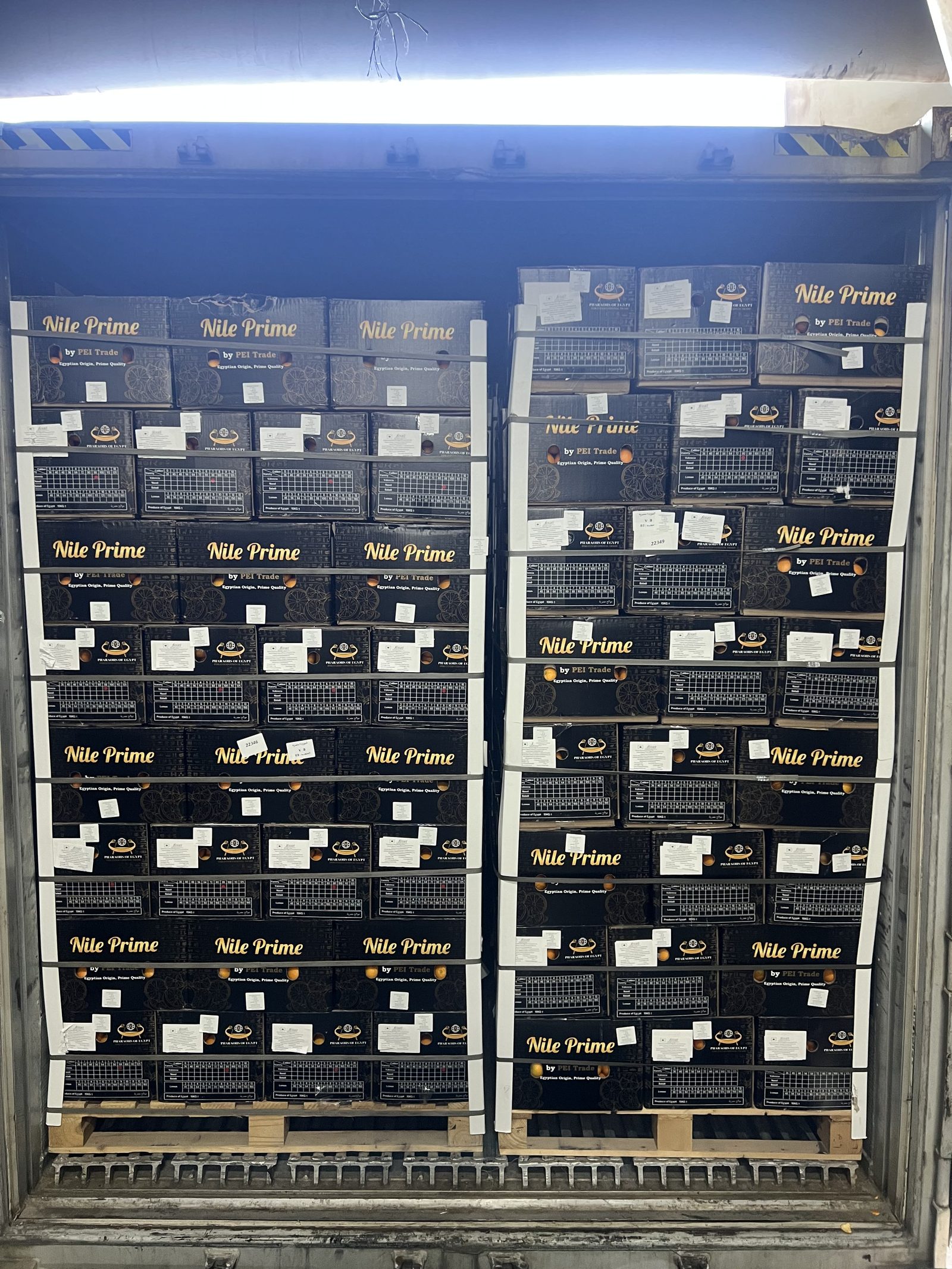
The most underused structure in Egyptian trade is the single-exporter mixed container: one 40RF carrying, say, eight pallets of oranges, six of onions, four of dates, and two of garlic — one supplier, one document set, one clearance, your own setpoint. It works because integrated Egyptian houses carry broad baskets, per the exporter rankings, and it converts the small buyer’s weakness into a portfolio: five products at two-pallet depth instead of one product at container depth. The two disciplines it demands: compatibility — everything shares one temperature, one humidity, one ethylene environment, so the combination must clear the storage chart’s co-loading rules (oranges + onions is the classic violation; oranges + pomegranates + potatoes works); and lot-level specs — each product line needs its own contract spec and tolerances, or arrival day dissolves into ambiguity across five products at once.
Where Small Shipments Go Wrong
- Setpoint roulette in LCL: your strawberries in a consolidation reefer running +4°C for someone else’s citrus — always ask the consolidation’s setpoint and co-cargo before booking.
- Handling multiplication: LCL cargo is touched at origin CFS, stuffing, destination CFS, and delivery — four handling events for fragile cartons that FCL touches twice.
- Documentation per kilo: phyto, origin, and clearance costs are near-fixed per shipment; on two pallets they can add $0.15–0.30/kg that container buyers never see.
- Priority in peak season: consolidations get bumped when reefer space tightens; December strawberry LCL is a gamble the calendar warns against.
- Claims complexity: shared containers mean shared evidence problems — whose pallet warmed the box? Loggers per lot, per the claims guide, are non-negotiable.
Worked Example: From Two Pallets to a Container of Your Own
A hypothetical Maltese specialty grocer wants Egyptian products for a Mediterranean-island market that consumes steadily but slowly. Stage one (months 1–4): reefer LCL via a Valletta-lane consolidator — two pallets of dates and one of pomegranates monthly; per-kilo landed cost runs perhaps 35% above container rates, painful but survivable on specialty margins, and the volumes prove demand without betting real capital. Stage two (months 5–12): the mixed container — his now-proven basket (dates, pomegranates, oranges, garlic) fills a shared 20-foot reefer with a Gozo restaurant supplier he met through the consolidator; one clearance, split by pallet count, each party’s lots separately specified and logged. Landed costs drop ~20%. Stage three (year two): his own monthly 40RF mixed container from one Egyptian house — the full basket at two-to-six pallets per product, FCL economics, his own setpoint, and an exporter relationship that now answers same-day. Total journey in this sketch: fourteen months from first two-pallet order to container-scale buying, with no stage risking more than the last stage proved. That staircase — LCL to shared to mixed FCL — is the standard growth path this guide exists to map.

The Growth Path: Engineering Your Way to FCL
Three accelerators shorten the staircase. Find the basket, not the product: five slow-moving products consolidate into one viable container long before any single line justifies it — audit your shelf for everything Egypt exports before concluding you’re too small. Recruit neighbors deliberately: the shared-container partner who halves your fixed costs is probably a competitor-adjacent business one harbor over; the trade’s informal buyer clubs mostly began as two emails. Let the exporter help: established houses assemble mixed containers routinely and will flex pallet-level minimums for buyers who look like future programs — say so explicitly, per the trial order guide: a two-pallet buyer with a credible growth story gets treated like the container buyer he’s becoming.
FAQ
Can I import less than a full container of produce from Egypt?
Yes — through reefer LCL consolidation (1–8 pallets on major lanes), mixed containers combining several products from one exporter, shared containers split between neighboring buyers, or air freight for premium small lots.
How much more does LCL produce shipping cost than a full container?
Typically 25–50% more per kilo once consolidation handling, shared-space margins, and near-fixed documentation costs spread over small volumes — a premium that specialty margins absorb and commodity margins don’t.
What products can share one mixed container?
Only products matching on temperature, humidity, and ethylene compatibility: citrus with pomegranates and potatoes works; onions (low humidity) or strawberries (near-zero setpoint) need separate equipment. Check the storage chart before designing the load.
What is the best growth path from small orders to full containers?
The staircase: LCL consolidation to prove demand, then a shared or single-exporter mixed container to capture FCL economics across a basket, then your own container as volumes mature — each stage risking only what the previous stage proved.
Sources
FIATA — freight forwarding and consolidation standards (fiata.org) · Container Handbook — mixed-cargo stowage and compatibility (containerhandbuch.de) · UC Davis Postharvest — commodity compatibility groups (postharvest.ucdavis.edu) · PEI Trade — mixed-container and small-program support for growing buyers · Drewry — LCL and reefer market analysis (drewry.co.uk).