
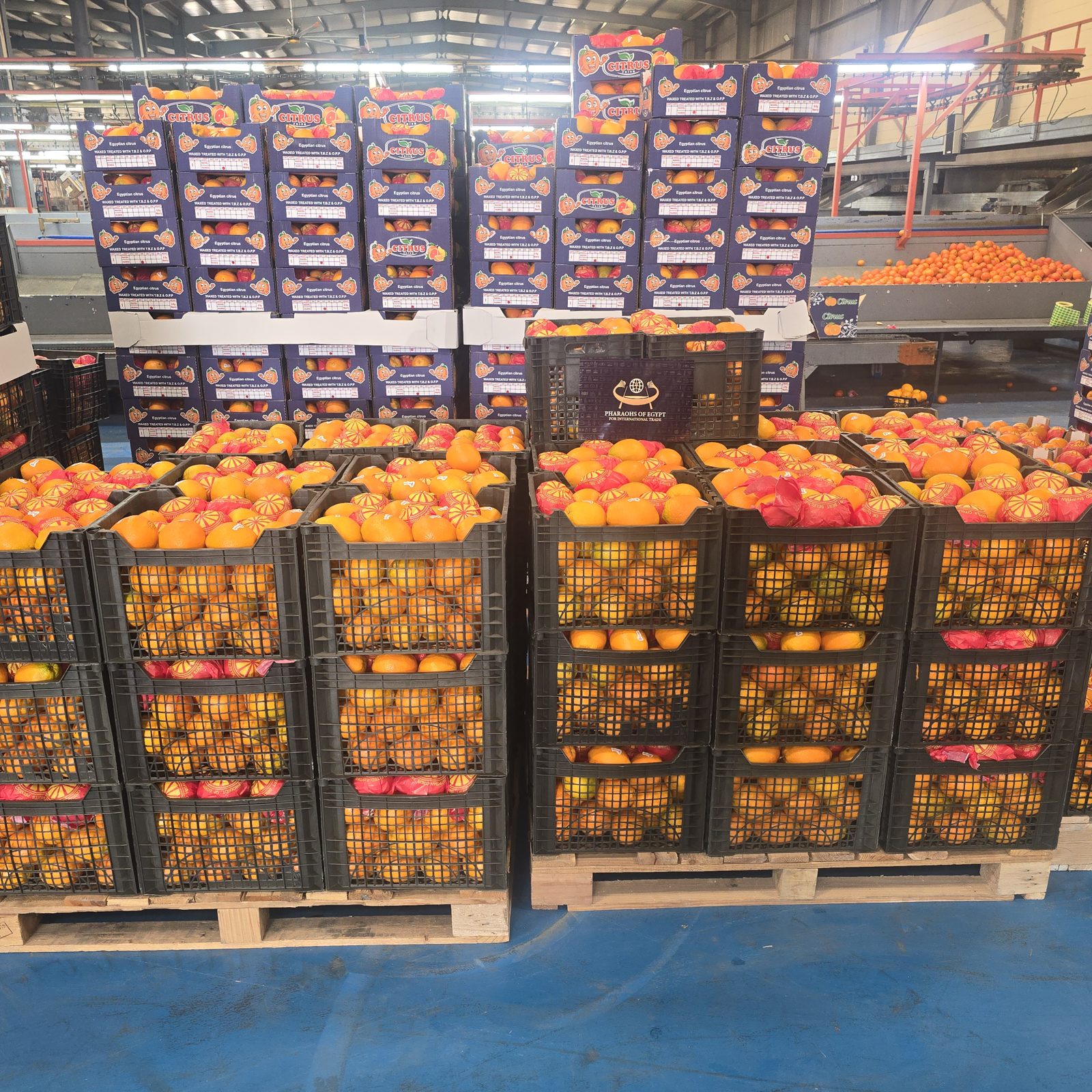
Two importers can buy the same Valencia from the same packhouse in the same week and receive loads that behave differently on arrival. The fruit is not the variable. The carton, the pallet build and the stow pattern are. Citrus is dense cargo and it is one of the few products where the container fills on weight before it fills on space, so every configuration decision has a cost consequence as well as a quality one.
The carton formats in use
| Format | Net weight | Where it goes |
|---|---|---|
| Telescopic two-piece carton | 15 kg | Gulf, Russia, Asia, general export |
| Telescopic or open-top carton | 10 kg | EU and UK retail programmes |
| Open-top display tray | 6 to 7 kg | Retail shelf-ready |
| Mesh or raschel bag, loose in carton or on pallet | 2 to 5 kg per bag | Eastern Europe, promotional packs |
The 15 kg telescopic remains the default for Egyptian orange and grapefruit. Board specification matters more than buyers expect: citrus is heavy, the cartons stack eight to eleven high on a pallet, and an under-specified bottom carton deforms in the cold store before the container is even booked. Vent area of roughly 4 to 5 percent of the carton face, aligned vertically from carton to carton up the stack, is what lets a forced-air cooler pull heat out of the middle of the pallet rather than just off the outside.
Pallet footprints and cartons per pallet
Two footprints dominate. The Euro pallet at 1200 by 800 mm suits European retail and the standard or industrial pallet at 1200 by 1000 mm is used for the Gulf and most other destinations. On a 1200 by 1000 pallet a 15 kg citrus carton typically builds five or six cartons per layer and eight to ten layers, landing between 48 and 60 cartons, or roughly 720 to 900 kg net. On a Euro pallet the layer count drops and the usual build is 42 to 54 cartons. Packhouses will quote their own exact configuration, and it is worth asking for it in writing because the number drives both the pallet count and the weight calculation.
Build height is normally held at 2.0 to 2.2 metres including the pallet for a high cube reefer. Corner boards and vertical strapping hold the stack square. Stretch wrap is applied in bands rather than as a full seal, because a fully wrapped pallet blocks the airflow the vent holes were designed to allow.
Loading the container
A 40ft high cube reefer takes 20 pallets on the 1200 by 1000 footprint in a straight single-row stow, or 22 to 24 Euro pallets depending on the door configuration and whether the last row is turned. The practical limit on citrus is almost always payload rather than floor space: at 800 kg or more per pallet, 20 pallets puts the cargo weight near the road limits that apply at destination long before the container runs out of room. Pallet count should therefore be set against the payload ceiling for the specific lane, not against the theoretical floor plan.
Keep the T-floor channels clear, do not block the evaporator at the front, and leave the last 30 to 40 cm before the doors free so the return air is not choked. The same principles applied to a different crop are set out in our note on shipping pomegranates from Egypt, and the handling that happens before palletisation is covered in inside an Egyptian citrus packhouse.
What to state on the order
Six lines remove almost all ambiguity: carton format and net weight, count per carton, pallet footprint, cartons per pallet, pallet height, and whether ISPM 15 heat-treated wood is required. Add the label language and the country of origin marking for the destination market. Anything left unstated will be built to the packhouse default, which is usually sensible but may not match what your warehouse can handle.
Send the configuration with the enquiry
If you already know your racking height, your pallet standard and your unloading equipment, send those with the enquiry rather than after the first container arrives. Nile Prime will build to your configuration where the fruit and the payload allow it. WhatsApp +20 10 9911 1918 reaches the export desk.