
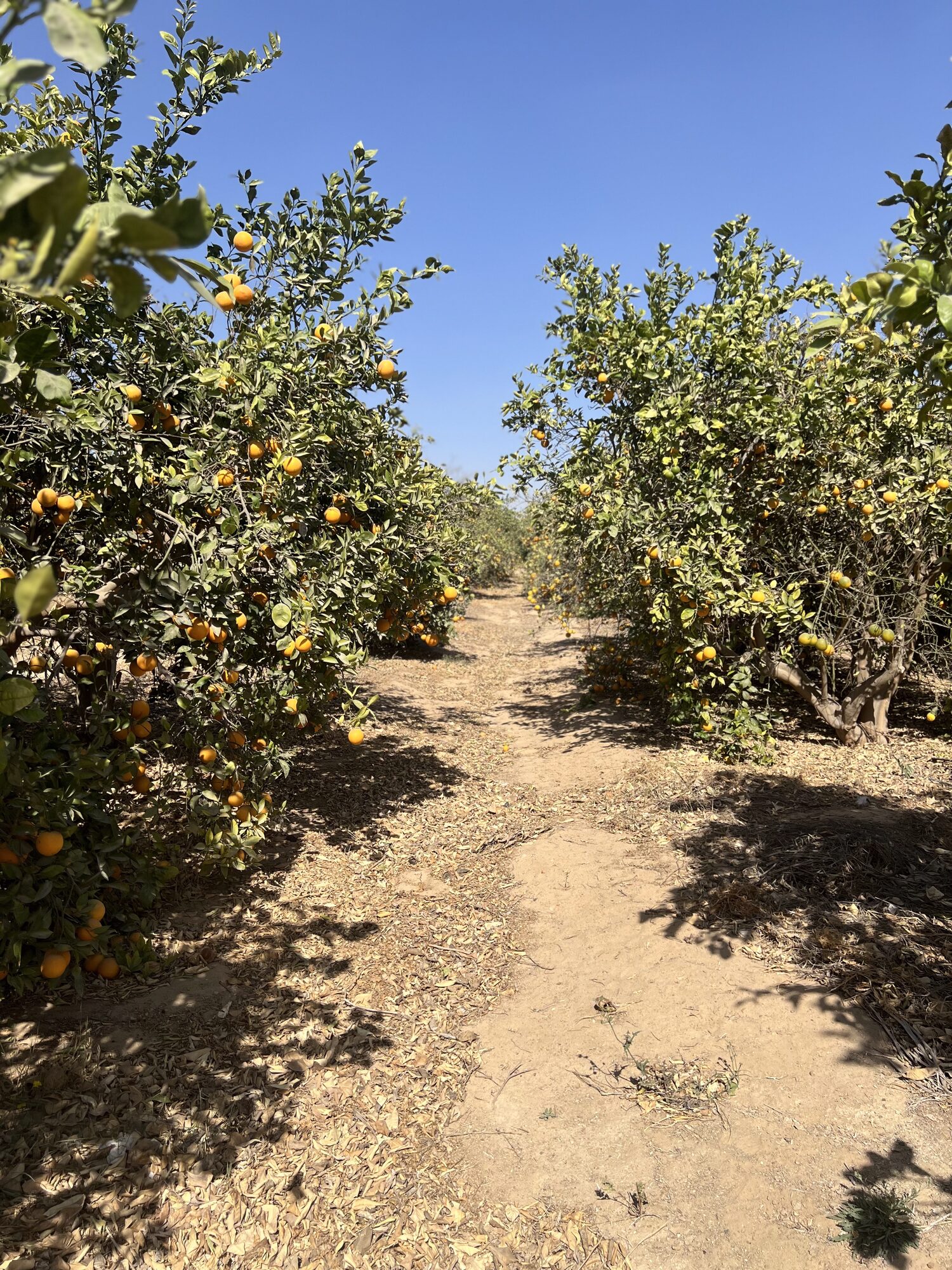
Buyers new to Egyptian citrus often treat Navel and Valencia as two names for the same orange. They are not interchangeable, and the choice decides the shipping window, the size curve you can expect, the markets you can serve and how much transit the fruit will take. With Navel maturity testing under way and the first bookings opening, this is the comparison our commercial desk goes through with every new importer.
Season windows
Navel opens first. Colour break and maturity testing run through late September and October, first commercial picking follows in the second half of November in a normal year, and the variety carries volume through to late January or early February. Valencia follows behind it, opening in late January or February and running to May, with the tail into June depending on the region and the year.
The two varieties overlap only briefly. A buyer wanting continuous Egyptian orange supply from November to May is buying Navel first and Valencia second, and should contract both in the same conversation rather than coming back in February to find the good Valencia volume already committed. Month by month availability is set out in the Egyptian citrus season calendar.
Size curve
Navel runs larger. The bulk of a Navel crop lands in counts 48 to 72, with meaningful volume in 40 and 44 in a good year. Valencia runs smaller and tighter, concentrated in 56 to 88, with counts 100 and 113 available in volume for markets that want small fruit.
This matters commercially. A retail programme built on count 56 to 64 is a Navel programme. A juice or wholesale programme in the Gulf that moves count 88 to 113 in mesh or 15 kg cartons is a Valencia programme. Asking for large Valencia at the start of the season is asking against the natural size curve, and it will be priced accordingly if it can be filled at all.
Eating quality and brix
Navel is seedless, peels easily and eats as a table orange. It is the variety that wins a retail listing on appearance. Valencia carries fewer seeds than most seeded varieties, holds a higher juice yield and generally reaches a higher brix later in its window, which is why juice buyers wait for it.
Neither is picked on brix alone. The maturity decision uses the brix to acid ratio, and the picking date follows the ratio rather than the calendar. The method and the thresholds are set out in the note on maturity standards on Egyptian citrus.
Rind behaviour and transit tolerance
Navel has a thinner, softer rind and a navel end that is a natural entry point for decay. It bruises more easily on the line and is less forgiving of a long transit or a poorly run reefer. Valencia has a tougher rind, resists handling better and carries longer, which makes it the more comfortable variety for distant markets and for buyers whose cold chain at destination is not fully controlled.
Practically, that means Navel to markets within roughly two weeks of sailing, and Valencia where transit is longer or where the fruit will sit before it sells.
Which markets take which
Navel moves into European retail, the UK, and the premium end of the Gulf trade, in 15 kg or 10 kg cartons, often sleeved or wrapped. Valencia moves into Russia, Eastern Europe, the wider Gulf and East Asia, in 15 kg cartons and mesh, and into juice channels. Some markets take both across the season, which is exactly the programme structure worth building.
Packing and loading
Both varieties pack in the standard telescopic 15 kg carton, with 10 kg and 4.5 kg formats for retail programmes. Pallet builds and cartons per pallet follow the same configuration for both. The transit set point is the same for both varieties and sits close to the chilling injury threshold, so the set point should never be lowered to buy extra shelf life.
Contract the season, not the week
Tell us the destination port, the counts you sell, the carton format and the weeks you need covered from November through May, and we will build a specification and a price against Incoterms 2020 out of Alexandria, Damietta or Sokhna. WhatsApp +20 10 9911 1918.