
Egyptian ports for produce export are a strategic choice disguised as a logistics detail: Alexandria, Damietta, and Sokhna serve different geographies, carriers, and transit times, and the port on your bill of lading can add or subtract a week of shelf life at destination. This guide maps Egypt’s three produce gateways — plus the specialized roles of Port Said and the smaller terminals — with the lane-by-lane logic that decides which port should load your cargo.
Table of Contents
- The Three Gateways at a Glance
- Alexandria & El Dekheila — The Mediterranean Workhorse
- Damietta — The Container Specialist
- Sokhna — The Red Sea Advantage
- Worked Example: One Exporter, Three Ports, One Season
- Choosing the Port: A Decision Table
- FAQ
- Sources
The Three Gateways at a Glance
| Port | Coast | Natural Markets | Signature Strength |
|---|---|---|---|
| Alexandria / El Dekheila | Mediterranean | Europe, North Africa, Americas | Sailing frequency and proximity to Delta farms |
| Damietta | Mediterranean (east) | Europe, East Med, transshipment | Container efficiency, growing capacity |
| Sokhna | Red Sea | Gulf, Asia, East Africa | Days-shorter transits south and east |
| Port Said East | Canal mouth | Transshipment hub | Connections via the world’s transshipment traffic |
Alexandria & El Dekheila — The Mediterranean Workhorse
Alexandria and its El Dekheila extension handle the largest share of Egypt’s produce exports for two stubborn reasons: geography and frequency. The port sits an hour or two from the Delta and Beheira growing belts — the shortest farm-to-quay runs in the country — and its sailing board offers near-daily departures to European and Mediterranean ports, with 5–10 day transits to Italy, Spain, Greece, and the western Med. The trade-offs are those of any dominant incumbent: congestion in peak citrus weeks, older infrastructure in parts of the terminal complex, and cut-off discipline that punishes late trucks. For Europe-bound fresh programs — where every sailing skipped is shelf life lost — Alexandria’s frequency usually beats any rival’s efficiency.
Damietta — The Container Specialist
Damietta, on the Delta’s eastern edge, built its reputation as a disciplined container port — strong crane productivity, less congestion drama than Alexandria, and good service to European and East Mediterranean destinations. For exporters in the eastern Delta (and for frozen cargo, where a day’s difference matters less than reliable equipment and plugs), Damietta frequently offers the calmer operation. Its ongoing expansion keeps adding capacity and services; on some European lanes its schedules now rival Alexandria’s. The practical rule many houses run: fresh to Alexandria for frequency, frozen to Damietta for orderliness — adjusted lane by lane against each week’s actual sailing board.
Sokhna — The Red Sea Advantage
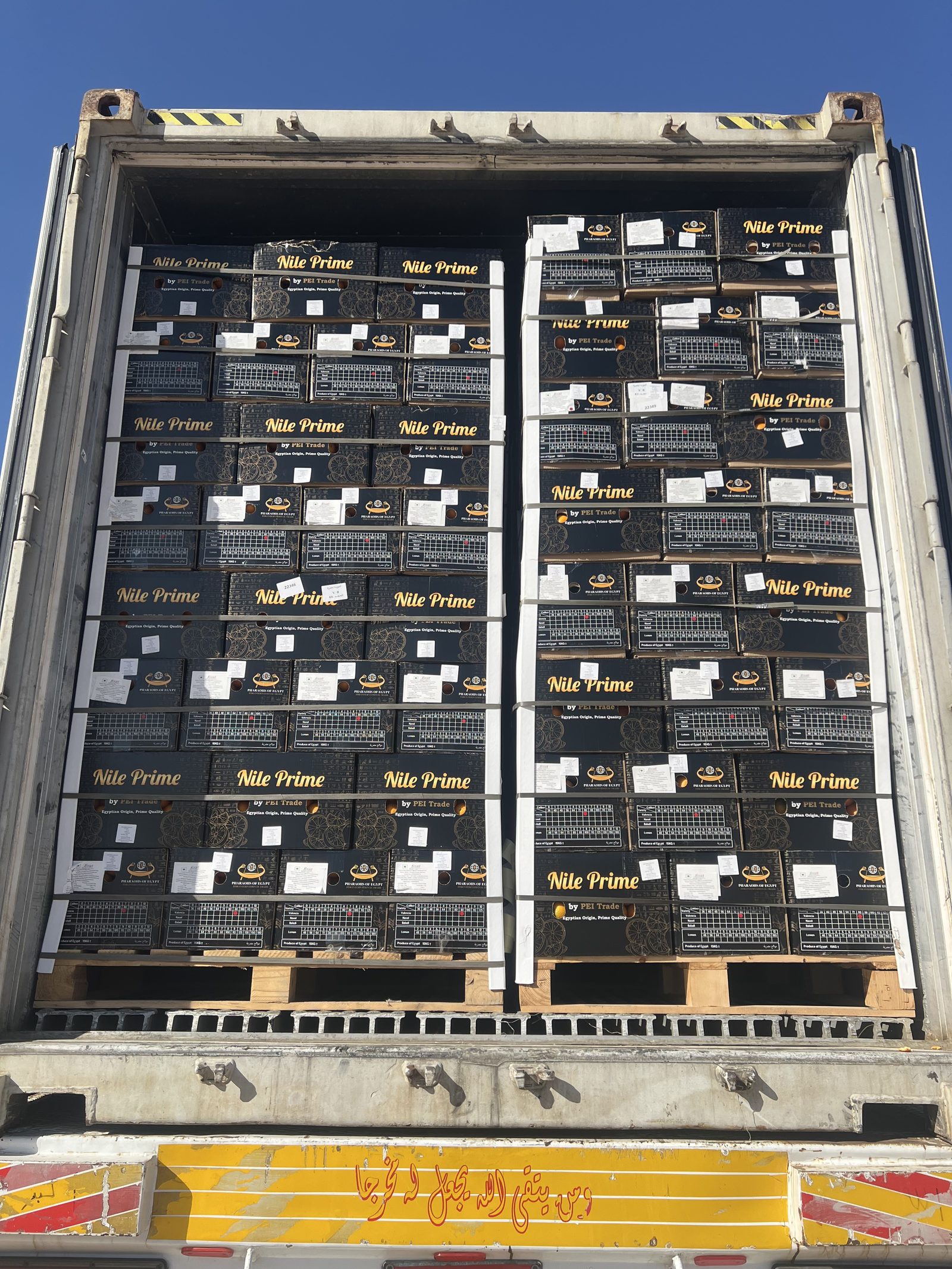
Sokhna, on the Gulf of Suez an hour from Cairo, is the structural gift to Egypt’s eastern trade: cargo loading there is already south of the Canal, which converts into transits no Mediterranean competitor can touch — Jeddah in 3–5 days, Jebel Ali in 8–10, Indian and East African ports without the Canal queue. For the Gulf programs that dominate Egyptian citrus, the mango trade, and the Ramadan surges, Sokhna is the default answer; for Asia lanes it’s the growing one. Its modern terminals (developed with major global operators) run efficiently, and the Cairo–Sokhna road makes it practical for Upper Egypt and reclamation-land producers too. Constraint to manage: fewer weekly services than Alexandria on some lanes — program bookings secure space that spot shippers scramble for.
Worked Example: One Exporter, Three Ports, One Season
A hypothetical Beheira citrus house runs a 300-container season across all three gateways, and its port allocation reads like a market map. Alexandria, 140 boxes: the European programs — Rotterdam, Genoa, Piraeus — riding the near-daily sailings; farm-to-quay in 90 minutes keeps fruit freshest for the longest lanes. Sokhna, 130 boxes: the entire Gulf book — Jeddah weeklies for Saudi retail, Jebel Ali for UAE and re-export — plus two trial containers to Mombasa; the 3–5 day Jeddah transit is the program’s crown jewel, landing fruit the Spanish competition needs two weeks to match. Damietta, 30 boxes: the frozen sideline (IQF strawberries from a partner plant) plus overflow European sailings when Alexandria’s board gaps. The overhead of running three port routines — three trucking patterns, three cut-off disciplines — costs the house real coordination effort, and buys it something dearer: every container sails the geometry its market deserves. Single-port exporters, the house’s manager likes to say, are leaving either freshness or freight on the table every single week.
Choosing the Port: A Decision Table
| Your Destination | First Choice | Logic |
|---|---|---|
| Western/Northern Europe | Alexandria | Frequency + Delta proximity |
| East Mediterranean, Adriatic | Damietta or Alexandria | Compare weekly schedules |
| Saudi Arabia (west coast) | Sokhna | 3–5 days; unbeatable |
| UAE, Qatar, Kuwait | Sokhna | 8–12 days, no Canal queue |
| India, Bangladesh, Far East | Sokhna | South of Canal head start |
| East Africa | Sokhna | Direct Red Sea services |
| Russia (Black Sea) | Alexandria / Damietta | Novorossiysk services from the Med |
| Frozen, any lane | Follow equipment + plugs | Reliability outranks a transit day |
Two closing disciplines. First, the port is only as good as the truck plan behind it — cut-offs, plug availability for reefers awaiting sailing, and the gate congestion calendar all belong in your exporter’s SOP, per the reefer guide. Second, ask your exporter which ports they actually ship from weekly — a house with live routines at your lane’s natural port beats one improvising there, whatever the quote says. Port pairing detail for the Gulf sits in the Gulf citrus guide.
FAQ
Which Egyptian port is best for exporting produce to Europe?
Alexandria (with El Dekheila) — near-daily Mediterranean sailings and the shortest farm-to-quay runs from the Delta growing regions. Damietta competes on some eastern Mediterranean lanes with calmer terminal operations.
Why is Sokhna port faster for Gulf and Asia shipments?
Sokhna sits on the Red Sea, south of the Suez Canal — cargo loading there skips the Canal transit entirely, reaching Jeddah in 3–5 days and Jebel Ali in 8–10, roughly a week faster than Mediterranean-loaded alternatives.
Can one shipment use different Egyptian ports for different markets?
Yes — established exporters routinely run parallel port routines: Europe via Alexandria, Gulf and Asia via Sokhna, frozen via Damietta, choosing per lane on transit time, sailing frequency, and equipment availability.
What matters more than the port itself?
The routine behind it: truck scheduling to cut-offs, reefer plug availability, pre-lodged documents, and an exporter who ships from that port weekly rather than occasionally.
Sources
Alexandria Port Authority (apa.gov.eg) · Damietta Port Authority (dpa.gov.eg) · Suez Canal Economic Zone — Sokhna development (sczone.eg) · PEI Trade — multi-port export operations from Egypt · UNCTAD — port performance statistics (unctad.org).