
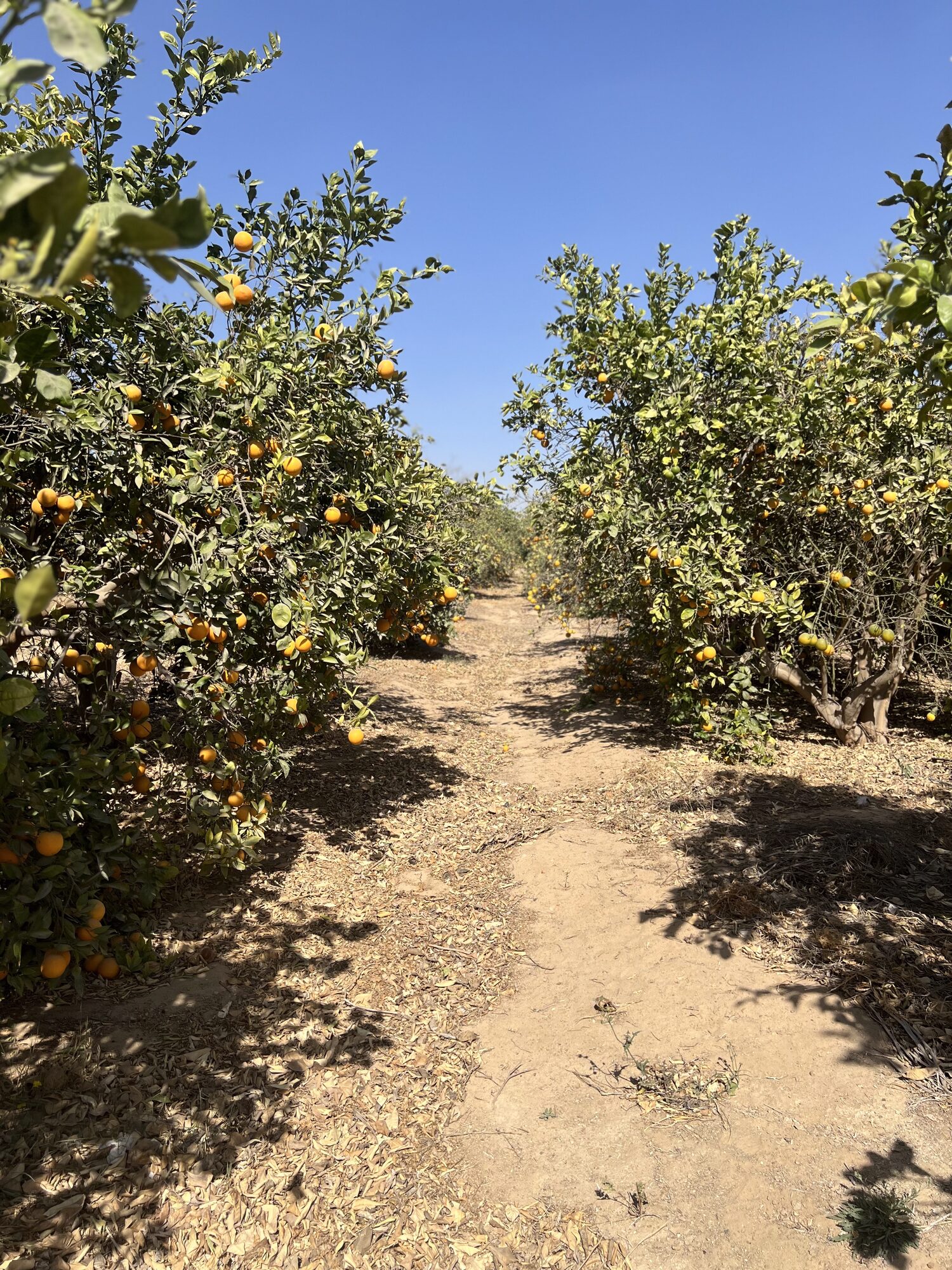
The European Union takes a large share of Egyptian citrus every season, and it is the most procedurally demanding destination on the list. Nothing about it is unusual once a lane is running. The difficulty is that almost all of the work sits on the importer side and has to be done before the vessel arrives, not after.
Pre-notification and the border control post
Fresh citrus entering the EU is plant material subject to official controls. The consignment has to be pre-notified in TRACES with a CHED-PP, and it has to be presented at a designated border control post that is approved for that category of goods. The pre-notification is the importer’s legal responsibility, not the exporter’s, and it needs the phytosanitary certificate details to be complete and consistent with the commercial documents. A mismatch between the botanical name, the quantity, the lot references or the place of origin is the single most common reason a container is held while everyone waits for a corrected certificate from Cairo.
At the border control post the consignment goes through a documentary check, and a proportion are selected for identity and physical checks. The selection rate varies by commodity and by the recent interception record of the origin. Plan the arrival week on the assumption that a physical check can happen, because the shelf life lost while a box waits for an inspection slot is real and it is not recoverable.
False codling moth and cold treatment
The pest requirement that shapes EU citrus programmes is false codling moth, Thaumatotibia leucotreta. The EU applies specific requirements to host citrus from countries where the pest is present, and the compliance route is stated on the phytosanitary certificate: an approved treatment, or origin from a recognised pest-free area or place of production, or a systems approach, depending on what the exporting country’s plant protection organisation has in place for that season.
Where a cold treatment route applies, the schedule is a fixed combination of pulp temperature and duration, and it has to be run and recorded properly or the whole consignment fails on paper regardless of fruit condition. The treatment interacts directly with rind condition, since holding citrus near the bottom of its tolerance for a long period is exactly the condition that produces rind pitting. We set out that interaction in our note on chilling injury on Egyptian citrus. Confirm the applicable route and schedule for the current season with your supplier and your own plant health authority before contracting, because these requirements are reviewed and do change.
Residues
EU maximum residue levels are stricter than several other destinations Egypt ships to, and they are the second compliance layer after plant health. Serious EU programmes are built on a documented spray record, respected pre-harvest intervals, and a pre-shipment residue analysis from an accredited laboratory against the EU limits specifically. Requesting a report issued against a different market’s limits is a common and expensive mistake. The mechanics are covered in pesticide residues and MRLs on Egyptian citrus.
The quality specification EU buyers write
EU marketing standards for citrus set minimum maturity, a juice content requirement, colour requirements and size uniformity within the carton. Commercially, most EU programmes buy tighter than the legal minimum. Expect a specification that names the variety and the picking window, a size range by count, a minimum Brix and Brix to acid ratio, a colour reference, a defect tolerance expressed as a percentage, and the pack format. Navel dominates the earlier EU window and Valencia the later one, and the handover between them is worth planning around rather than discovering.
Certification and traceability
GLOBALG.A.P. with a valid GGN is effectively a commercial precondition for EU retail, and for many wholesale buyers as well. Add GRASP where the customer requires a social assessment, and expect the lot code on the carton to resolve back to the orchard block. None of this is a legal import condition. All of it decides whether a retail buyer will look at the offer.
Practical sequence
Agree the specification, confirm the plant health route for the season, book the treatment if one applies, run the residue test before loading, issue documents that match each other exactly, pre-notify in TRACES against the correct border control post, and schedule collection with an inspection contingency in the calendar.
To discuss Navel or Valencia volume for the 2026/2027 EU window, including the treatment route and the residue protocol, message the Nile Prime desk on WhatsApp at +20 10 9911 1918.