
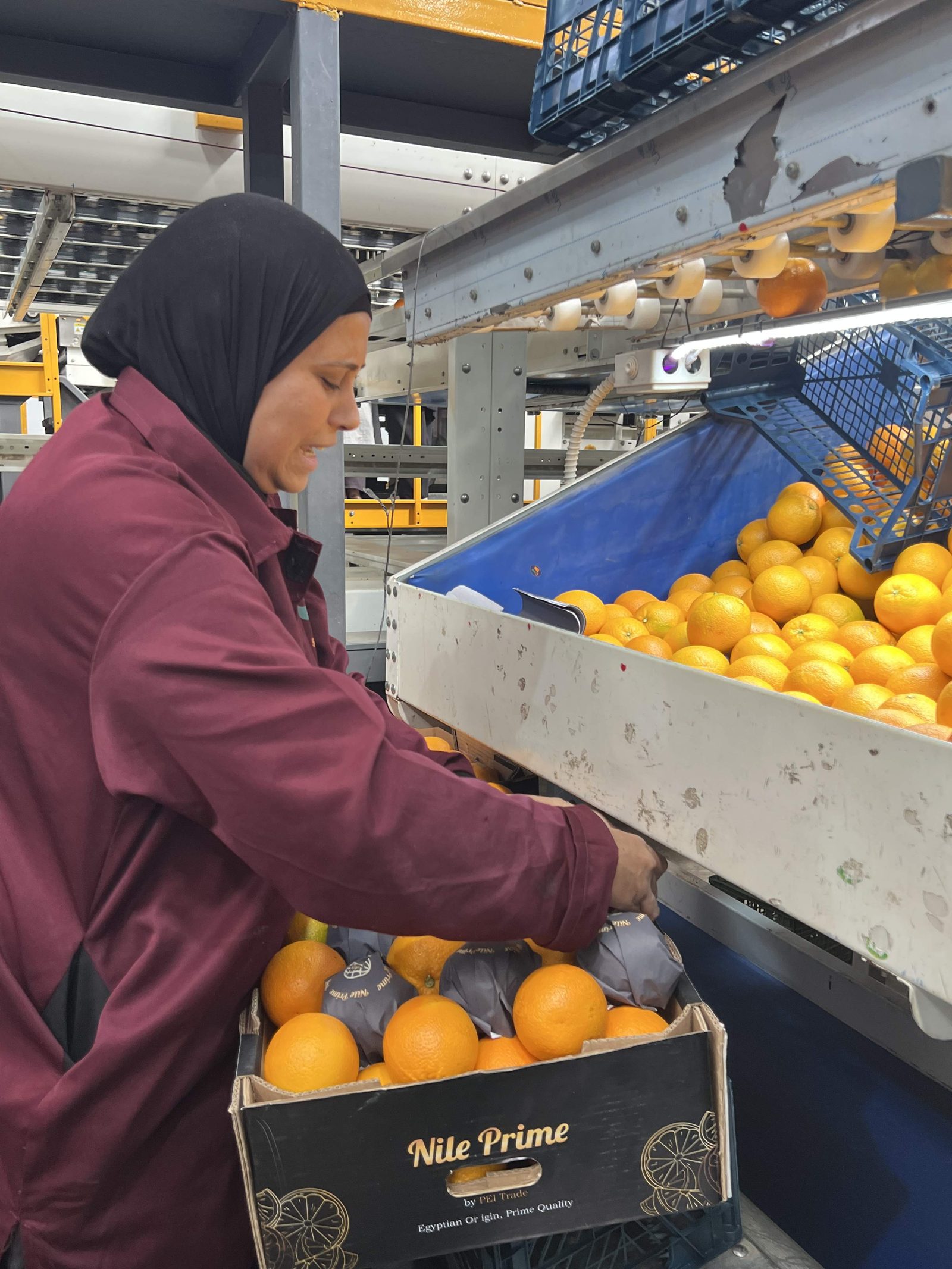
A buyer sends an order for four reefers of Navel, count 56, and asks for confirmation. The honest answer is that no orchard produces only count 56. A block produces a distribution, the sizer sorts it, and the packhouse can supply a given count only in the proportion the trees delivered that week. Understanding the size curve is the difference between an order that loads on schedule and one that waits while the line accumulates fruit.
How the curve forms
Fruit size is set months before harvest. Crop load is the dominant factor, because a tree carrying a heavy set divides the same resources across more fruit and produces smaller calibres. Irrigation through the cell expansion phase, tree age, rootstock, and the summer temperatures in the Nubaria and Beheira growing areas all move the curve. A season with a light set and adequate water gives a large-fruit curve. A heavy set gives a small-fruit curve, and no amount of ordering changes it.
The curve is also not static through the season. Early picks on Navel skew larger because the outer and upper canopy fruit sizes first. Later picks bring in the interior fruit and pull the average count up, meaning smaller. Valencia follows the same pattern over a longer window.
What a working distribution looks like
The following is an indicative split for a mid-season Navel block in a normal year, expressed as a share of packed export-grade fruit in a 15 kg carton.
- Counts 36 to 48, large: around 15 to 20 per cent
- Counts 56 to 72, the commercial core: around 50 to 60 per cent
- Counts 80 to 100, small: around 20 to 30 per cent
Valencia typically sits one step smaller across the board, with counts 64 to 88 carrying the bulk. Mandarin is sized by diameter rather than count and behaves differently again. These proportions shift year to year, and any exporter quoting a guaranteed single count without qualification is either holding inventory from several blocks or is going to disappoint you later.
Why the large counts cost more
Price follows scarcity, not quality. Count 48 Navel is not better fruit than count 72. It is simply less of the crop, and the Gulf retail trade competes hard for it. When the season runs small, the premium on large counts widens sharply, and buyers who insisted on a single large count find their price moving under them. Buyers who took a two-count spread paid the blended rate.
How to write the order
Name a primary count and an acceptable secondary count, with a ratio. For example: 70 per cent count 64, 30 per cent count 72, tolerance plus or minus 10 per cent on the split. That gives the packhouse room to fill from the curve while keeping your shelf presentation consistent.
Second, decide whether count or weight is the binding term. On a 15 kg carton the count determines the piece weight, and mixing counts inside one carton is not acceptable on retail programmes. State one count per carton and manage the spread at pallet level instead.
Third, book early in the window if you need the large end. Our note on Navel and Valencia compared sets out the season windows, and the picking date itself is governed by the maturity work described in maturity standards on Egyptian citrus. Early Navel picks carry the large counts. By January the curve has moved.
Finally, ask what happens to the rest of the curve. A supplier who can place the small counts into other markets is a supplier who will not push them onto you as a condition of supplying the sizes you want.
Nile Prime packs Navel, Valencia and mandarin to specified counts from Alexandria, Damietta and Sokhna under Incoterms 2020. To discuss a count split for the coming season, message the export desk on WhatsApp at +20 10 9911 1918.