
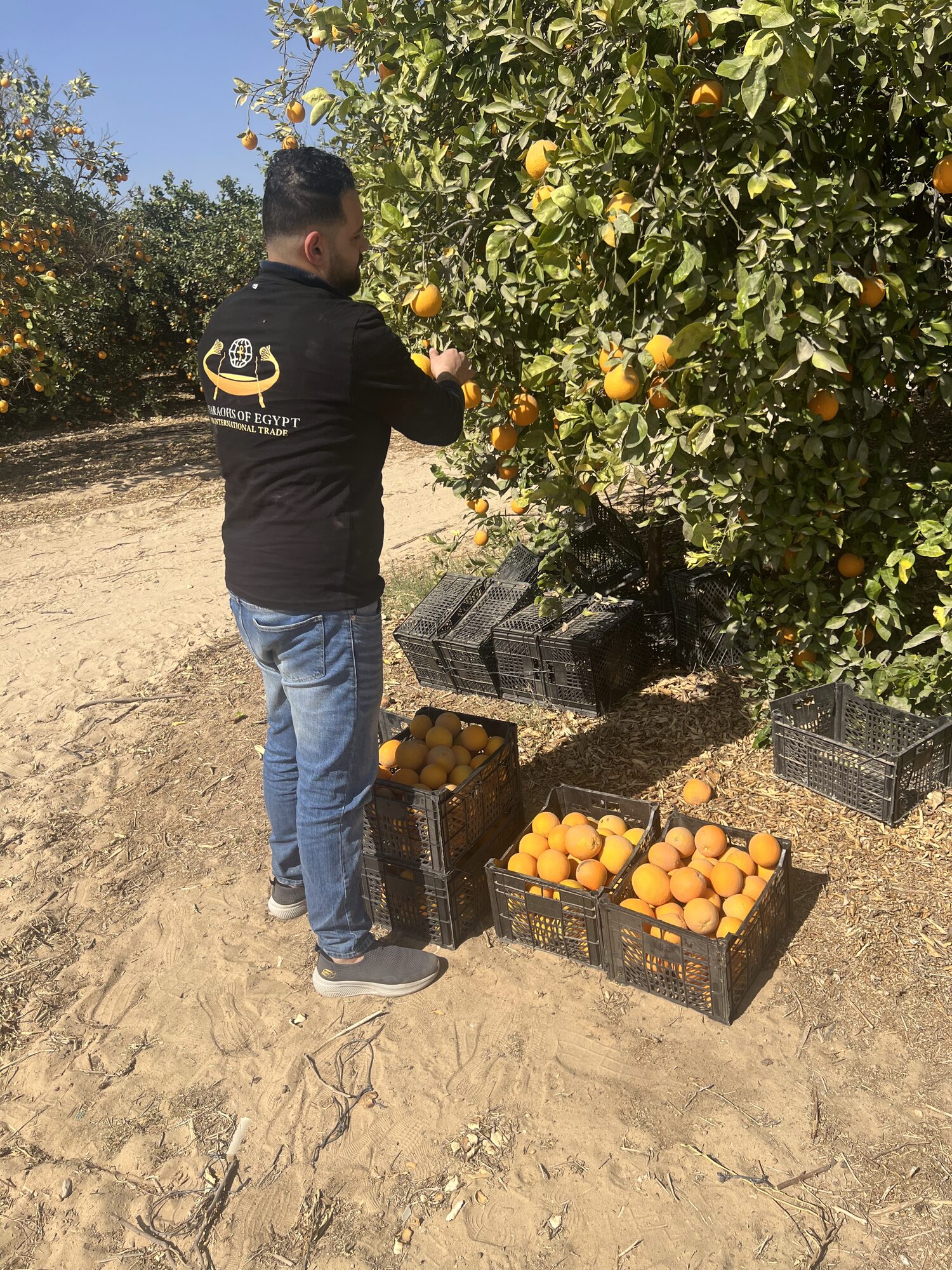
Citrus does not ripen after picking. Whatever sugar, acid and juice the fruit carries when it leaves the tree is what your customer tastes six weeks later at destination. That single fact is why maturity standards exist, and why the first shipment of an Egyptian season is the one most likely to disappoint on eating quality. With the 2026/2027 Navel harvest opening in the coming weeks, here is what the numbers mean and what to write into your specification.
The four measurements
Brix is total soluble solids in the juice, measured with a refractometer and expressed in degrees. It is a good proxy for sweetness but not a complete one. Titratable acidity is the citric acid content, expressed as a percentage of the juice. Juice content is the extracted juice as a percentage of whole fruit weight. Colour break is the point at which the rind loses enough chlorophyll for the underlying carotenoid colour to show.
None of these alone tells you the fruit is ready. High Brix with high acid still tastes sharp. Good colour with low juice content means a fruit that looks right and eats dry, which is the most common early-season complaint on Egyptian Navel.
The ratio is the real standard
The measurement that governs picking is the Brix to acid ratio, calculated by dividing degrees Brix by percentage acidity. It is the number that most importing markets legislate against, and it is what our quality team calls before a block is released.
As working figures for the Egyptian crop, Navel oranges are picked at a minimum ratio around 8 to 1, with Brix typically 10.5 to 13.0 and acidity falling from roughly 1.2 percent early to 0.9 percent at mid-season. Valencia, harvested later, arrives at a similar or slightly higher ratio with Brix commonly 11.0 to 13.5. Mandarins and Murcott run sweeter and are usually released above 10 to 1. Minimum juice content for export-grade oranges sits around 33 to 35 percent depending on the destination standard applied.
These are release thresholds, not targets. Fruit picked exactly at the minimum will pass an inspection and still eat thin. For programme customers we hold the first pickings back until the ratio is comfortably above the floor, which costs a week and saves the account.
Why the early fruit is the risk
Ratio climbs through the season because acid falls faster than sugar. Early Navel therefore sits closest to the legal floor while commanding the highest price of the year, which is precisely the combination that tempts under-mature picking somewhere in the supply chain. The rind is also often still green at a point when the internal chemistry is acceptable, which leads to degreening. Degreening changes colour without changing the ratio, so a well-coloured early orange proves nothing about how it eats.
What to put in your specification
State a minimum Brix, a maximum acidity, a minimum Brix to acid ratio and a minimum juice percentage, and ask for the packhouse readings on the lot you are buying rather than a seasonal average. Ask for the sample size and the date. Where the fruit has been degreened, ask separately for the exposure time, because prolonged degreening costs shelf life and raises the risk of the rind disorders set out in our reference on creasing, granulation and oleocellosis.
Maturity is only the first gate. What happens between the tree and the container decides the rest, and our guide to the first 72 hours from harvest to loading covers where shelf life is lost after the picking decision is made.
Booking the 2026/2027 season
We are taking Navel positions now for Alexandria, Damietta and Sokhna, with lot-level maturity readings supplied against each shipment and Incoterms 2020 quoted on request. Send your target ratio, size range and delivery weeks to the export desk on WhatsApp at +20 10 9911 1918.