
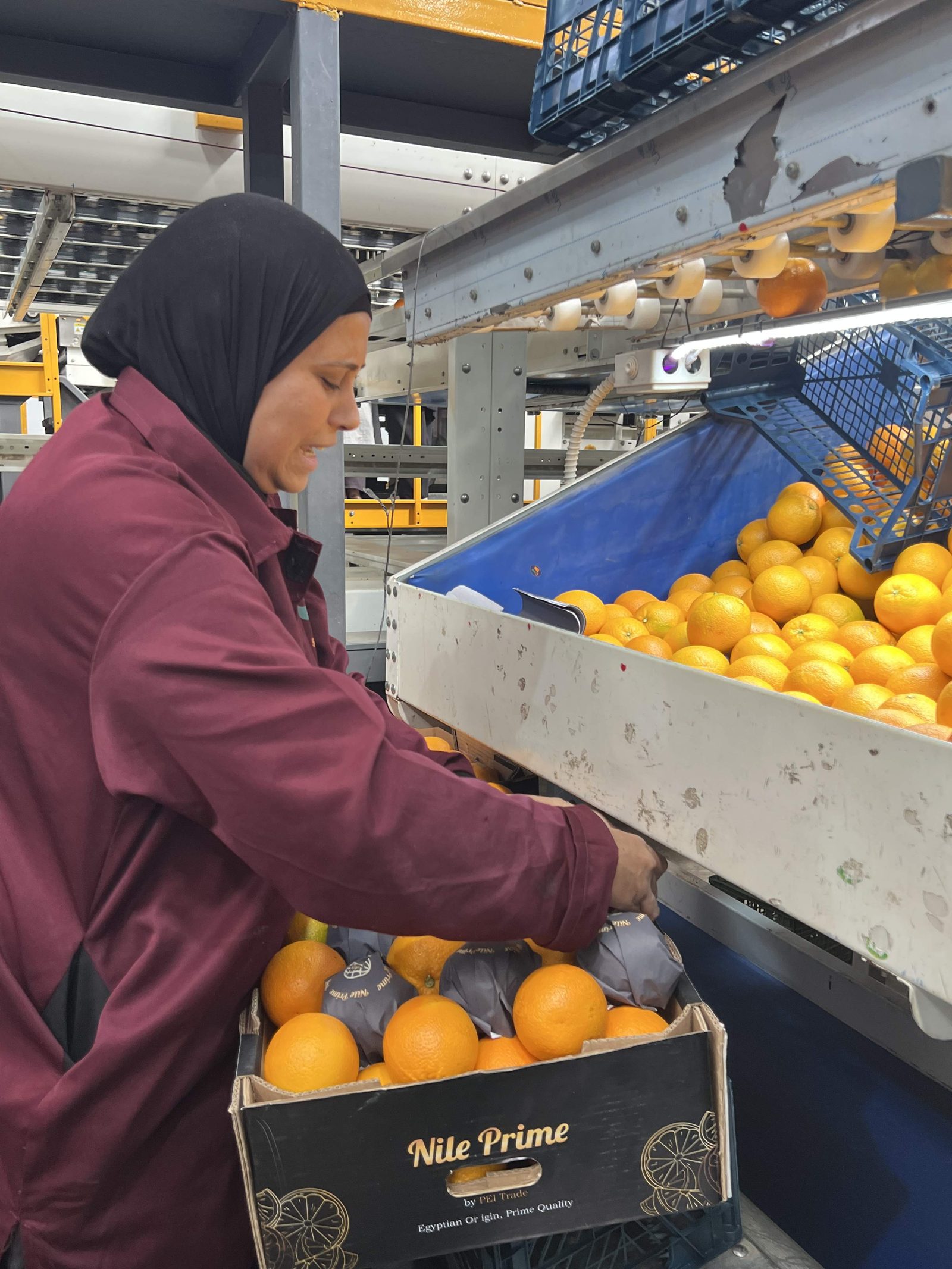
Two pests decide whether an Egyptian citrus programme into Europe runs smoothly or spends the season one consignment away from a problem: false codling moth, Thaumatotibia leucotreta, and Mediterranean fruit fly, Ceratitis capitata. Neither is a quality issue in the ordinary sense. A carton can pass every visual grading standard and still carry a single larva that causes the whole consignment to be rejected at the border. This note sets out how both are managed on the Egyptian side and what a buyer should be asking to see.
Why these two pests matter more than the others
False codling moth is a quarantine pest for the European Union. The female lays on the fruit surface, the larva bores into the rind and feeds inside, and the external sign can be nothing more than a small discoloured entry point. Detection at the packhouse depends on catching that entry point on a moving line.
Mediterranean fruit fly oviposits under the rind, and infested fruit softens and breaks down. Several destinations outside the European Union treat Medfly as the binding constraint on citrus imports from the Mediterranean basin and require a treatment schedule rather than inspection alone.
The common feature is that both are internal. Neither can be graded out reliably by eye at the speed a commercial line runs, which is why control has to start in the orchard.
Orchard control
The work that actually reduces interception risk happens months before loading. Pheromone trapping grids across the block, with trap counts recorded weekly, give the population picture. Mating disruption dispensers are used where pressure justifies the cost. Sanitation matters more than growers like: fallen and mummified fruit left on the orchard floor is a reservoir, and removing it is unglamorous, labour-intensive and effective.
Bait sprays are used against fruit fly, with the spray record and the pre-harvest interval documented. Any chemical intervention has to be checked against destination residue limits before it is applied, not afterwards, which is the point we make in our note on pesticide residues and MRLs on Egyptian citrus.
Ask your supplier for the trap-count record for the blocks your fruit comes from. A packhouse that can produce it by block and by week is running a real programme. One that cannot is relying on luck.
Packhouse detection
On the line, control is a matter of lighting, line speed and trained graders. Fruit is inspected after washing and waxing, when entry points are most visible, and suspect fruit is cut and examined rather than waved through. Line speed is the variable most often sacrificed under volume pressure, and it is the one that costs you. Where a block has shown elevated trap counts, that fruit should be run at reduced speed or diverted entirely.
Sampling at the end of the line, with fruit cut open from each lot, is the check that tells a packhouse whether its grading is working. The packhouse process from drencher to palletiser sets out where each stage sits.
Cold treatment and the systems approach
Several destinations require in-transit or pre-shipment cold treatment against fruit fly, run to a published schedule of days at a specified pulp temperature, with calibrated probes and a treatment certificate. Others accept a systems approach, combining orchard monitoring, area-of-low-prevalence status, packhouse controls and inspection. Which one applies is a function of the destination and the pest, and it has to be confirmed at booking. Cold treatment is not something that can be added after the container sails.
What an interception actually costs
A live-larva finding at an EU border control post does not end with the affected pallet. The consignment is held, and the options are destruction, re-export or in some cases processing under supervision. The costs land in several places at once: the value of the fruit, the freight already paid, storage and demurrage while the case is decided, the destruction or re-export cost, and the buyer’s failure to supply a customer that week.
There is also a consequence beyond the single load. Repeated interceptions from an origin lead to increased inspection frequency, which slows every subsequent consignment from that origin, whether or not it is from the same exporter. That is why Egyptian exporters treat this as an industry-level problem and not only a commercial one. The EU-side documentation and check regime is set out in our note on Egyptian citrus into the European Union.
What to ask before you book
Which orchards the fruit comes from and whether they sit in a monitored area. Trap-count records by block. The packhouse cull rate and end-of-line sampling protocol. Whether cold treatment is required for your destination and who is certifying it. Who bears the cost if the consignment is held. That last question is an Incoterms and contract matter, and it is far easier to settle in September than in January.
Nile Prime ships Egyptian citrus from monitored blocks through Alexandria, Damietta and Sokhna, with third-party inspection available on request. To discuss a 2026/2027 citrus programme or to request the pest-management documentation for a specific lot, message our export desk on WhatsApp at +20 10 9911 1918.