
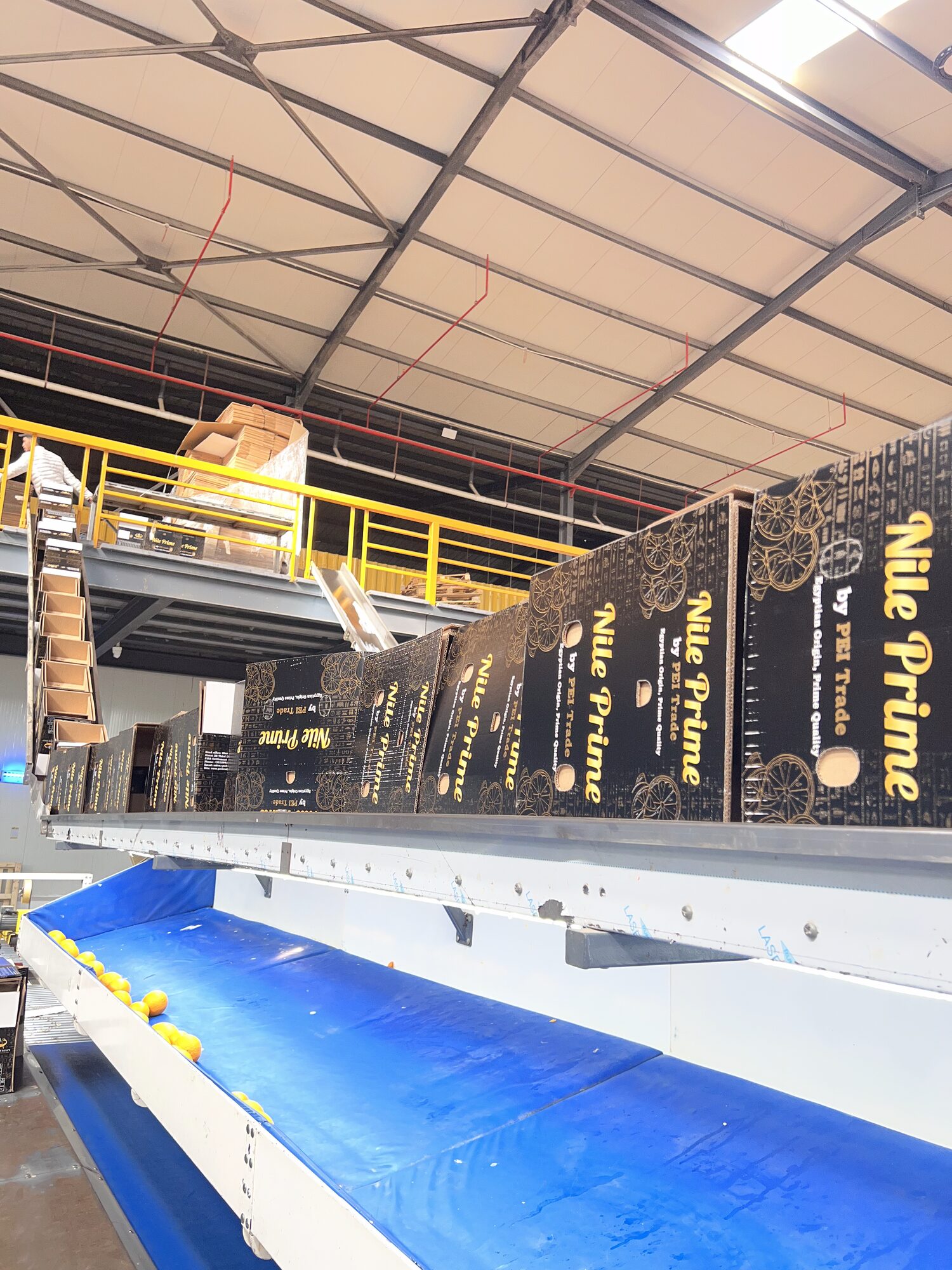
An importer who has audited a mango line will not recognise a citrus line. The crops are handled differently, the equipment is different, and the failure points sit in different places. With the Egyptian citrus season starting from late October, this is the walk through worth understanding before you commit a programme.
Tipping and pre-sort
Field crates arrive and are tipped, usually into water to cushion the drop. A pre-sort follows immediately, removing split fruit, obvious rots and anything with a visible wound. This station earns its keep. Every rotting fruit removed here is one that does not infect a carton in transit, and the money spent on pre-sort labour is the cheapest quality spend in the whole building.
Drencher and wash
Fruit passes through a drencher or dip and then over brushes. Two things happen at once: soil and sooty mould come off, and the sanitiser or approved fungicide goes on. The tank has to be monitored on concentration and pH, and dumped on a schedule, or the water becomes a distribution system for spores rather than a defence against them. This is where most of the decay outcome is decided, as we set out in our note on green mould, blue mould and sour rot in transit.
Degreening, where required
Early Navel picked in October is internally mature before it is externally orange. Degreening rooms hold the fruit under controlled ethylene, temperature and humidity with air exchange, to break down chlorophyll in the rind. It is a colour treatment, not a ripening treatment, and it costs shelf life. Over-degreened fruit is softer, more prone to stem-end rot and less tolerant of a long voyage. Ask what the room schedule is and how long your lot sat in it.
Drying and waxing
Fruit is dried before coating, because wax applied to a wet surface sits unevenly. The waxer then applies a carnauba or shellac based coating, and the fruit passes through a drying tunnel. The coating choice changes gas exchange inside the fruit, so it is a specification item rather than a packhouse detail. Our note on waxing and coating on Egyptian citrus covers what to ask for.
Grading and sizing
Fruit is graded on external quality, by eye or by optical sorter, and then sized by weight or by diameter into the calibres your order specifies. Egyptian export oranges commonly run counts 48 to 125 in a 15 kg telescopic carton, and the count is what the price is built on. Confirm the calibre range and the permitted mix before agreeing a figure.
Packing and palletising
Cartons are filled to a fixed count and weight, labelled with lot, class, count and origin, then palletised, corner-boarded and strapped. From there the pallet goes to forced-air cooling, not straight into the container.
The four places damage is created
First, the tip, where a drop onto a hard surface bruises the rind and produces oleocellosis. Second, transfers between conveyors, where a small unpadded step does the same. Third, a badly managed drench tank. Fourth, the gap between packing and cooling, which is the only station in the building where nothing appears to be happening and where field heat quietly stays in the fruit.
When you audit a citrus line, watch those four points and ignore the polish elsewhere.
Nile Prime packs and loads Egyptian citrus from Alexandria, Damietta and Ain Sokhna under Incoterms 2020, with SGS or Intertek pre-shipment inspection on request. To discuss your 2026/2027 citrus programme, message our export desk on WhatsApp at +20 10 9911 1918.