
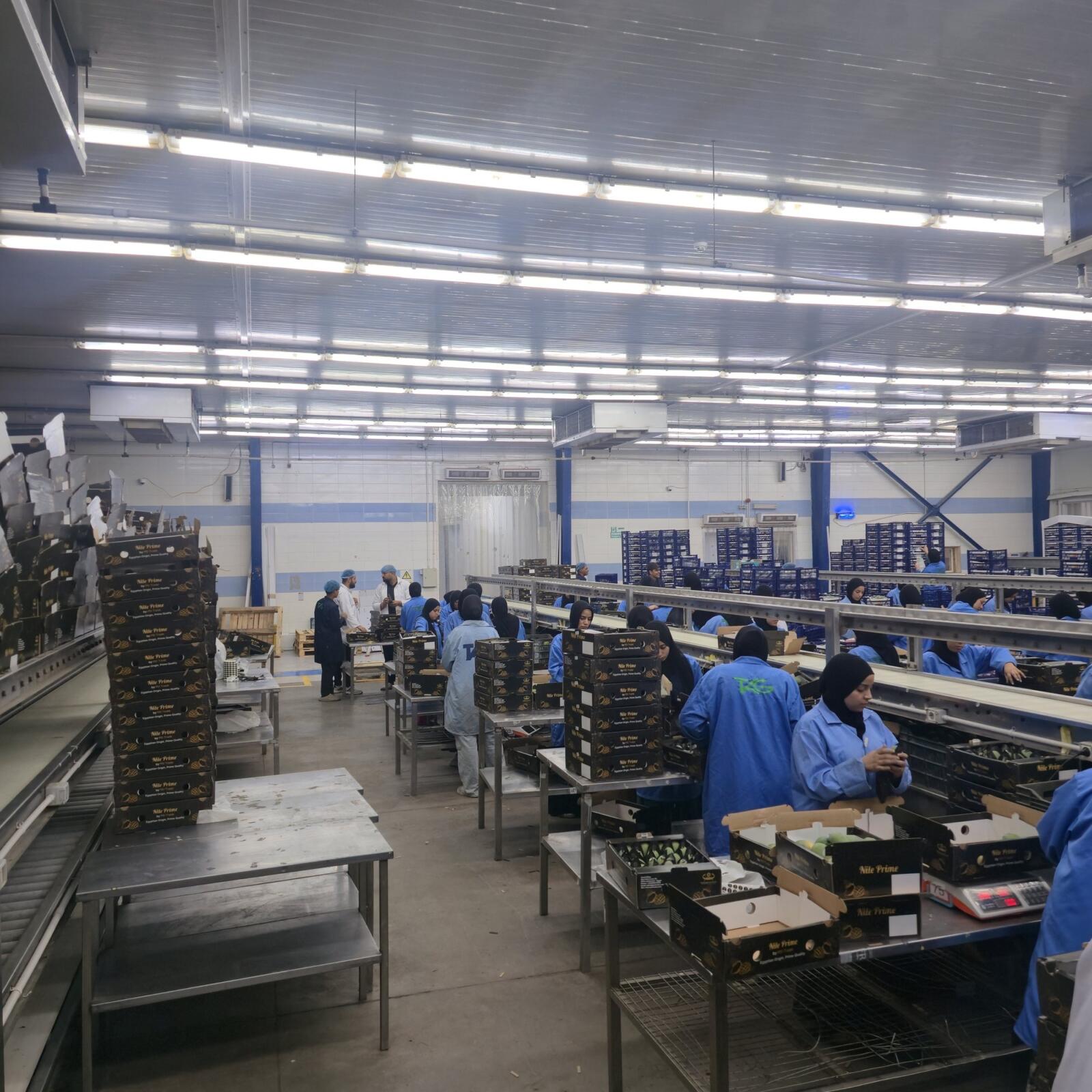
Importers usually judge a mango supplier on the fruit that comes out of the container. What decides that outcome happens in the twelve to twenty-four hours between the tree and the reefer door. This is what a Keitt or Kent carton passes through before it reaches your port, and what an importer should ask about when auditing a new supplier.
Harvest and the first hour
Picking runs in the early morning to avoid field heat. Fruit is cut with a short stem, roughly one to two centimetres, rather than pulled, because a clean cut limits sap flow and stem-end rot later. Crates are kept in shade from the moment they are filled. Mango picked at midday and left in the sun for two hours has already lost shelf life that no cold store will give back.
Maturity is judged on shoulder fill, flesh colour at the stone and dry matter rather than skin colour alone, since Keitt stays green even when fully mature. This is the point where a supplier either respects the maturity standard or cuts fruit early to hit a vessel.
De-sapping
Mango sap burns the skin and leaves black streaks that show up days later in the importer’s cold store. Fruit is inverted on de-sapping racks or trays so the stem drains away from the skin, typically for twenty to thirty minutes. Where a lime or detergent solution is used, the concentration and contact time are logged. Sapburn is one of the most common arrival complaints on Egyptian mango and it is almost entirely preventable at this stage.
Washing, drying and grading
Fruit moves to a wash line where it is cleaned in potable water with an approved sanitiser, then air dried. Grading follows in two passes. The first is a visual pass on the sorting table where staff remove fruit with bruising, latex marks, insect damage, cracks or misshape. The second is electronic or manual weight grading into export counts.
Keitt is commonly packed at 6 to 10 pieces per 4 kg carton, Kent at 8 to 12, and Naomi across a similar range depending on the block. The specification detail for each is set out in our references on Keitt sizes and carton formats and Kent sizes and ripening profile.
Hydro-cooling and cold room
Removing field heat quickly is what buys transit time. Fruit is cooled to a core temperature in the 10 to 12 degree Celsius range for mango, either through hydro-cooling or forced-air cooling in the cold room. Mango is chilling sensitive, so pushing below roughly 10 degrees risks internal browning and grey pulp that only becomes visible after the fruit is ripened at destination.
Fruit is held in the cold room until the container arrives, not loaded warm and cooled in transit. A reefer unit is designed to hold temperature, not to pull it down through a full pallet stack.
Packing and palletising
Each fruit is placed in a foam net sleeve and single-layered into a ventilated 4 kg carton, stem end down or laid flat depending on count. Cartons are palletised in a stacked pattern that keeps vent holes aligned from top to bottom, because a pallet with blocked vents will not cool evenly no matter how the reefer is set. Corner boards and strapping hold the stack, and pallets are labelled with lot, variety, count, pack date and grower code.
That labelling is not decoration. It is what makes a claim traceable back to a specific block and pick date, as covered in our note on carton labelling and traceability.
Loading
Pallets are loaded into a pre-cooled reefer with the set point normally at 10 to 12 degrees Celsius, fresh air vent adjusted for transit length, and a temperature logger placed in the load. Loading is done through a cold dock where the facility has one. Shipments leave through Alexandria, Damietta or Sokhna depending on destination.
If you want the packhouse specification, certification scope and loading protocol for a specific programme, message our export team on WhatsApp at +20 10 9911 1918 and we will send the documentation along with current availability.