
A mixed citrus and pomegranate reefer works with orange and mandarin, and fails with lemon and grapefruit. The reason is a six degree gap in the safe set point, and one container has one set point. From October the two Egyptian seasons overlap and buyers start asking to combine them, so this is the loading decision the packhouse faces every autumn.
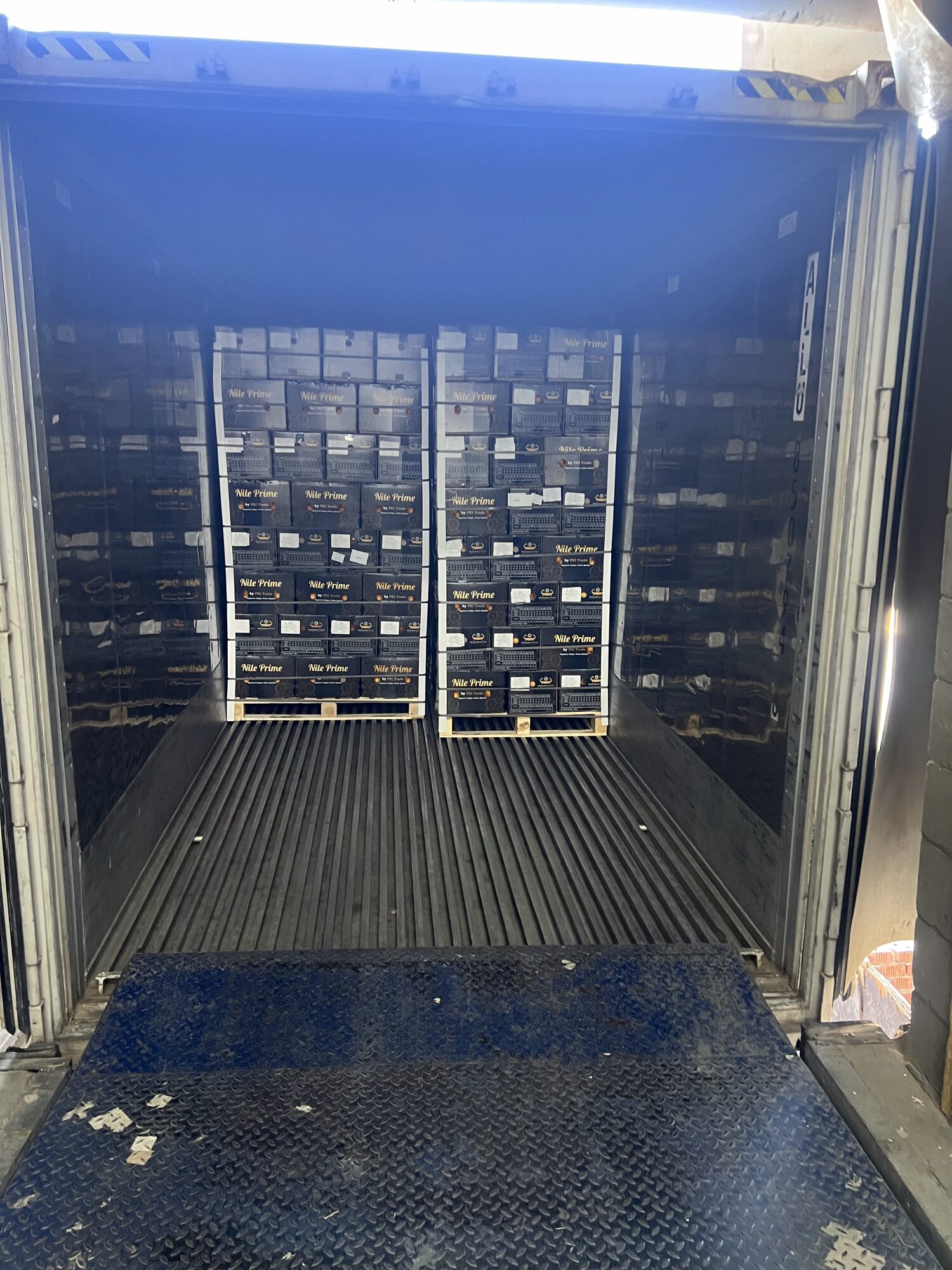
The set point decides the pairing
| Product | Carrying temperature | Shares with pomegranate at 5 to 6 C |
|---|---|---|
| Pomegranate, Wonderful | 5 to 7 C | Reference product |
| Navel orange | 4 to 7 C | Yes, set 6 C |
| Valencia orange | 4 to 7 C | Yes, set 6 C |
| Mandarin, Murcott | 5 to 8 C | Yes, set 6 C |
| Lemon | 10 to 13 C | No |
| Grapefruit | 10 to 13 C | No |
Splitting the difference is the mistake to avoid. A reefer set at 8 C to accommodate both lemon and pomegranate gives the pomegranate a temperature high enough to shorten its arrival window and gives the lemon a temperature low enough to risk rind pitting on a long voyage. Two products, both damaged, to save one container.
Fresh air vent: citrus wants it open, pomegranate does not mind
Citrus respires and accumulates carbon dioxide and volatile compounds in a closed box, which shows up at destination as off-flavour and, on degreened fruit, as accelerated rind breakdown. The fresh air vent is normally opened for citrus, in the region of 15 to 25 cubic metres per hour depending on the volume loaded and the transit length. Pomegranate tolerates that setting without difficulty, so on a mixed load the citrus requirement governs and the vent stays open.
The trade-off is humidity. An open vent pulls in outside air, which on a Red Sea transit is dry, and both products lose weight faster. Pomegranate husk in particular dries and turns leathery. Where the load is mostly pomegranate with a minority of orange, reduce the vent setting to the lower end of the range and accept the shorter citrus shelf life rather than the reverse.
Stow order: pomegranate away from the door
The door end of a reefer runs warmest, typically one to two degrees above the set point, because return air has already passed the full length of the load. Pomegranate is the more temperature-sensitive of the two at the warm end, so it belongs at the front, over the T-floor delivery air, with the citrus pallets stowed towards the doors. This also matches the unloading order in most cases, since citrus tends to be the larger volume and moves first.
Keep the two products in whole pallets rather than mixing them within a pallet. A mixed pallet is impossible to sort at arrival without breaking it down, and it makes any claim harder to attribute. Label each pallet with the product, count and lot code on two faces.
Pre-cool separately, load together
Both products should reach their carrying temperature before the container doors close. A reefer unit is designed to hold temperature, not to remove field heat, and a mixed load makes that limitation worse because the pull-down demand is uneven. Pomegranate is normally forced-air cooled to 6 C within 24 hours of harvest, citrus within 48. Load only when both pallet cores read within one degree of the set point.
Related reading: shipping pomegranates from Egypt covers the single-product pomegranate settings, and chilling injury on Egyptian citrus explains what happens when the set point runs too low for the variety.
Nile Prime is the exporter, not a neutral reviewer. To discuss a mixed citrus and pomegranate booking for the October window, message the shipping desk on WhatsApp at +20 10 9911 1918 with the products, volumes and destination port.