
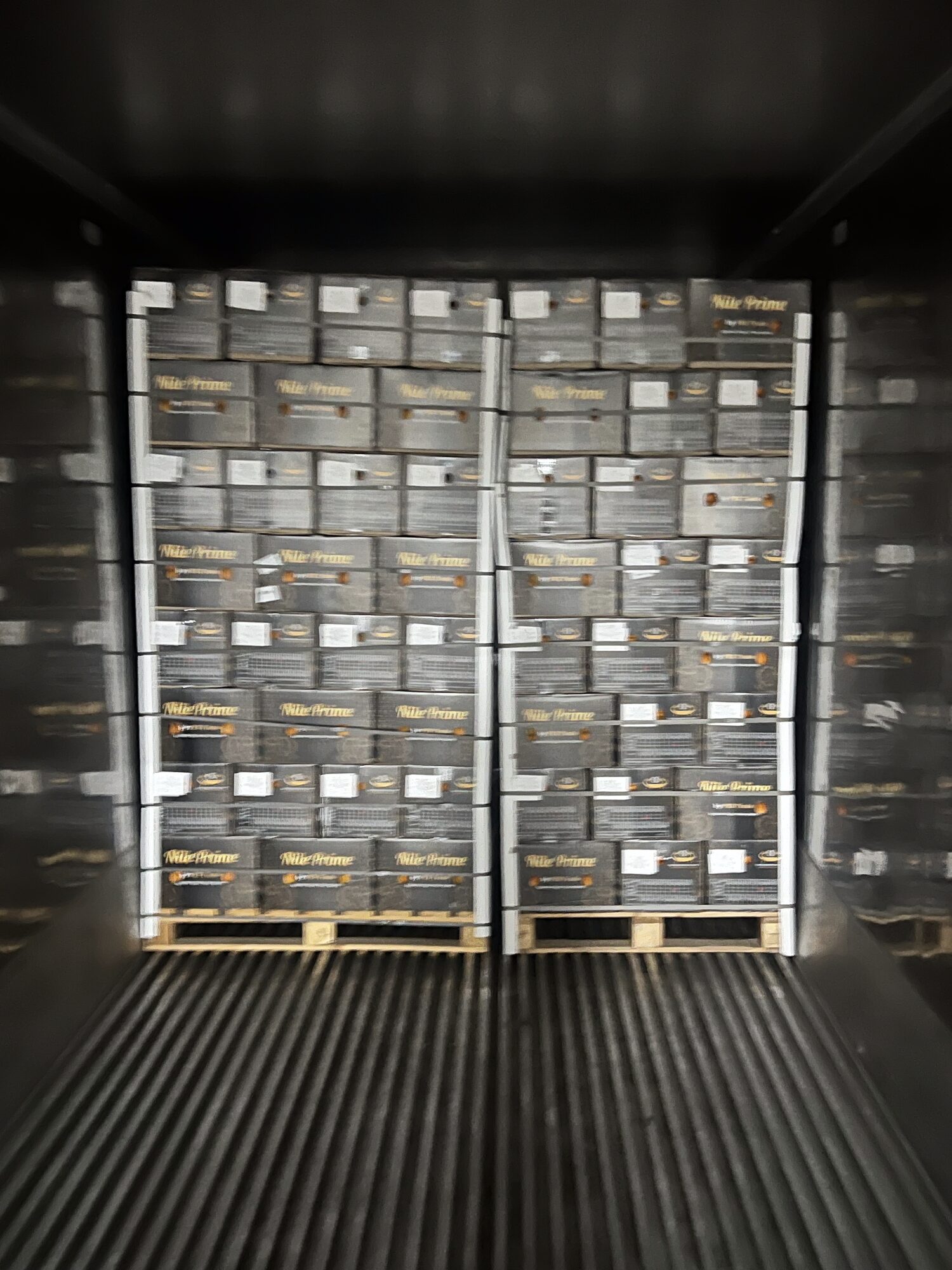
A reefer container is designed to hold a temperature, not to pull one down. Load fruit warm and the unit spends the first several days of the voyage chasing field heat it was never sized to remove, while the fruit at the centre of each pallet stays warm longest and ages fastest. On citrus and pomegranate the difference between a load that arrives with a week of shelf life and one that arrives tired is usually decided in the cold store, before the doors close.
The target before loading
Fruit should reach its carriage temperature, or close to it, before it enters the container. On Egyptian oranges and mandarins that means pulp temperature down to the agreed set point, typically in the 4 to 8 degree Celsius band depending on variety and destination requirement. On pomegranate the working band is around 5 to 7 degrees Celsius. What matters is the pulp reading taken at the centre of the fruit in the middle of the pallet, not the air temperature of the room and not a surface reading with an infrared gun.
The usual industry rule of thumb is seven-eighths cooling: the point at which the fruit has shed seven-eighths of the gap between its starting temperature and the room temperature. That is the point at which a pallet is genuinely ready to load.
Room cooling versus forced-air
Room cooling moves cold air past the outside of the pallet and relies on it working inward. It is slow. On a fully packed citrus pallet in a well-run store, expect 24 to 72 hours to reach the target, and longer if pallets are stacked tight against each other or against a wall.
Forced-air cooling pulls air through the vent holes of the cartons by creating a pressure difference across the pallet, usually with a fan and a tarpaulin. On the same fruit it does the job in roughly 4 to 12 hours. It costs more per pallet in handling and energy, and it dries the fruit slightly more, but it is the only practical method when picking and loading are close together. Pomegranate in particular benefits, because slow cooling gives husk scald more time to establish.
Whichever method is used, carton vent alignment decides the result. Cartons stacked so that vent holes do not line up between layers block the airflow path, and no amount of fan pressure fixes a blocked pallet.
Where the cold chain breaks
Three gaps account for most warm loads. Fruit held in field crates in the yard before it enters the store, sometimes for hours in September heat. Pallets moved out of the cold store to a staging area and left there while the container is positioned. And the loading itself, where an unrefrigerated dock in daytime ambient undoes part of the cooling in twenty minutes. Load through a chilled dock where possible, keep the container running before loading, and keep the staging time short.
Recording it
Pulp temperature at loading belongs on the loading record, taken from several pallets and written down with the pallet numbers. It is the figure that separates a transit problem from a pre-cooling problem when an arrival is disputed, and it sits alongside the container seal and photographs described in our note on bolt seals and the loading record that settles a claim. The pallet configuration and vent settings that follow are covered in shipping pomegranates from Egypt.
Speak to the export desk
Nile Prime pre-cools to the agreed set point and records pulp temperatures at loading with pallet numbers. For citrus and pomegranate specifications, ports of loading at Alexandria, Damietta or Sokhna, availability and a quotation on Incoterms 2020 terms, message the desk on WhatsApp at +20 10 9911 1918.