
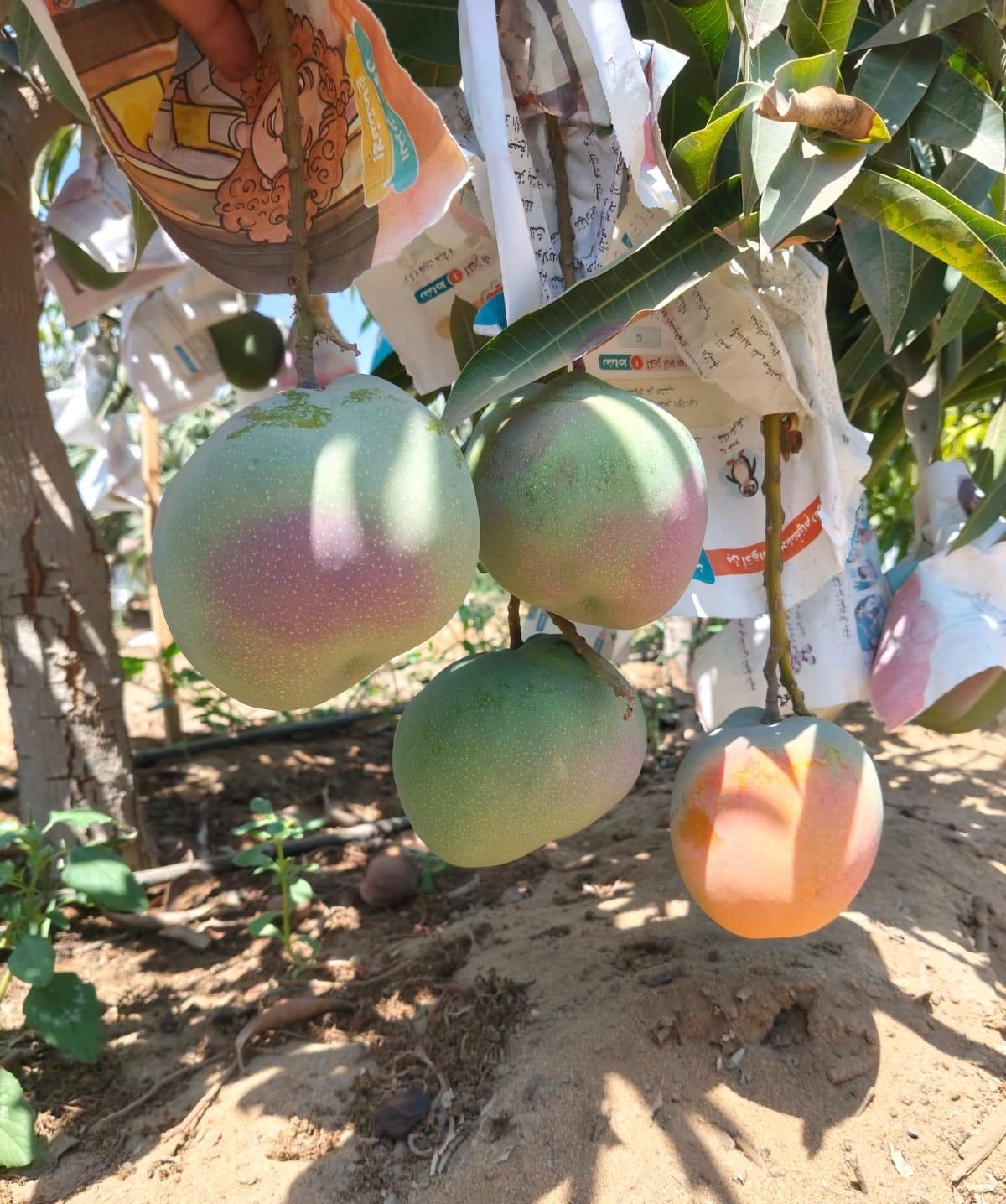
Next season’s Egyptian mango crop is largely decided in the four months after this season’s harvest ends. Between September and December the trees rebuild carbohydrate reserves, push a new vegetative flush and set the buds that will flower in late winter. A buyer contracting 2027 volume in October is really buying the result of orchard work that is happening while the contract is being negotiated, so it is worth understanding what that work is.
What Happens in the Orchard Between September and December?
| Period | Orchard operation | Why it matters to next season |
|---|---|---|
| Late August to September | Harvest completion and post-harvest pruning | Removes spent panicles and opens the canopy so the new flush gets light |
| September to October | Post-harvest fertigation, nitrogen and potassium | Rebuilds reserves depleted by fruit fill; a starved tree flowers weakly |
| October to November | Vegetative flush and hardening | The flush must mature before winter or it will not carry flower buds |
| November to December | Water reduction and bud dormancy | A controlled dry period supports flower induction |
| January to March | Flowering and fruit set | The first point at which crop size becomes visible |
Why Does Post-Harvest Pruning Change Fruit Size?
Pruning after harvest sets how many terminal shoots the tree carries into flowering. Cut too lightly and the canopy stays crowded, the flush is thin, and the following crop tends toward high fruit numbers at small counts. Cut harder and the tree carries fewer, stronger shoots, which usually gives a smaller total count and a larger average fruit. On Keitt, where GCC and Russian buyers want counts of 6 to 8 pieces per 4 kg carton, this is one of the levers that decides whether those counts exist in volume the following July.
The same logic runs through the size curve within a season, which we cover in why the Egyptian mango size curve moves between seasons.
What Is Alternate Bearing and Does It Affect Egyptian Export Varieties?
Alternate bearing is the tendency of a tree to follow a heavy crop with a light one, because fruit fill exhausts the reserves needed for the next flowering. Egyptian local varieties such as Zebda show it strongly. The main export varieties, Keitt, Kent and Naomi, are more regular, but they are not immune. After a heavy Keitt year, a grower who does not fertigate aggressively in September will usually see weaker flowering the following February. This is why a supplier who can show you a post-harvest nutrition programme is telling you something real about next year’s availability.
What Can a Buyer Actually Verify in October?
Nobody can promise 2027 volume in October, and any supplier who does is guessing. What you can reasonably ask for is evidence of process rather than a number.
Ask which blocks were pruned and when. Ask for the post-harvest fertigation schedule. Ask the age profile of the blocks allocated to you, since young blocks coming into bearing add volume and blocks over roughly 25 years old usually decline. Ask whether the packhouse has a claim on those specific blocks or is buying on the open market, because open market buying transfers all the crop risk onto your February price.
The first honest volume estimate comes after fruit set in March, and the first reliable size estimate comes in May. Contracts written in October should therefore be written with a tolerance band rather than a fixed tonnage, and that is how we set out the timing in our guide to planning 2027 Egyptian mango allocation.
What Could Still Change the 2027 Crop?
Winter temperature during induction, rain or dust storms during flowering in February and March, and mango hopper pressure at panicle stage are the three factors that move an Egyptian crop most between bud and harvest. None of them are visible in October. A programme that survives that uncertainty is one where volume is banded, price is indexed to a stated mechanism, and both sides agree in advance what happens if the crop comes in short.
Contact
To discuss 2027 Keitt, Kent and Naomi allocation, block assignment and contract structure, message the Nile Prime export desk on WhatsApp at +20 10 9911 1918 with your market, target counts and indicative volume.