
IQF vs block freezing is the first specification fork in any frozen fruit or vegetable contract — and buying the wrong one wastes real money in both directions: paying IQF premiums for fruit destined for a juice press, or feeding block-frozen slabs into a line built for free-flowing berries. This guide explains both technologies, their true cost logic, and exactly which applications call for which. It underpins everything in our frozen range.
Last updated: July 2026 · By the Nile Prime export team
Table of Contents
- How Each Works
- Side by Side
- The 30-Second Decision Rule
- IQF vs Block — FAQ
- Spec It Right, Then Order
- Worked Example: Two Methods, Two P&Ls
- Reading Quality Signals
How Each Works
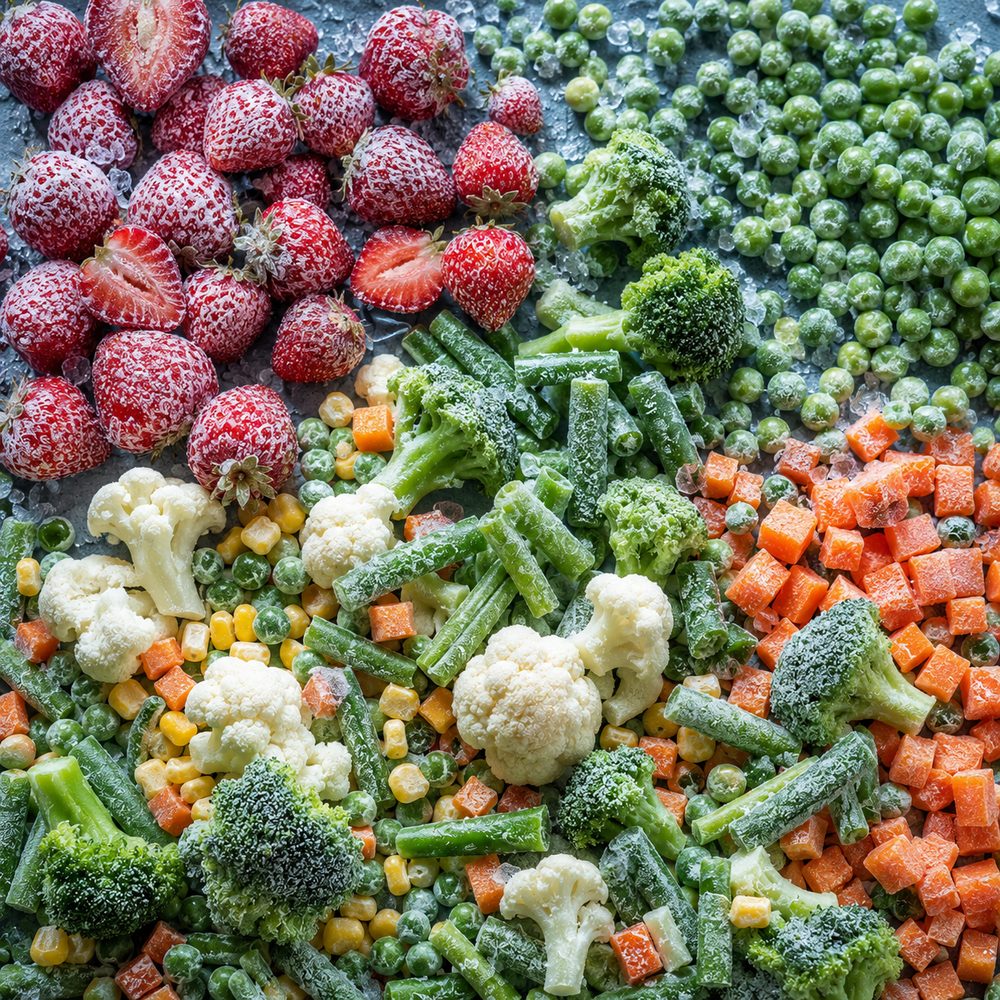
IQF (Individually Quick Frozen): product travels a fluidized-bed or tunnel freezer at ≈−35°C, each piece freezing separately in minutes. Ice crystals stay small, cell walls survive, and the output pours like marbles — every berry or okra pod discrete and intact.
Block freezing: product is packed into cartons or drums — often with sugar or syrup for fruit — and frozen solid as one mass in a blast room. Slower freeze, larger crystals, softer thawed texture, and a slab you process, not portion.
Side by Side
| IQF | Block | |
|---|---|---|
| Piece integrity | Whole, discrete, shape-true | Mass — pieces merge/soften |
| Dosing | Pour exactly what’s needed | Thaw/saw the block |
| Thawed texture | Best available | Soft — fine for purée/juice |
| Price | Premium | Cheapest frozen format |
| Typical products | Strawberries, okra, peas, mixes | Juice fruit, pulp, sugared berries |
| Right buyer | Retail bags, fruit preps, toppings, food service | Juice, jam bulk, purée, bakery fillings |
The 30-Second Decision Rule
Ask one question: will anyone see or bite the individual piece? If yes — retail bag, yogurt inclusion, cake topping, restaurant plate — buy IQF; the premium buys shape, color, and dosing control. If the product dies in a press, pot, or blender — juice, jam base, purée — block does the identical job at the lowest cost, and paying for IQF is burning margin. Mixed operations buy both: IQF Grade A for the visible applications, block or IQF Grade B for the kettle. Egyptian plants run both lines — grades and formats in the IQF strawberries guide, the vegetable side in the frozen vegetables guide.
Worked Example: The Same Strawberry, Two Freezing Methods, Two P&Ls
Run one hypothetical tonne of Egyptian strawberries through both methods and follow the money. IQF path: fruit rides a fluidized-bed tunnel, each berry freezing individually in minutes; it packs into 4 × 2.5 kg retail-ready bags, pours freely, and a bakery customer scoops exactly the 180 g a recipe needs. Price: the premium tier — say a reference price X. Block path: the same fruit freezes slowly in 10 kg cartons into a solid mass, often with sugar added (4+1 or 7+1 ratios for industrial juice and jam work); it sells at maybe 15–25% under X but the buyer must thaw whole blocks, plan production around defrost cycles, and accept drip loss on thawing. Neither is “better” — a jam line boiling everything gains nothing from IQF’s berry-by-berry freedom, while a yogurt-topping line cannot function on blocks. The costly error in this scenario is mismatch: paying IQF premiums for fruit that gets cooked, or forcing a retail packer to repack thawed block fruit that promptly refreezes into clumps. Spec the method to the end use and the P&L fixes itself.
Reading Quality Signals in Frozen Product
- Clumping in an IQF bag means a temperature excursion somewhere in the chain — product refroze after partial thaw. Reject-worthy on arrival inspection.
- Ice crystals and frost inside packaging signal repeated temperature cycling in storage; quality has already been paid away.
- Freezer burn (dry, pale patches) points to poor packaging or overlong storage — check production dates on lot codes.
- Drip loss on thawing beyond spec indicates slow freezing or poor raw material; a lab thaw test on samples settles disputes cheaply.
- Uniform free flow — the boring, correct result — is what a −18°C unbroken chain from tunnel to shelf looks like.
IQF vs Block — FAQ
What is the difference between IQF and block frozen?
IQF freezes each piece individually in minutes at ≈−35°C, keeping shape, texture, and free-flowing dosing; block freezing solidifies the product as one mass — cheaper, softer when thawed, made for processing.
Why is IQF more expensive than block frozen?
Faster freezing technology, higher energy intensity, and stricter raw-material grading — the premium pays for intact pieces, better texture, and portion control that processing applications don’t need.
Which should juice and jam producers buy?
Block (or IQF Grade B where block is unavailable) — the fruit is destined for a press or kettle, so paying the IQF premium for piece integrity adds cost without adding value.
Does Egypt supply both IQF and block frozen fruit?
Yes — Egyptian plants run both lines across strawberries and vegetables, letting buyers take IQF Grade A for visible applications and block or Grade B for industrial processing in the same contract.
Spec It Right, Then Order
Tell Nile Prime — the premium brand of PEI Trade — your application, and we’ll spec the right format: WhatsApp +20 109 911 1918 · [email protected].
Sources: industry freezing-technology practice · PEI Trade plant operations.