
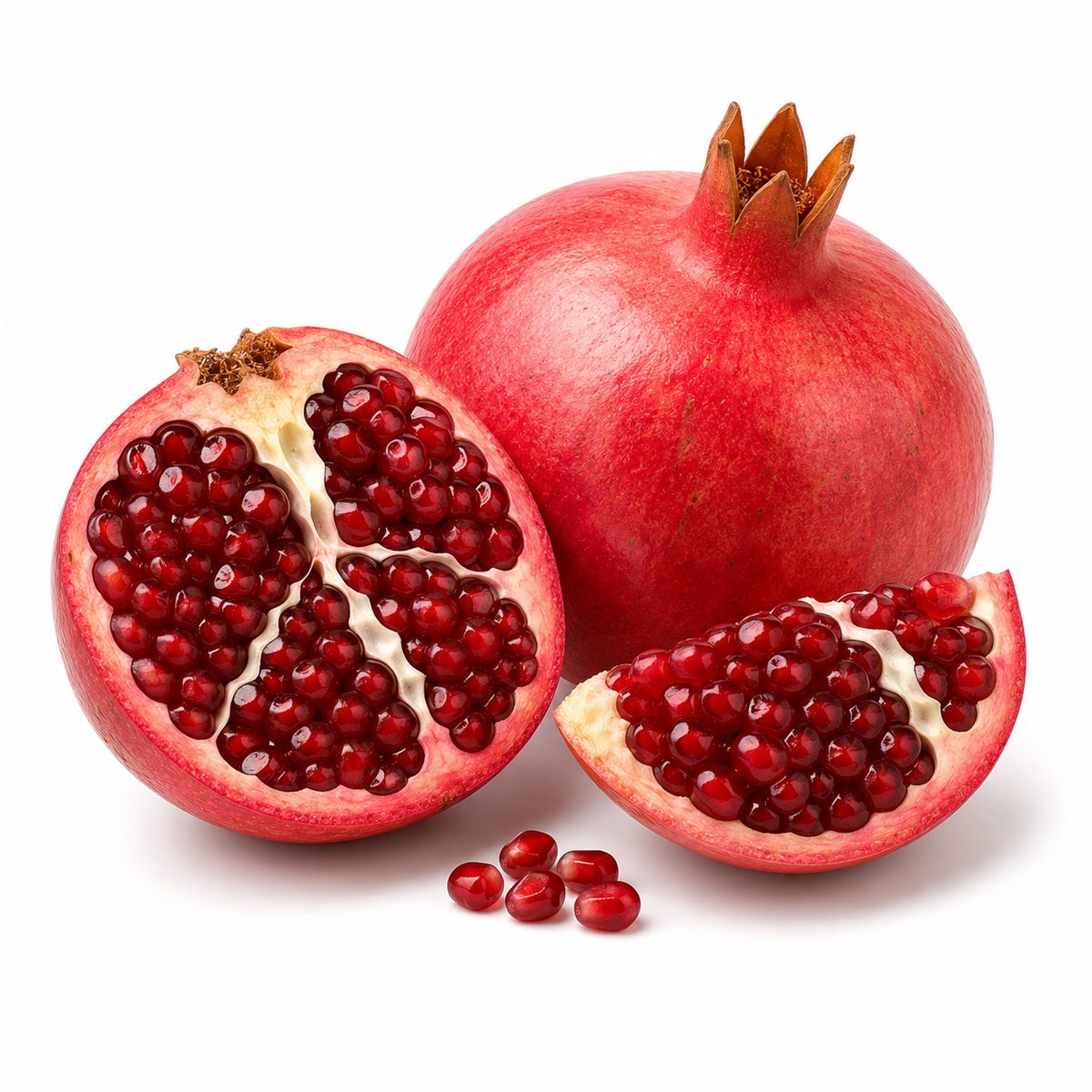
Egyptian pomegranate export has grown into a serious autumn trade on the back of one variety: Wonderful — deep crimson, sweet-tart, heavy with juice — shipped from September into December to the Gulf, Europe, Russia, and Asia. Egypt’s advantage is the familiar one: a strong harvest window, short freight lanes, and pricing that undercuts every competing origin in the same weeks. This guide covers varieties, season, specs, and packing — published now because September programs are contracted in July and August. Part of our fruits hub.
Last updated: July 2026 · By the Nile Prime export team
Table of Contents
- Varieties & Windows
- Export Specs & Packing
- Markets & Timing
- Egyptian Pomegranate Export — FAQ
- Book September Now
- Reading Quality Like a Pro
- Market by Market
- Egypt vs Other Origins
- The Arils Frontier
- Four First-Timer Mistakes
Varieties & Windows
| Variety | Window | Character | Best For |
|---|---|---|---|
| Early 116 / Baladi types | Aug–Sep | Earlier, lighter color, sweeter-softer | Regional & early programs |
| Wonderful | Sep–Nov (stored into Dec–Jan) | Deep red skin & arils, sweet-tart, juice-heavy | The export flagship — retail & juice |
Export Specs & Packing
| Parameter | Standard |
|---|---|
| Sizes | 200–300 g / 300–400 g / 400–500 g / 500+ g |
| Grade A | Uniform deep color, clean skin, no cracks or sunburn |
| Brix | 15–17° Wonderful |
| Packing | 3.5–4 kg single-layer cartons; 8–10 kg bulk for wholesale/juice |
| Transport | Reefer +5–7°C, 90% RH; EU 10–12 d, Gulf 3–7 d |
| Storage life | 2–3 months cold-stored — extends the sales window to January |
| Compliance | GLOBALG.A.P, phytosanitary, MRL per destination |
Markets & Timing
The Gulf takes premium large sizes through autumn; Europe and the UK run retail programs against the Sep–Nov window (where Egyptian fruit lands cheaper than Spanish and earlier than Indian arrivals at scale); Russia buys volume on the established produce lanes; and juice processors take bulk grades all season. Cold-stored fruit carries programs to New Year demand peaks. The clock: September allocation is contracted in July–August — which is exactly why this guide is published now. Suppliers ranked in the pomegranate companies guide; timing context in the season calendar.
Reading Pomegranate Quality Like a Professional
Wonderful rewards buyers who know what actually predicts arrival quality. Skin color sells the first carton, but the professional checks run deeper: weight-for-size — a heavy fruit is a juicy fruit, and light fruit means thick rind or dry arils; crack and sunburn tolerance written as percentages, because autumn heat spikes mark shoulders and split skins in bad weeks; internal color staging — early-season Wonderful can wear red skin over pale arils, so cut tests per lot matter in September more than any month; and calyx condition, the freshness clock every wholesale buyer reads first. Storage-bound fruit adds one more filter: only unblemished, fully mature lots hold three months at 5–7°C — which is why exporters select storage lots at harvest, and why December fruit from a disciplined store beats December fruit from an optimist’s.
Market by Market
| Market | What It Buys | Note |
|---|---|---|
| Gulf | Large premium sizes (400–500+ g) | Autumn fruit culture; short lanes preserve calyx freshness |
| EU & UK | 300–400 g retail sizes, Class I | Egyptian fruit lands under Spanish pricing in the same weeks |
| Russia | Volume across sizes | Established lanes; robust Wonderful travels the 12–14 days well |
| Asia | Premium large fruit, growing | Air and protocol sea programs developing |
| Juice industry | Bulk grades all season | The floor under the whole trade — nothing is wasted |
Egypt vs the Other Pomegranate Origins
The autumn window is crowded — Spain’s Mollar and Wonderful, Turkey’s Hicaz, Iran’s enormous but logistics-limited crop, and later Peru’s counter-season fruit — yet Egypt has carved a defensible slot on three advantages: Wonderful at Wonderful-market prices below Spain’s, freight to the Gulf that Turkey matches but Spain and Peru cannot, and cold-storage discipline that stretches Egyptian supply into the December–January gap after Mediterranean competitors fade. Iran undercuts everyone on price but struggles with banking and logistics access to Western markets — a gap Egyptian exporters quietly fill. The buyer’s frame: benchmark Egyptian offers against Spain for EU programs and against Turkey for Gulf ones; in both cases the discount at matched grade is the argument.
The Arils Frontier
The fastest-growing pomegranate product isn’t the fruit — it’s the ready-to-eat aril cup in Europe’s convenience chillers and the frozen aril bag in every smoothie program. Both start from exactly the fruit Egypt grows cheaply, and Egyptian processors are building aril lines beside the packhouses: fresh cups air-freighted with 7–10 day shelf life, IQF arils shipped at −18°C year-round. For buyers, arils convert Wonderful’s juice-heavy character from a table-fruit weakness into the product itself — and for private-label retail programs, Egyptian aril economics against Spanish processing costs tell the same story as every category in this catalog.
Four Mistakes First-Time Pomegranate Buyers Make
- Buying September fruit on skin color alone — early Wonderful can be red outside and pale inside; demand cut-test photos per lot until mid-October.
- Skipping crack/sunburn tolerances — autumn heat marks shoulders; without written percentages, your Class I is the packer’s opinion.
- Treating stored fruit as identical to fresh — December fruit is only as good as the store it slept in; ask when the lot was harvested and at what temperature it was held.
- Ignoring the juice-grade escape valve — contracting only Class I with no agreed outlet for downgrades leaves you arguing over every borderline carton; professional contracts price the second grade upfront.
Egyptian Pomegranate Export — FAQ
When is the Egyptian pomegranate season?
Early types from August, Wonderful from September through November, with cold-stored fruit extending sales into December–January — covering the autumn retail and New Year demand peaks.
Which pomegranate variety does Egypt export?
Wonderful dominates the export trade — deep red, sweet-tart, 15–17° Brix — with earlier Baladi-type fruit serving August programs.
How are Egyptian pomegranates packed and shipped?
Single-layer 3.5–4 kg cartons for retail (sizes 200–500+ g) and 8–10 kg bulk for wholesale and juice, shipped in reefers at +5–7°C — EU in 10–12 days, Gulf in under a week.
When should importers book Egyptian pomegranates?
July–August for the September opening — first allocation of Wonderful goes to committed programs, and storage-quality fruit for the December window is selected early.
Book September Now
Nile Prime — the premium brand of PEI Trade — is contracting Wonderful allocation for the coming season: WhatsApp +20 109 911 1918 · [email protected] · Egyptian pomegranates — specifications.
Sources: Tridge — Egypt pomegranate exports · PEI Trade.