
The Egyptian mango market this week is a late-Keitt market. Picking continues across Ismailia and the Nubaria belt, the size curve has flattened rather than fallen further, and packhouses are beginning to plan the changeover of lines to autumn crops. September loading positions are the live question for most buyers.
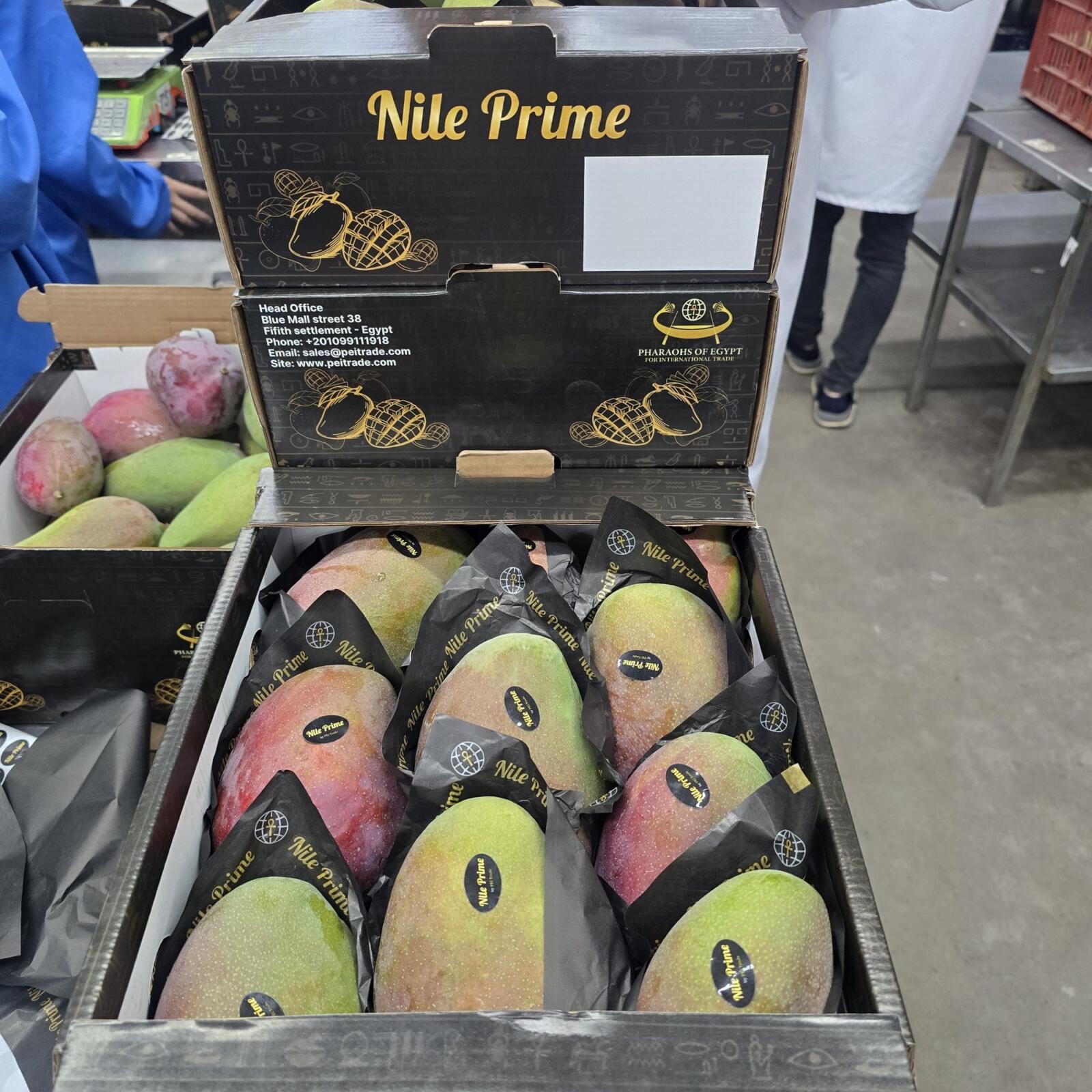
Sizing and availability
The curve has settled around counts 8 to 10 in a 4 kg carton, with counts 6 and 7 now scarce enough that they should be treated as an allocation item rather than something to expect on an open order. Counts 12 and above are readily available and are where processing and value retail demand is being met. Buyers who need the larger end for a Gulf retail pack should confirm the count in writing at the time of booking, not at the time of loading.
Quality picture
Late-season fruit carries more accumulated field exposure than the July crop. Lenticel spotting and light sap burn are the two defects appearing most often in grading, both cosmetic and both manageable if the sorting line is set for them. Dry matter is high on this fruit, which is why late Keitt eats well after a long transit. Internal breakdown risk rises if the fruit is held warm before pre-cooling, so the gap between harvest and the cold store is the number worth asking about. Grading tolerances are set out in our note on skin defects on Egyptian mango.
September loading positions
Bookings for the first half of September are firming and the practical picture out of Alexandria and Damietta is unchanged from last week. Reefer space to Jebel Ali and Jeddah remains straightforward at roughly 7 to 10 days port to port. European bookings via Damietta run 9 to 14 days depending on the service, and buyers wanting arrival before the end of September should be gating in during the first ten days of the month. The second half of September will be a thinner market, and some packhouses will have closed their mango lines by then.
The packhouse changeover
From the last week of August, packhouses that run more than one crop begin resetting sizers, replacing carton stock and scheduling deep cleans ahead of pomegranate, sweet potato and, from late October, citrus. Practically this means two things for a mango buyer. Late September fruit will come from a shrinking number of houses, and the packing line running your order may be handling a different crop the following week, so lot coding matters more at this point in the season than at any other. Programme planning for next year is covered in planning 2027 Egyptian mango allocation.
Pricing
FOB levels are holding rather than moving, with the spread between large and small counts wider than it was in early August. That spread is the main thing to watch: a quote that does not state the count is not comparable to one that does. We publish current FOB indications against a specific count, carton format and port on request rather than as a blanket figure, because a single number across the whole size range is not usable for costing.
For September Keitt positions from Alexandria, Damietta or Sokhna on Incoterms 2020 FOB, CFR or CIF, send your count, carton format, volume and destination port to +20 10 9911 1918 on WhatsApp. We will come back with an available position and a firm price against that specification.
Nile Prime is an exporter of Egyptian mango, not a neutral market reporter. This update reflects our own packing and booking position in the week of 26 August 2026 and should be read alongside your other sources.