
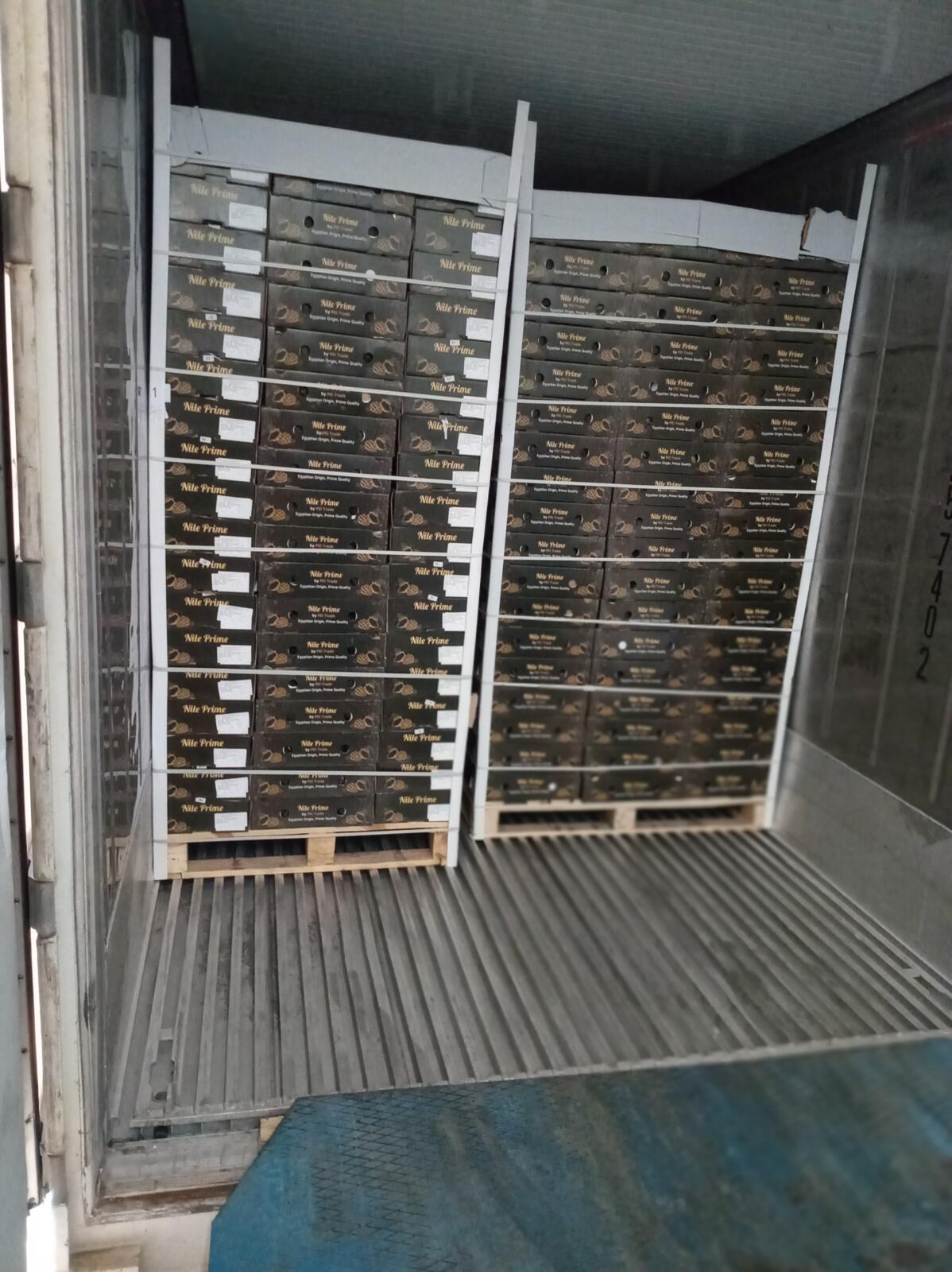
Reefer stowage decides how evenly an Egyptian mango container arrives, and it is settled in the twenty minutes it takes to load the box. A refrigeration unit does not cool fruit. It circulates air at a set point and maintains a temperature the fruit already has. If the air cannot travel through the cargo in the pattern the container was designed for, half the pallets arrive on specification and the door end arrives two degrees warm with soft fruit in the top layer.
How air moves inside the box
Marine reefers use bottom-air delivery. Chilled air leaves the evaporator at the front, runs the length of the container along the channels in the T-section floor, rises through and around the cargo at the door end, then returns along the ceiling to the unit. The cargo is part of the duct. Any route that lets air reach the ceiling without passing through fruit is a short circuit, and the container will report a healthy supply temperature while the pallets it never touched sit warm. The German Transport Information Service maintains a detailed technical reference on this in its container handbook.
Pallet pattern in a 40 ft high cube
| Item | Figure | Why it matters |
|---|---|---|
| Pallet positions | 20, two across | Block stow, no lengthwise gaps |
| Carton height on pallet | 8 to 10 layers | Must finish below the red load line |
| Clearance above cargo | Minimum 120 mm | Keeps the ceiling return channel open |
| Set point, Keitt | 10 to 12 C | Below 10 C risks chilling injury |
| Relative humidity | 90 to 95% | Limits weight loss over transit |
| Fresh air exchange | 15 to 25 cubic metres per hour | Vents accumulated ethylene and CO2 |
| Supply to return spread | 1.0 to 2.0 C | Wider spread suggests a short circuit |
The three mistakes that cost temperature
First, solid stretch wrap. Wrapping a mango pallet tight from top to bottom seals the vertical path air needs and turns the pallet into a sealed block. Use corner boards with horizontal strapping, or netting, and keep the carton vent holes aligned from layer to layer so the column is continuous.
Second, open T-floor at the door end. If the last pallet position is empty, the delivery air rises there and returns to the unit without ever entering the cargo. Cover the exposed floor channels with board or plastic sheet and block the gap so nothing shifts in transit.
Third, loading warm fruit. A reefer pulling a container of 25 degree mango down to 11 degrees is doing a job it was not built for, and it will take days it does not have. Fruit should reach set point in the packhouse before it goes near the box, which is the point of the forced-air stage described in our note on pre-cooling and inland transport.
Why the door end always runs warmest
By the time delivery air reaches the door it has absorbed heat from the full length of the cargo. The doors are also the least insulated surface on the container and the one exposed to direct sun on a terminal. A spread of one to two degrees between supply and the door-end top layer is normal. Anything beyond that points at stowage rather than machinery, which is why a logger belongs in the door-end top carton and not only at the supply grille. Placement and download are covered in our guide to temperature loggers on mango shipments.
Nile Prime is the exporter here, not an independent surveyor. The figures above are what we load to and what we ask our own loading supervisors to sign off.
Ask for the loading photographs
Any supplier can describe a stow. Ask for date-stamped photographs of the container empty, half loaded and closed, plus the PTI printout. We send them as standard. WhatsApp +20 10 9911 1918 to open a September mango position.