
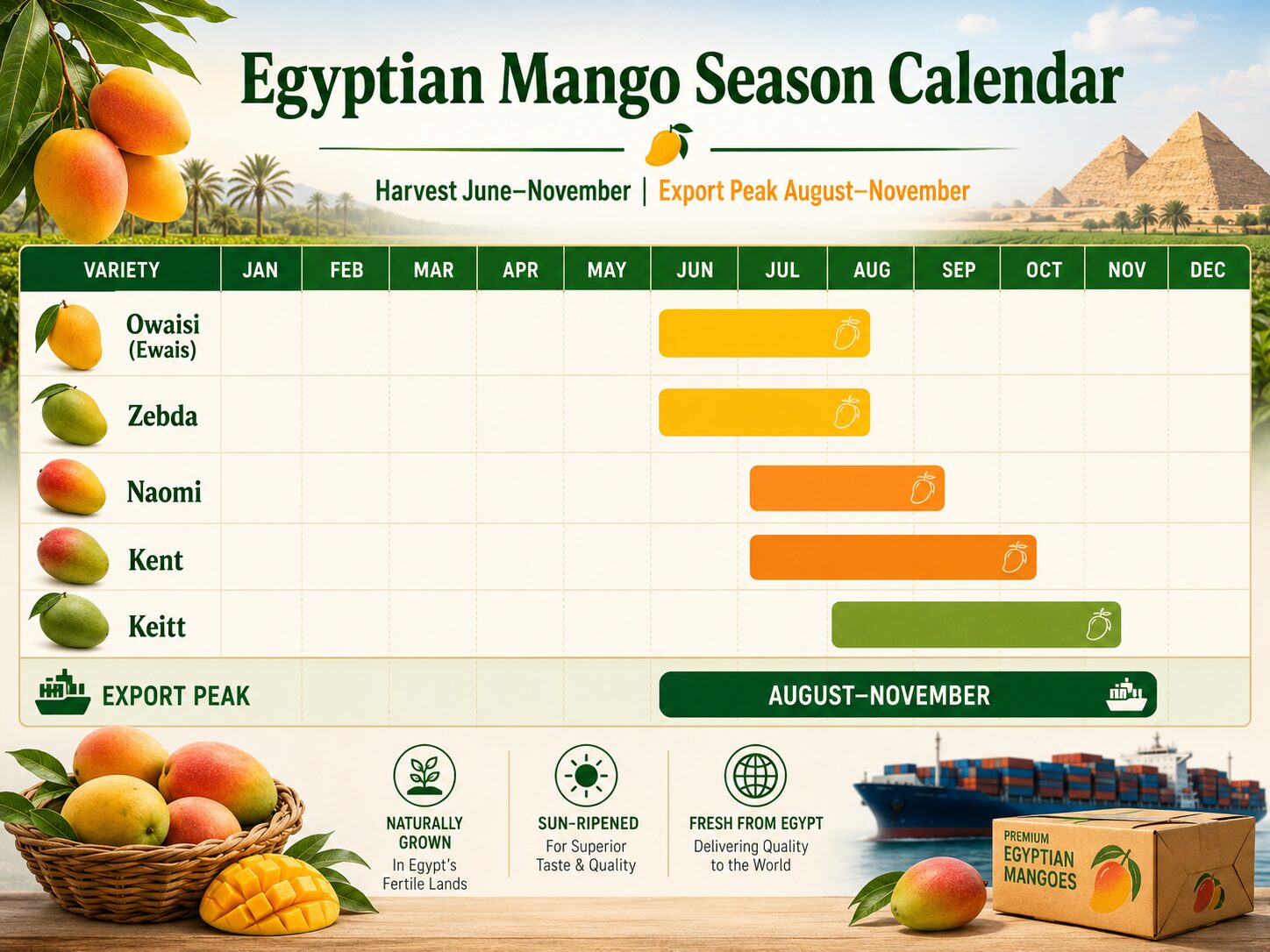
Importers running mango year round buy from four or five origins and care less about any single one than about where each fits in the calendar. Egypt is often added to a programme without that question being asked properly, which leads to Egyptian containers arriving alongside Brazilian fruit and both selling badly. The Egyptian window is real, but it is narrow and it does not overlap the way buyers sometimes assume.
The Egyptian window
Egyptian mango loads from mid-June to late September. Naomi and the early local varieties open the season and finish by the first week of August. Kent runs through July and into early August. Keitt carries the second half, from late July to the end of September, and represents the majority of exported volume. Arrival dates therefore run from late June in the Mediterranean and the Gulf, through to the first half of October on the last Keitt sailings to Asia.
What the other origins are doing in those months
Peru ships from December to March, which places it in direct opposition to nothing Egypt does. Brazil runs almost year round from the Sao Francisco valley but its heaviest export months into Europe are September to December, so it meets Egypt only at the very tail of the Keitt season. Ivory Coast and Mali ship April to June, ending as Egypt begins. Spain, mainly Osteen and Keitt from Malaga, runs September to November and represents the closest competitor on the European lane, arriving as Egyptian volume declines.
India ships Alphonso and Kesar from April to July, principally by air and principally to markets that specifically want those varieties. Pakistan runs a similar window. Neither overlaps materially with Keitt volume on sea freight.
The conclusion for a European buyer is that Egypt fills July and August, the two months when African fruit has finished and Brazilian and Spanish volume has not yet built. For a Gulf or South Asian buyer the case is stronger still, because freight from Egypt is short and the July to September gap in those markets is otherwise served by expensive residual volume.
Planning the handover
The practical planning problem is not the start of the Egyptian season but the end of it. Buyers who leave the transition to Brazil or Spain until September find that both the last Egyptian bookings and the first competing arrivals land in the same fortnight. The cleaner approach is to reduce Egyptian volume from the second week of September, taking the tail as smaller counts for processing or foodservice, and to have the next origin’s first container water-borne before the final Egyptian one discharges.
Two other factors shape the handover. Sizing declines through September, so a buyer holding out for count 8 late in the season will be disappointed. Freight positions also tighten as the Northern Hemisphere peak season builds. Both are covered in our note on late-season Egyptian mango and September positions.
Contracting next year
Buyers who intend to hold the July and August slot with Egyptian fruit rather than buying it spot should contract in the first quarter, when variety split and weekly volume can still be reserved against the packhouse plan. The considerations are set out in our guide to planning 2027 Egyptian mango allocation.
Nile Prime supplies Keitt, Kent and Naomi from Egyptian orchards in Ismailia and Sharqia, shipping from Alexandria, Damietta and Ain Sokhna under Incoterms 2020. To discuss where Egyptian fruit fits in your calendar, message our export desk on WhatsApp at +20 10 9911 1918 with your market, weekly volume and the months you need covered.