
Egyptian strawberry exports tell two stories at once: the world’s largest frozen strawberry trade, and a fresh winter business that owns Gulf shelves and fills Europe’s darkest months. This report gives buyers the numbers and structure behind both — volumes, destinations, seasonality, and what the coming seasons look like. Data companion to the complete strawberry guide.
Last updated: July 2026 · By the Nile Prime export team
Table of Contents
- The Headline Numbers
- Where It Goes
- Outlook
- Egyptian Strawberry Exports — FAQ
- Source From the #1 Origin
- The Two-Trade Structure
- Variety Economics
- Competitive Landscape
- The Buyer’s Quarterly Rhythm
- Where the Crop Grows
The Headline Numbers
| Indicator | Level | Direction |
|---|---|---|
| Frozen strawberry exports | World #1 — hundreds of thousands of tonnes | Leadership consolidated |
| Fresh exports | Major winter supplier, Gulf-led | Growing with air capacity |
| Destinations | 60+ markets frozen; Gulf+EU fresh | US & Asia frozen lanes expanding |
| Season | Fresh Nov–Apr; frozen produced Dec–May, shipped year-round | Early varieties stretching November |
| Lead variety | Festival | Fortuna/Sensation shares rising |
Where It Goes
| Segment | Buyers | Guide |
|---|---|---|
| Frozen — Europe | Jam, dairy, bakery, smoothie industry + retail bags | Europe frozen guide |
| Frozen — US & Asia | Industrial + retail, fast-growing lanes | IQF guide |
| Fresh — Gulf | Next-day air punnet programs | Gulf fresh guide |
| Fresh — Europe | Winter-window retail, Dec–Mar | Season guide |
Outlook
- Frozen leadership holds: the cost-plus-scale combination has no near challenger; Poland shrinks, Morocco stays smaller, China serves Asia.
- Compliance stratification: EU virus-protocol and residue regimes keep concentrating trade in certified plants — quality exporters gain share.
- Fresh upside: air-capacity growth from Cairo and earlier varieties push the November window — premium fresh is the margin frontier.
- Pre-season contracting deepens: more industrial buyers lock Sep–Nov each year; spot buyers pay for waiting.
The Two-Trade Structure — Why It Matters to Buyers
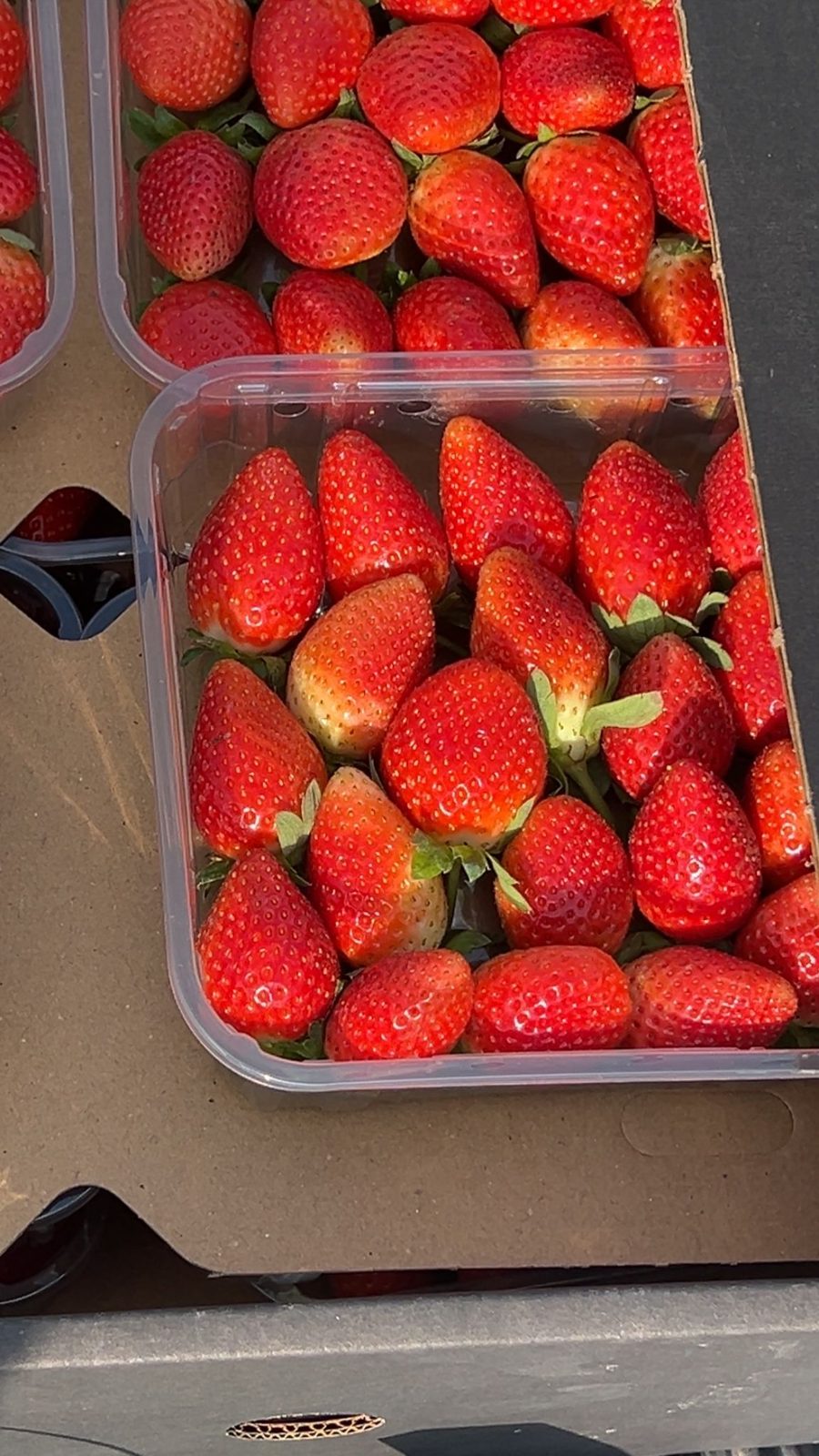
Egypt’s strawberry sector runs as one harvest feeding two completely different businesses, and the interplay between them is what sophisticated buyers exploit. The fresh trade skims the best fruit of each morning’s pick — uniform 25–32 mm berries with perfect calyx — and pays premium farm-gate prices for it, because next-day Gulf shelves reward looks. Everything else flows to the IQF plants, where color and Brix matter but cosmetics don’t. This dual channel does two things for the market: it keeps fresh-grade discipline high (farms are paid to sort hard), and it gives the frozen trade enormous raw-material depth at costs no single-channel origin can match. When fresh demand spikes — a cold snap in Europe, a strong Gulf campaign — IQF raw material tightens and frozen prices firm weeks later; when fresh demand softens, plants run flush and frozen contracts sweeten. Buyers who track the fresh market’s temperature therefore see frozen price moves before they land in offers.
Variety Economics Behind the Numbers
Festival’s dominance is an economic story, not an agronomic accident. The variety delivers three commercial properties at once: deep red color that penetrates the flesh (critical for IQF, where a white core reads as defect), a sugar-acid balance that survives freezing, and yields that keep farm-gate costs low through the peak. Fortuna earns its acreage in the fresh trade — earlier, larger, glossier — and its expansion is effectively a bet on the premium fresh window continuing to grow. Sensation’s rise is about labor: it picks faster and ships harder, trimming the two biggest cost lines in the fresh chain. For buyers, the variety mix on offer is a signal: a supplier quoting Festival for IQF and Fortuna-led punnets for fresh is aligned with the market; one quoting the reverse is moving fruit against its economics, and the price will show it somewhere — usually in quality.
The Competitive Landscape in One Table
| Origin | Frozen Position | Fresh Position | Trajectory |
|---|---|---|---|
| Egypt | World #1 — scale + cost + Festival color | Gulf leader, EU winter supplier | Consolidating both |
| Poland | Legacy EU industrial supplier (Senga) | Domestic summer only | Shrinking crop, rising costs |
| Morocco | EU-focused, mid-scale | EU winter competitor | Stable, water-constrained |
| Spain (Huelva) | Minor frozen | The EU fresh giant Feb–May | Egypt’s fresh window sits before its peak |
| China | Large, Asia-oriented | Minimal export fresh | Serves its region |
| Mexico/US | Americas supply | Americas supply | Parallel market, rarely competes |
The strategic read: Egypt’s fresh window (Nov–Mar) deliberately front-runs Spain’s Huelva peak (Feb–May), and its frozen scale replaces Poland’s structural decline. Neither position faces a credible challenger this decade — the constraint on Egyptian growth is plant capacity and compliance depth, not demand.
The Buyer’s Quarterly Rhythm
| Quarter | Market State | Smart Buyer Move |
|---|---|---|
| Q3 (Jul–Sep) | Pre-season: plants quoting next harvest | Fix IQF annual contracts — the year’s best terms |
| Q4 (Oct–Dec) | Fresh opens; first new-crop IQF runs | Launch Gulf fresh programs; take early-crop IQF quality |
| Q1 (Jan–Mar) | Both trades at absolute peak | Maximize fresh volume; audit IQF deliveries against contract |
| Q2 (Apr–Jun) | Fresh tails; IQF production ends | Cover any IQF shortfall before stock-market pricing starts |
Where the Crop Grows — and Why It Keeps Expanding
The export crop concentrates in three zones, each feeding the trade differently. Ismailia and the eastern Delta hold the historic acreage and much of the IQF plant capacity — short field-to-freezer distances are why Egyptian frozen quality holds up. Beheira and the western Delta carry large mixed fresh/frozen acreage with good access to Alexandria’s ports for the European lanes. The reclaimed desert fringes host the newest, most professional fresh-export farms — drip-fed, plastic-tunneled, GLOBALG.A.P from the first season, and pointed squarely at the Gulf premium trade. Expansion economics remain compelling: strawberries return more per feddan than almost any field crop in Egypt, the labor pool for picking exists, and both sales channels are undersupplied at world level. The realistic constraints are winter water allocations, airfreight capacity out of Cairo in the December–February crunch, and the pace at which plants can add EU-grade compliance — which is why volume growth keeps arriving in steps rather than a straight line.
Egyptian Strawberry Exports — FAQ
How much strawberry does Egypt export?
Egypt leads world frozen strawberry exports with hundreds of thousands of tonnes annually to 60+ markets, plus a major fresh winter trade concentrated on the Gulf and Europe.
Who buys Egyptian strawberries?
Frozen: European industry leads, with the US, Asia, and Russia growing. Fresh: Gulf retail on next-day air, and European chains through the December–March window.
Why does Egypt dominate frozen strawberries?
Festival-variety color, IQF plants beside the fields, competitive costs, and 10–12 day EU freight — a combination no origin currently matches, reinforced by shrinking Polish supply.
What is the outlook for Egyptian strawberry exports?
Continued frozen leadership with trade concentrating in certified plants, growing US and Asian lanes, and fresh-side upside as air capacity and earlier varieties stretch the premium November window.
Source From the #1 Origin
Nile Prime — the premium brand of PEI Trade: WhatsApp +20 109 911 1918 · [email protected] · IQF · Fresh.
Sources: Tridge — Egypt strawberry export data · PEI Trade.