
Egyptian onions export is one of the oldest continuous trades out of this origin — and still one of the smartest buys in bulk vegetables. Egypt ships red and golden onions from March through most of the year, cured hard for long transit, at volumes that make it a top-tier world supplier to Europe, the Gulf, Russia, and Asia. This guide covers types, seasons, specs, packing, and the storage logic that separates suppliers. It anchors our vegetables hub.
Last updated: July 2026 · By the Nile Prime export team
Table of Contents
- Red vs Golden — The Two Trades
- Why Egyptian Onions Win
- Export Specs & Packing
- Season & Buying Calendar
- Egyptian Onions Export — FAQ
- Book Your Onion Program
- Worked Example: Crisis to Program
- Curing — The Whole Ballgame
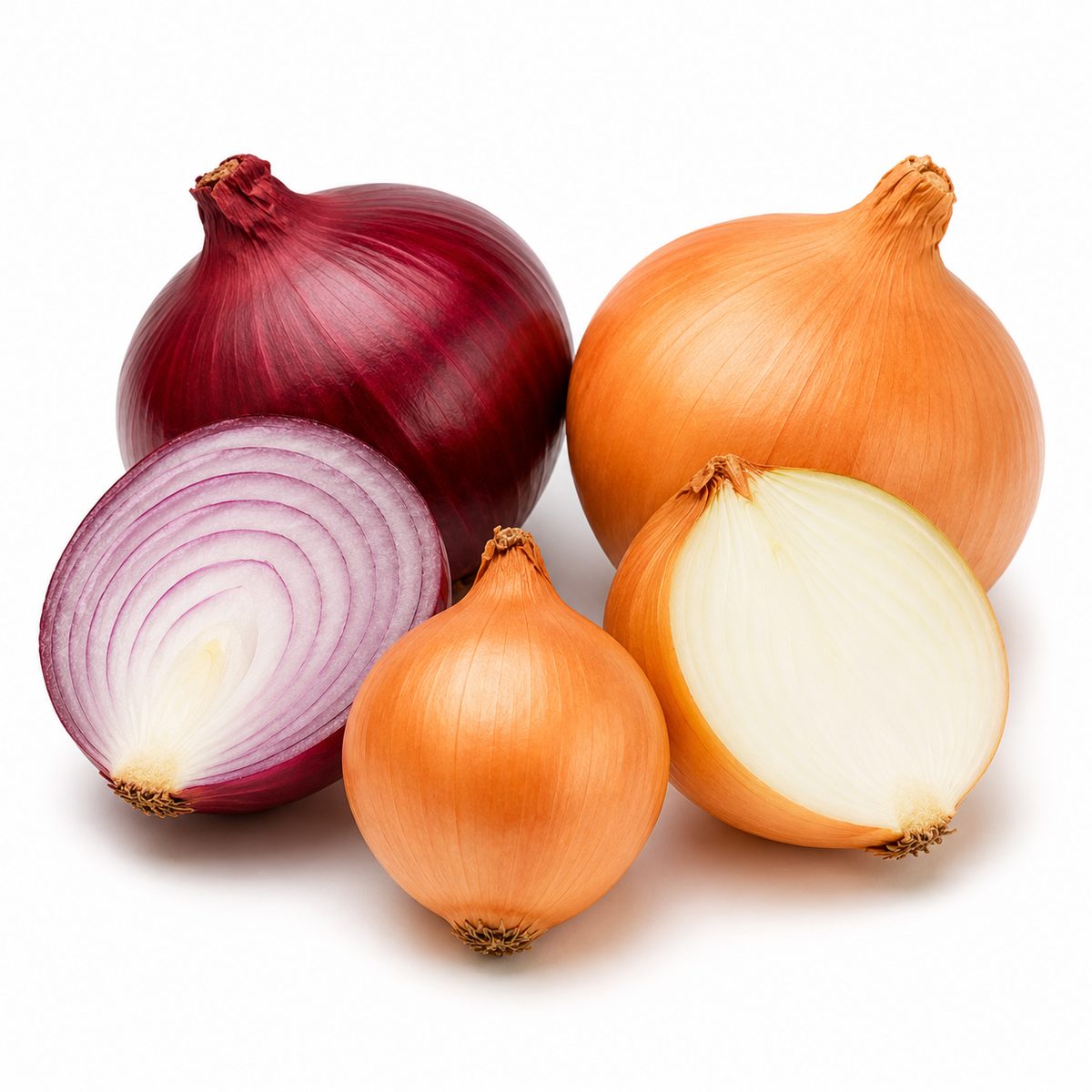
Red vs Golden — The Two Trades
| Red Onions | Golden (Yellow) Onions | |
|---|---|---|
| Character | Deep purple-red, pungent, firm | Golden skin, milder, all-purpose |
| Main markets | Europe, Gulf, Far East | Europe, Russia, Africa, Gulf |
| Sizes | 40–60 / 60–80 / 80+ mm | 40–60 / 60–80 / 80+ mm |
| Season | March–August fresh, stored beyond | March–August fresh, stored beyond |
| Buy for | Retail color programs, salads | Volume retail, food service, industry |
Why Egyptian Onions Win
- The spring window. Egyptian new-crop onions arrive March–May, exactly when European stored crop runs down and before other origins fill the gap.
- Hard curing. Dry Egyptian heat cures bulbs with tight skins and low moisture — the difference between onions that arrive firm after 3 weeks at sea and onions that arrive sprouting.
- Dual-color capability at scale from the same suppliers, one consolidation.
- Freight position: days to the Gulf, under two weeks to Europe and Russia — landed costs few origins match in the window.
Export Specs & Packing
| Parameter | Standard |
|---|---|
| Sizing | 40–60 mm / 60–80 mm / 80+ mm, graded uniform |
| Curing | Field + shed cured; dry outer skins, closed necks |
| Packing | 25 kg mesh bags (the workhorse); 5–10 kg retail mesh; big bags for industry |
| Container payload | ≈27–28 t per 40-ft (ventilated or reefer per season) |
| Transport | Ventilated containers in cool months; reefer +2–5°C in heat |
| Compliance | GLOBALG.A.P farms, phytosanitary per shipment, MRL per destination |
Season & Buying Calendar
| Period | What Ships | Buyer Move |
|---|---|---|
| Feb–Mar | Early new crop (green-topped then cured) | Book the Europe gap window early |
| Apr–Jun | Peak new crop, best quality & price | Run volume programs hard |
| Jul–Oct | Cured stored crop | Confirm storage conditions before contracting |
| Nov–Jan | Tail stored crop | Inspect lots — quality varies by store discipline |
The storage question is where suppliers separate: ask how lots are stored (ventilated shed vs cold store), request cut tests on stored crop, and check neck closure on samples — open necks mean early sprouting on arrival. Product specs: Egyptian onions (red & golden).
Worked Example: A Dhaka Importer’s Crisis Order, Then a Program
Bangladesh’s onion market periodically detonates when India restricts exports — and a hypothetical Dhaka importer lives that cycle. The crisis order: India announces a ban; local prices triple in a week; he needs 20 containers yesterday. Egyptian golden onions — thick-skinned, cured for voyages, loadable within days from stored stock — are among the few origins that can ship immediately at scale. He pays crisis prices, ships ventilated containers on the ~3-week lane, and lands profitably anyway because the destination market has repriced harder than the origin did. The lesson he converts into a program: rather than repeating the scramble at every ban, he contracts a standing 4-container monthly baseline from Egypt year-round — small enough to blend into normal costing, large enough that when the next ban hits (and it does, in this sketch, fourteen months later) he holds allocation, relationships, and freight routines while competitors start from zero. His blended cost across the cycle beats the pure-crisis buyer by a wide margin. The importer is invented; the India-ban cycle and Egypt’s role as the world’s shock absorber for it are documented trade history, repeating roughly every other year.
Curing — The Whole Ballgame in One Section
Everything buyers fear about onion shipments — sprouting, rot, soft necks, weight loss disputes — traces to one variable: whether the crop was properly cured before packing. Curing (field-drying then shade-finishing until necks close and outer skins paper over) seals the bulb’s defenses for months of storage and weeks at sea. The verification is visual and cheap: a video of the lot showing tight dry necks, rustling skins, and zero green shoulders tells more than any certificate. Specify curing in the contract (“fully cured, necks closed, skins intact”), cap the moisture and sprouting tolerances, and choose ventilated containers in cool months (reefer only in summer heat) per the container guide. Buyers who verify curing have boring seasons; buyers who verify prices have interesting ones.
Egyptian Onions Export — FAQ
When is the Egyptian onion season?
New crop ships from March through August, peaking April–June, with hard-cured stored crop extending supply through most of the year. The March–May window — when European stored crop runs out — is Egypt’s strongest play.
What onion types and sizes does Egypt export?
Red and golden onions, graded 40–60, 60–80, and 80+ mm, packed in 25 kg mesh bags as standard with 5–10 kg retail mesh and big bags available — about 27–28 tonnes per 40-ft container.
How should Egyptian onions be shipped?
Ventilated containers in the cooler months, reefer at +2–5°C in summer heat. Hard curing with closed necks is what keeps bulbs firm across a 2–3 week voyage.
What should I check before buying stored-crop onions?
Storage method (ventilated vs cold store), cut tests on the actual lots, neck closure and skin condition on samples — stored-crop quality follows storage discipline, not the calendar.
Book Your Onion Program
Red, golden, or both — Nile Prime, the premium brand of PEI Trade, ships graded, hard-cured onions with full documentation. Sweet potatoes and the wider vegetable range consolidate in the same containers: WhatsApp +20 109 911 1918 · [email protected].
Sources: Tridge — Egypt onion export intelligence · PEI Trade.