
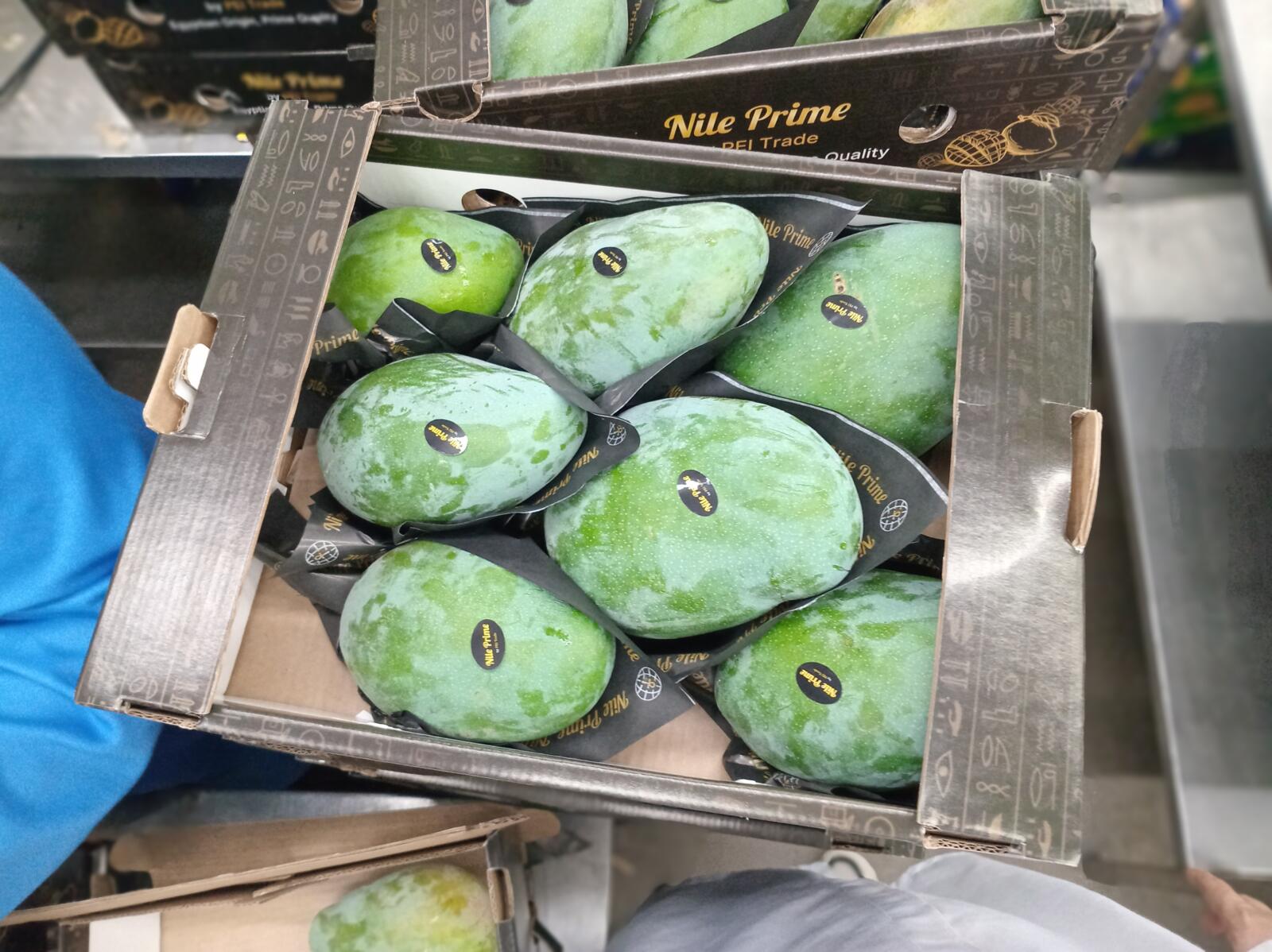
A question that comes up every August, usually from a first-season buyer, is why a container of Egyptian mango declared at 4 kg net per carton weighs less than that when the receiver puts a sample of cartons on a scale. The answer is straightforward, but it needs to be agreed before loading rather than argued after arrival.
What net weight means on the carton
Net weight is the weight of the fruit alone, excluding the carton, the liner, the tray and the pallet. Gross weight includes packaging. On our standard Keitt formats the difference is not trivial. A 4 kg net telescopic carton with a single-face liner and a moulded tray adds roughly 0.35 to 0.45 kg of packaging depending on board grade. When a receiver weighs a full carton and compares it to the net declaration, the two numbers are not measuring the same thing.
The declared net weight also has to be reconciled with the fruit count. A 4 kg carton at count 8 needs individual fruit averaging 500 g. At count 10 the average falls to 400 g. Because mango does not grade into exact weights, the packhouse fills to the count and then verifies against the scale. The relationship between count, size and carton format is set out in our note on mango sizing and carton counts.
Overpack, and why it exists
Egyptian packhouses routinely pack above the declared net figure. On a 4 kg declaration, a target fill of 4.05 to 4.15 kg is normal practice. This is not generosity. It is a deliberate allowance so that the carton still meets its declaration after the fruit loses moisture in transit. Ask what overpack percentage your supplier applies and have it written into the specification. A supplier packing exactly to declaration on a twenty-day sailing is setting up a short-weight claim.
Moisture loss during transit
Mango transpires. Water leaves the fruit through the skin and lenticels, and the rate depends on pulp temperature, relative humidity in the container, air circulation and how long the fruit sat before pre-cooling. On a well-run reefer at 10 to 12 degrees Celsius with humidity held high, loss over a fourteen to twenty day sea transit typically runs in the region of one to three percent of fruit weight. Fruit loaded warm, or shipped in a container running dry, will lose more. Perforated liners slow the loss without trapping condensation, which is one of the reasons packaging choice is a technical decision rather than a cost decision. Our piece on carton board, liners and trays covers the trade-offs.
Weight loss also shows up as a change in appearance before it shows up on a scale. Slight skin shrivel at the shoulder, a duller finish and softening of the stem end all indicate that the fruit has given up water. If the receiver reports shrivel alongside a weight shortfall, the two findings are usually the same event.
How a weight discrepancy should be assessed
A credible weight check follows a method. Weigh a defined random sample rather than selected cartons, normally a minimum of ten cartons drawn from different pallets and different positions in the container. Weigh gross and then tare the packaging from the same batch. Record the temperature data download at the same time, because the two together explain the result. Photograph the scale reading with the carton lot code visible.
Where a genuine shortfall exists, settlement follows the same route as any other arrival issue. Documentation, joint assessment and a credit against the affected cartons rather than the whole container. The process is described in our guide to arrival condition and claims on Egyptian mango.
What to agree before the container loads
Three lines in the specification prevent most of this. State whether the price is against net or gross weight. State the packhouse overpack target. State the tolerance the parties accept on arrival net weight, with a figure rather than a phrase. With those agreed, a weight check on arrival becomes a routine verification instead of a negotiation.
Nile Prime packs Keitt in 4 kg and 6 kg net formats with stated overpack, ships from Alexandria, Damietta and Sokhna on Incoterms 2020 terms, and supplies packhouse scale records with every shipment. For late-season Keitt positions and written specifications, message us on WhatsApp at +20 10 9911 1918.