
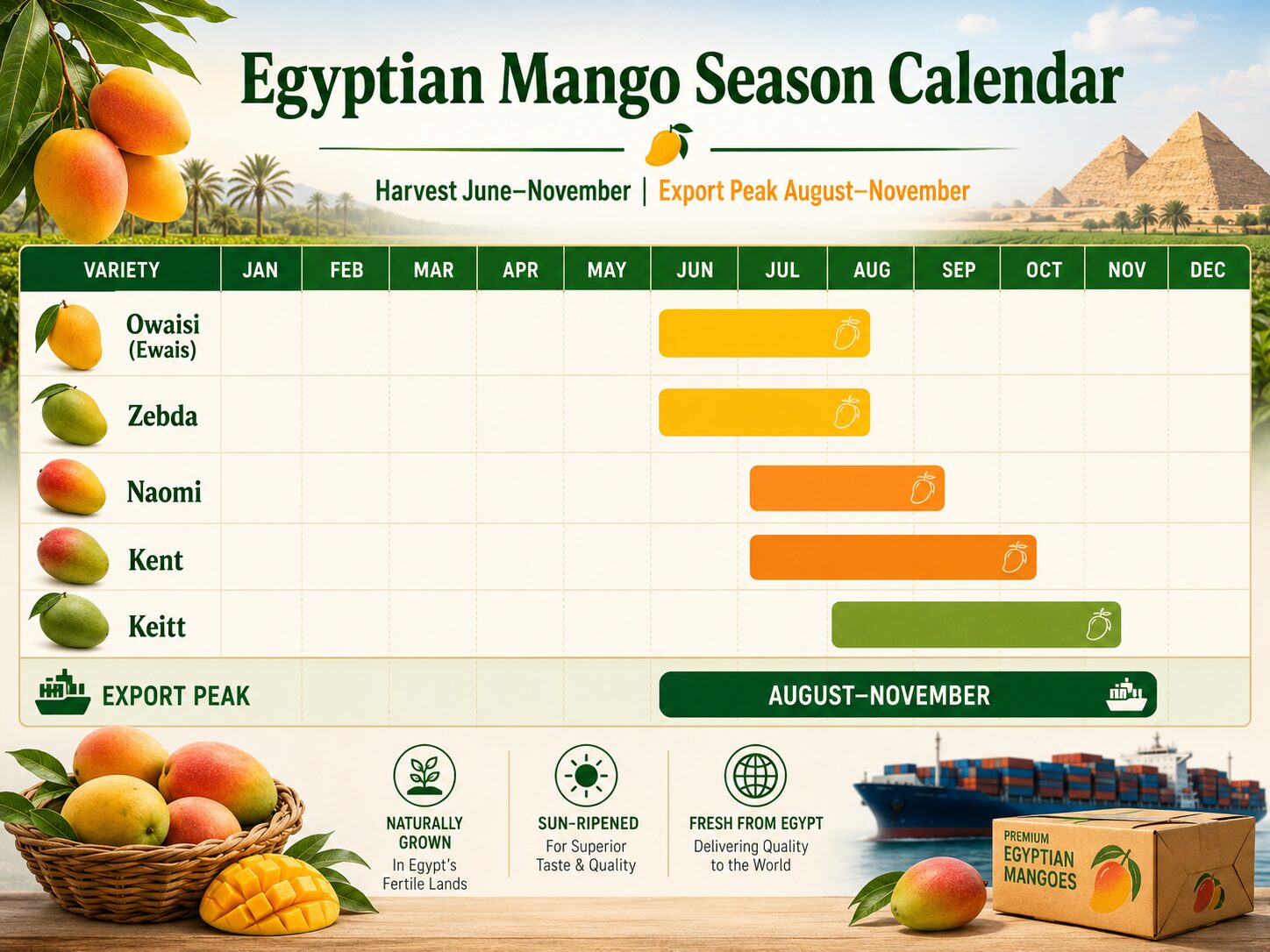
Most importers do not buy Egyptian mango because it is Egyptian. They buy it because of when it arrives and how quickly it gets there. Understanding where the Egyptian window sits inside the global supply calendar is therefore the first commercial question, ahead of variety or grade. Below is how the year actually breaks down for a buyer serving the Gulf, Europe or Eastern Europe.
The first half of the year belongs elsewhere
From December through March, Peru is the dominant counter seasonal origin, shipping mainly Kent with some Edward, and it sets the reference price into Europe and North America during that period. Mexico runs from February to September and supplies the United States almost exclusively, so it rarely competes for European or Gulf volume. Ivory Coast and Mali open around April and run to June, sending Kent and Amelie into Europe by sea and air.
The Indian subcontinent covers roughly the same window from a different direction. India ships Alphonso, Kesar and Banganapalli from April into July, and Pakistan follows with Sindhri and Chaunsa from May to August. These origins dominate Gulf demand during their season because of the large South Asian consumer base there, but they are variety specific and do not substitute for a Kent or Keitt programme.
The Egyptian window: late June to October
Egypt begins with early varieties in late June, moves through Naomi and Kent in July and August, and finishes with Keitt through September and into October. That places Egypt directly in the gap left when Pakistan winds down and before Brazil and Spain reach full volume. For buyers running a year round mango programme, this is the value of the origin: it fills a real hole rather than competing head on.
Transit is the second reason. From Alexandria, Damietta or Sokhna, sailing time runs around five to nine days to Jeddah, Dammam and Jebel Ali, and roughly seven to twelve days to Mediterranean European ports. Compared with a three to four week voyage from South America, that shorter transit means a firmer arrival and a longer selling window at destination. Details of routings and reefer settings are in our note on shipping Egyptian mango by sea.
The autumn overlap
From September, Egypt overlaps with Spain, which ships Osteen and Keitt from Malaga through to November, and with Brazil, which builds toward its peak of Tommy Atkins, Palmer and Keitt from September to December. Israel also runs July to October. This is the most competitive stretch of the Egyptian season, and it is where Keitt specification matters most, because a well graded Egyptian Keitt with the right count and a controlled cold chain competes on arrival quality rather than on price alone. We set out how to plan that period in our guide to late season September and October Keitt shipments.
Planning implications for buyers
If your market runs on Kent, Egypt gives you July and August coverage between the West African close and the Brazilian open. If you run Keitt, Egypt gives you a September and October position that can be booked earlier and cheaper than the Spanish equivalent. If you supply a South Asian consumer base in the Gulf, Egypt is a shoulder origin rather than a peak one, useful for August and September once Chaunsa is finished.
The practical takeaway is to treat the calendar as the starting point of the buying plan and then match variety to it, not the other way round. Buyers deciding between varieties can compare specifications in our note on choosing between Keitt, Kent and Naomi.
Nile Prime ships Keitt, Kent and Naomi from Alexandria, Damietta and Sokhna on Incoterms 2020 terms, with full cold chain records supplied against every load. To discuss where Egypt fits in your 2026 and 2027 coverage, message our export team on WhatsApp at +20 10 9911 1918.