
Egyptian mango exports have doubled in under a decade — from a domestic-first crop to one of the country’s headline fruit exports, shipped to more than fifty markets. This report gives importers the numbers behind the story: volumes and values, where the fruit goes, how the season distributes, and what the coming years look like as new orchard area reaches production. Data-heavy companion to the complete Egyptian mango export guide.
Last updated: July 2026 · By the Nile Prime export team
Table of Contents
- The Headline Numbers
- Where Egyptian Mangoes Go
- How the Season Distributes
- Outlook: What Changes Next
- Egyptian Mango Exports — FAQ
- Source From the Origin’s Premium Brand
- Statistics Into Decisions
- Five Structural Trends
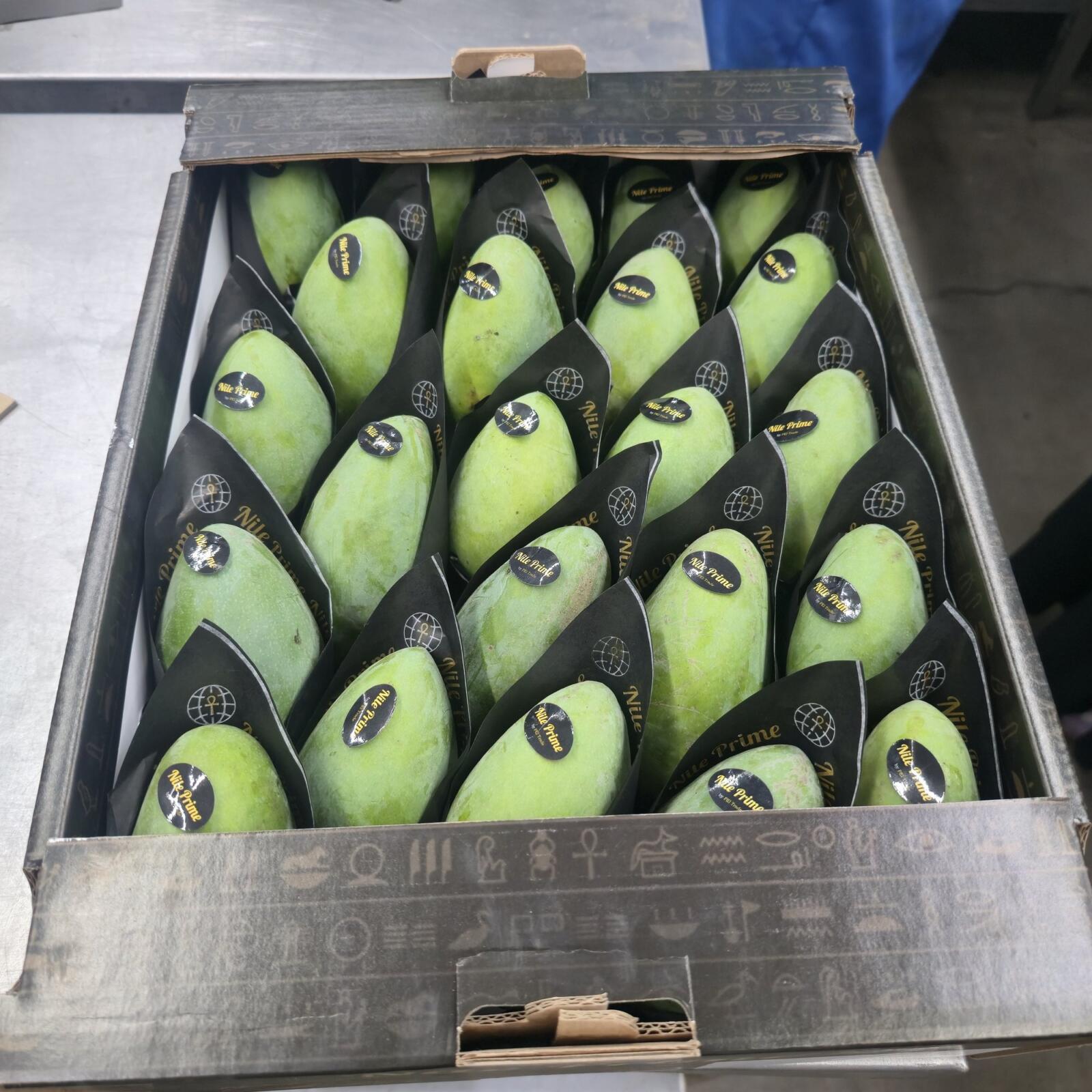
The Headline Numbers
| Indicator | Recent Level | Direction |
|---|---|---|
| Export volume | ~72,500 tonnes (2023) | Rising year on year |
| Export value | ~USD 133 million (2023) | Rising — premium varieties lift average price |
| Destination markets | 50+ countries | Broadening beyond the Gulf core |
| Season length | ~24 weeks (Jun–Nov) | Extending at both ends via regions & varieties |
| Rank among Egyptian fruit exports | Second after citrus | Consolidating |
Two structural drivers sit behind the growth: new high-density orchards in the Delta and reclaimed desert coming into bearing, and rising recognition that Egypt’s August–November window faces the year’s thinnest competition — the timing case explained in the origin comparison.
Where Egyptian Mangoes Go
| Region | Share of Trade | Character |
|---|---|---|
| Gulf (KSA, UAE, Kuwait, Qatar) | The core — roughly half of exports | Premium indigenous varieties by air + volume by sea; see the Gulf guide |
| Russia & EAEU | Fast-growing volume lane | Kent/Keitt programs on citrus rails; see the Russia guide |
| EU & UK | Growing premium segment | Keitt-led Sep–Nov window; see the Europe guide |
| Levant & North Africa | Steady regional trade | Traditional varieties, short lanes |
| Asia & Far East | Emerging frontier | Air via Gulf hubs; protocols developing |
How the Season Distributes
Shipment weight concentrates heavily in the August–October peak — roughly three-quarters of annual volume moves in those twelve weeks, when all ten commercial varieties overlap. The June–July opening carries premium early pricing on thin volume, while November’s late-Keitt tail earns the season’s best margins into an empty world market. Buyers who spread programs across all three phases capture both volume economics and edge-of-season pricing — the mechanics are in the season calendar.
Outlook: What Changes Next
- More volume, earlier and later. New orchard area and regional sequencing keep stretching the season at both ends.
- Premiumization. Branded cartons, wrapped fruit, and air-freighted indigenous varieties raise average export values faster than volumes.
- Compliance as moat. EU-grade traceability and residue discipline will separate exporters who grow from those who plateau.
- New lanes. Asian protocols and deeper European retail penetration are the next growth chapters.
Worked Example: Turning the Statistics Into a Sourcing Decision
Statistics earn their place when they move money, so put a hypothetical decision through this report. A Saudi retail buyer currently sources mangoes from three origins and wonders whether Egypt deserves a bigger share. Three numbers answer him. Growth trajectory: Egyptian mango exports trending upward year over year — driven by new plantings maturing outside the traditional Ismailia heartland — tells him supply depth is improving, not static; a bigger commitment won’t hit a ceiling. Destination concentration: the Gulf absorbing the overwhelming majority of volume tells him two things at once — the lane to him is proven and liquid (good), and he’s competing with every other Gulf buyer for peak weeks (plan early). The July–October window: mapped against his other origins’ calendars, Egypt owns the quarter when Indian and Pakistani supply exits — so the “bigger share” question is really a window question, and the answer in this sketch is: shift the entire Q3 program to Egyptian fruit, keep the subcontinent for Q2, and let the calendar — not loyalty — allocate the shares. That is how a professional reads an export report: three numbers, one decision, next season.
Five Structural Trends Behind the Numbers
- Acreage expansion: desert-reclamation mango plantings keep maturing into bearing age — volume growth is planted, not hoped for.
- Variety modernization: Keitt’s share grows because it ships; premium local varieties (Sedika, Ewais) anchor the air-freight top end.
- Gulf retail deepening: hypermarket programs replace souk trading — pushing grading, packing, and certification standards upward.
- European experiments scaling: sea-freight Keitt programs into Europe grow from novelty toward routine as ripening-room infrastructure spreads.
- Processing pull: juice and pulp demand gives the crop a floor price and gives buyers a second market for size and grade outliers.
Egyptian Mango Exports — FAQ
How much mango does Egypt export?
Roughly 72,500 tonnes worth about USD 133 million in 2023, with volumes rising steadily as new orchards reach production — making mango Egypt’s second fruit export after citrus.
Which countries import the most Egyptian mangoes?
Saudi Arabia and the Gulf states form the core, taking roughly half of exports, followed by Russia, the EU and UK, the Levant, and an emerging Asian segment — over fifty destination markets in total.
Why are Egyptian mango exports growing so fast?
A rare timing window (August–November peak with thin global competition), short freight lanes to the Gulf, Russia and Europe, exclusive indigenous varieties, and substantial new orchard area coming into bearing.
What is the outlook for Egyptian mango exports?
Continued growth in both volume and average value: a longer season, more branded and air-freighted premium fruit, deeper EU retail penetration, and new Asian lanes as phytosanitary protocols develop.
Source From the Origin’s Premium Brand
Nile Prime ships the varieties, windows, and markets described in this report — branded premium programs from June to November: WhatsApp +20 109 911 1918 · [email protected] · Egyptian mangoes — specifications.
Sources: Tridge — Egypt mango export data (2023: 72,520 t / USD 133.57M) · EastFruit via Tridge · PEI Trade — Egyptian Mango Export Report 2026.