
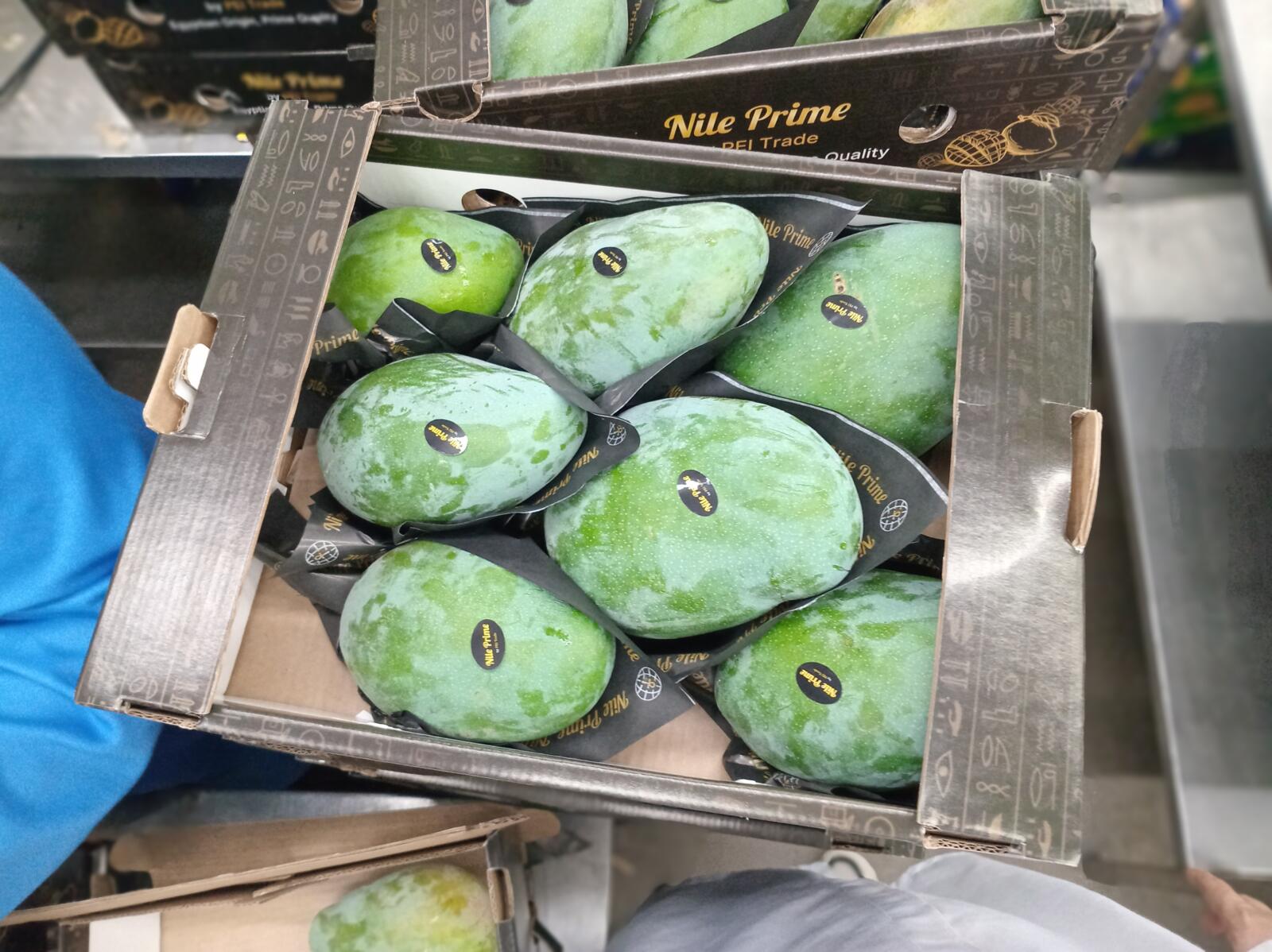
Every rejection argument on a mango container eventually comes back to the carton label. If the lot code on the carton cannot be matched to a packing record and an orchard block, a defect finding stays an opinion. If it can, both sides are looking at the same set of facts within an hour. That is the whole reason labelling is worth getting right before the season rather than after a problem.
What has to be on the carton
For Egyptian mango moving to the EU, UK or GCC, the minimum set is fairly consistent. The label must carry the product name and variety, the country of origin stated as Product of Egypt, the class, meaning Class I or Class II, the size or count and the corresponding size code, the net weight, the packer and dispatcher name and address or an officially issued code, and a lot or batch identifier that allows the consignment to be traced.
Where the buyer is a certified retailer or works to a retailer standard, the GLOBALG.A.P Number, printed as a 13 digit GGN, is normally required on the carton or at minimum on the pallet label. Buyers should say at the point of order whether they need the GGN at carton level or pallet level, since printing at carton level has to be set up before the run starts.
How the lot code is built
There is no single mandated format, but a workable lot code encodes the packing date, the packhouse line, the farm or orchard block and the shift. A typical structure is a date element, a two character packhouse identifier, a block reference and a sequential number. What matters is that the exporter holds a record linking each code to the harvest date, the block, the grader team and the pallet it went onto.
Practically, this means that if a buyer photographs three cartons of soft fruit on arrival and sends the lot codes, the packhouse can pull the harvest date, the pre-cooling record and the pulp temperature at loading for exactly those cartons. Without that link the discussion moves to the whole container, which serves nobody.
Pallet labelling
The pallet label sits above the carton label and should state the pallet number, total cartons, variety, class, count, net weight, GGN where applicable and the lot codes present on that pallet. Mixed lot pallets are common on later picks and are not a problem provided the label lists every lot code on the pallet. A pallet label that shows one lot code while the cartons beneath carry three is the single most common labelling error we see on inbound audits.
What importer and retail QA actually check
On a routine arrival check, QA teams verify that the variety and class on the label match the delivery note, that the count on the label matches the count in the carton on a sample basis, that net weight is within tolerance on a calibrated scale, that the origin declaration is present and legible, and that the GGN, where required, resolves to a valid certificate. They also check that the labels have not been overprinted or relabelled, since relabelling is treated as a serious finding under most retailer codes.
Getting these elements settled before the container is packed is far cheaper than fixing them at the destination. The wider inspection scope is covered in our note on what a third party surveyor checks before loading, and the specification side, including which counts belong in which channel, is set out in our guide to Egyptian mango sizing and carton counts.
Setting it up for your programme
Nile Prime packs Keitt in 4 kg export cartons under a fixed labelling specification agreed with the buyer before the first load. We can print buyer specific label artwork, carton level GGN and destination language requirements, provided the specification reaches us before the packing run is scheduled. Lot records are retained and can be produced against any carton code on request.
To agree your label artwork and lot code format for the remainder of the 2026 season, contact our export team on WhatsApp at +20 10 9911 1918 with your destination market, retailer standard and required count.