
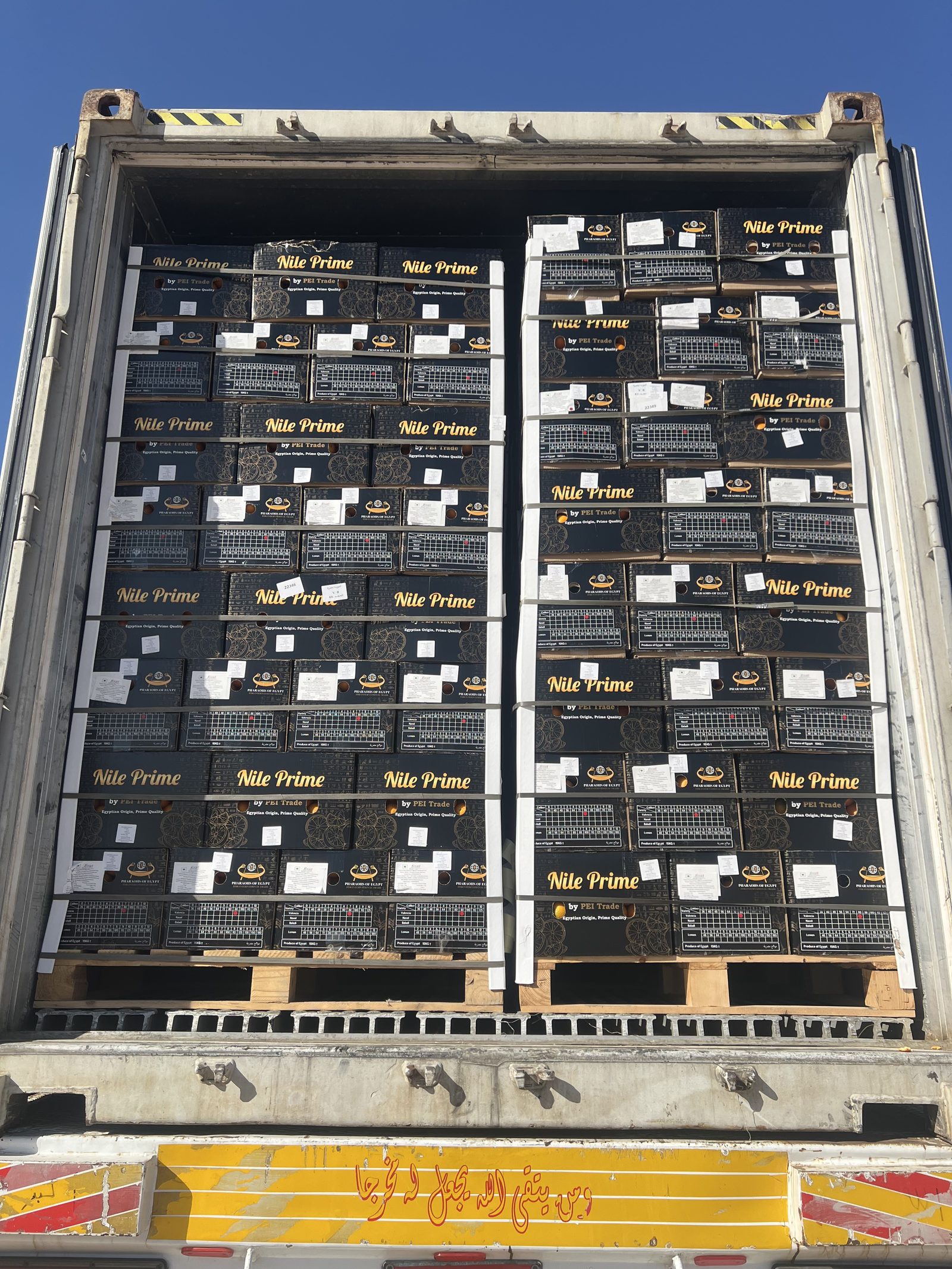
Asia is the largest single destination region for Egyptian oranges by volume, and the one where the specification diverges furthest from what European retail expects. A buyer coming to Egypt from the EU trade is usually surprised by three things: the sizes that move, the carton that moves them, and how much of the commercial risk sits with the import permit rather than the fruit.
Transit and routing
From Alexandria, Damietta and Port Said, the Suez transit puts South Asia within reach on a single reefer leg. Working sailing times are roughly 14 to 20 days to Nhava Sheva and Mundra, 18 to 24 days to Chattogram and Colombo, and 22 to 30 days to Port Klang, Tanjung Priok, Ho Chi Minh City and the southern Chinese ports, depending on whether the service is direct or transhipped through Jebel Ali or Singapore. Add the transhipment leg to your own shelf-life calculation rather than to the carrier’s quoted port-to-port figure.
Citrus tolerates that duration well when pulp temperature is right at the door. Navel and Valencia carry at 4 to 5 degrees Celsius for these lanes, with humidity at 90 to 95 percent. What the long transit does not tolerate is fruit loaded warm, which is covered in our note on pre-cooling citrus before the doors close.
What each market buys
India is a Valencia market first and a Navel market second, and it buys the middle and small of the size curve rather than the large. Counts 88, 100, 113 and 125 move in volume. The standard pack is the 15 kg telescopic carton, and mesh bags in 4 kg and 8 kg formats serve some wholesale channels. Colour expectation is lower than in Europe and internal quality carries the sale.
Bangladesh works similarly on specification and differently on payment, with letter of credit practice still common. Malaysia, Indonesia and Vietnam take both oranges and mandarins, with mandarin demand concentrated around Lunar New Year, which places the shipping decision in November and December for a late January arrival.
Because Asian buyers take the smaller counts, a container sold into Asia and a container sold into the EU come from different parts of the same harvest. That is a reason to run both, not a conflict. The mechanics are in our note on size curve and count distribution.
Market access and documentation
Every one of these destinations requires a phytosanitary certificate issued by the Egyptian plant quarantine authority against the importing country’s declared requirements. Several require more. An import permit obtained by the importer before shipment is mandatory in Indonesia, Vietnam and several others, and the permit conditions, not the contract, decide what may be loaded. China requires that the orchard and the packhouse both be registered and approved before any consignment ships, and a container loaded from an unregistered packhouse will not clear regardless of fruit quality.
Confirm three points in writing before booking: that the importer holds a valid permit covering the shipment period and volume, that the packhouse and orchard registration numbers satisfy the destination, and whether a cold treatment or other pest protocol applies to the lane. Pest interception risk is real on citrus, and the orchard and packhouse controls behind it are set out in our note on false codling moth and fruit fly.
Booking the 2026/2027 season
Navel volume opens from late October and Valencia from February, with mandarin in between. Asian lanes need their bookings placed earlier than European ones because of the transit. Send us the destination port, the counts and the carton format and we will confirm availability and a CFR price. WhatsApp +20 10 9911 1918.