
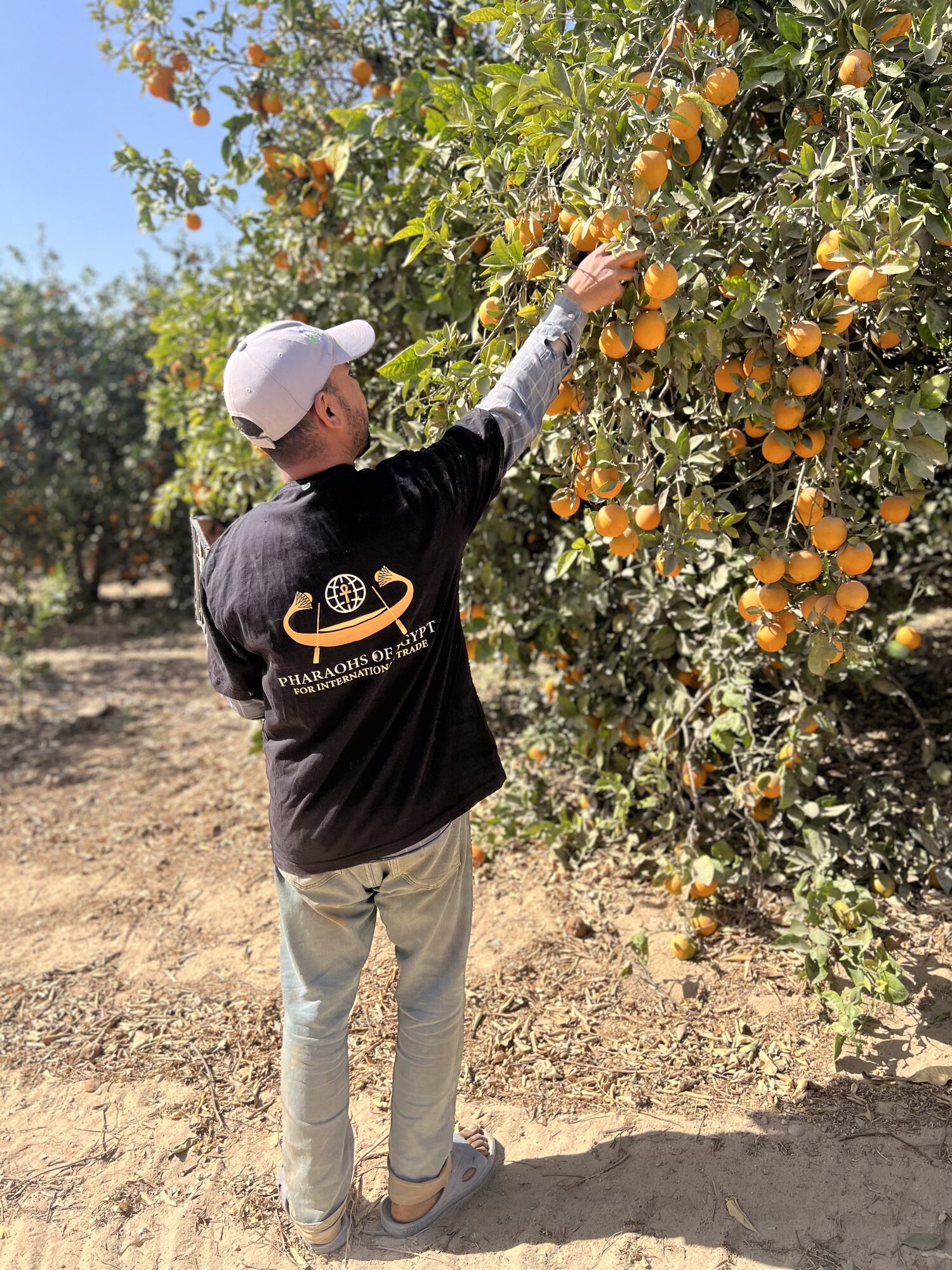
Most of the shelf life on an Egyptian citrus shipment is won or lost in the first 72 hours after the citrus harvest, long before the container is sealed. Fruit picked at 30 C in an October orchard carries field heat that no reefer machine can remove once the doors are shut. Fruit picked wet, or pulled instead of clipped, arrives with rind injuries that become green mould at the destination. The packhouse cannot undo either.
The 72-hour sequence
| Step | Timing | Temperature | What it decides |
|---|---|---|---|
| Picking | Hour 0, after dew has lifted | Ambient 25 to 32 C | Rind injury, oleocellosis |
| Field to packhouse | Within 12 to 24 h | Shaded, not sealed | Decay pressure, weight loss |
| Wash and drench | Hour 12 to 30 | Ambient | Green and blue mould control |
| Degreening, if required | 24 to 72 h | 20 to 22 C | Colour break, shorter shelf life |
| Grading and packing | Hour 30 to 54 | Ambient | Size accuracy, defect sorting |
| Forced-air cooling | 12 to 24 h | Pulp to 5 to 8 C | Arrival condition |
| Loading | Hour 66 to 72 | Within 1 C of set point | Whether the machine can hold |
Why the picking window is narrow
Citrus rind is turgid in the early morning while dew is still on the fruit. Handling it in that state ruptures the oil glands and produces oleocellosis, a sunken green-brown staining that shows up days later and is graded as a defect. Picking therefore starts after the dew has dried and stops when the fruit is too hot to handle comfortably. In an Egyptian October that leaves a working window of roughly six to eight hours, which is why an orchard block is picked over two or three mornings rather than in one day.
The step most often skipped
Forced-air cooling is the step that disappears when a vessel cut-off is close. Fruit that goes into the container at 18 C instead of 7 C asks the reefer machine to remove roughly 250 megajoules of heat from a full load, and the machine is not sized for it. The door end of that container will run several degrees above the set point for the first four or five days, which is exactly the window in which green mould establishes. Loading warm is the single most expensive shortcut in the citrus season.
Two further points belong on the specification. Ask whether the packhouse drenches or dips, and what the treatment is, because the decay profile on arrival follows directly from it. Our note on green mould, blue mould and sour rot in transit sets out what each pathogen looks like and when it appears. Ask separately about the coating, since a heavier wax slows water loss but also raises internal ethanol on long sailings, which is covered in waxing and coating on Egyptian citrus.
For an importer the practical control is simple. Ask for the pick date, the pack date and the pulp temperature recorded at loading, and ask for all three on every container. A supplier who records them is running the sequence above. A supplier who cannot produce them is guessing, and you will find out at discharge.
Nile Prime is an Egyptian exporter, not a neutral reviewer. Timings above are working targets for the 2026/2027 citrus season and vary by variety, region and destination protocol.
Building a citrus programme for this season? Send your variety, size range, destination port and required arrival weeks to Nile Prime on WhatsApp at +20 10 9911 1918 and we will come back with pack dates and sailing positions.