
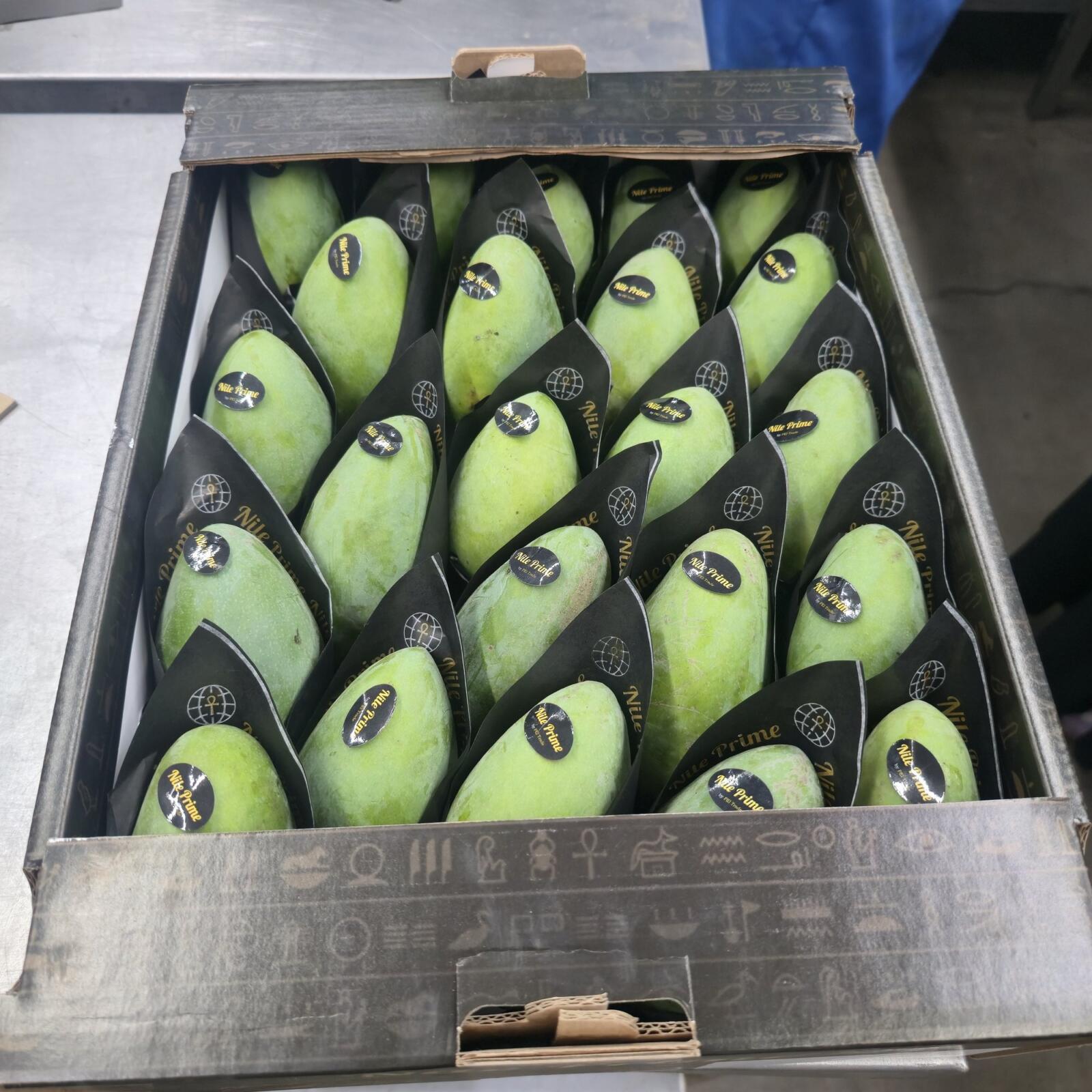
The Egyptian fresh mango season closes with the Keitt tail in October or November. From then until the following July there is no Egyptian fresh fruit to ship, and buyers who want to hold a mango line through the winter move to processed formats. Three products cover that period: IQF cubes and slices, aseptic puree, and dried mango. Each has its own specification, its own storage requirement and its own buying calendar.
What formats are available and how do they pack?
| Format | Typical specification | Retail and bulk packing | Storage |
|---|---|---|---|
| IQF cubes | 10 x 10 mm or 15 x 15 mm dice | 1 kg or 2.5 kg polybags in 10 kg cartons, or 10 kg bulk bags | Minus 18 C |
| IQF slices and halves | Cheek halves or 8 to 12 mm slices | 1 kg polybag or 10 kg bulk carton | Minus 18 C |
| Aseptic puree | Single strength, natural Brix, or concentrated | Aseptic bag in 220 litre steel drum, or bag in box | Ambient for aseptic, frozen for non-aseptic |
| Dried mango | Slices or strips, with or without added sugar | 5 kg or 10 kg cartons with food-grade liner | Ambient, cool and dry |
Which varieties go into processing?
Processing draws mainly on Keitt and on local Egyptian varieties with high pulp yield and low fibre. Keitt suits dicing because the flesh holds shape after freezing and the stone is comparatively flat, giving good recovery. Fibrous local varieties are usually directed to puree, where fibre is removed in the finisher rather than sold on the plate. Buyers who need a fibre-free cube should specify it, since fibre tolerance is the most common source of complaint on IQF mango.
When is processed mango produced and when should it be bought?
Production follows the fresh harvest. Freezing and pulping lines run from July to November, with the largest volumes in August and September when fruit is at peak availability and raw material is cheapest. Product then sits in cold store and is drawn down through the winter. The practical consequence for a buyer is that the best price and the widest choice of specification are available during the production window, not in February when the stock is already committed. Buyers who wait until the fresh season is over usually find that fibre-free cube in the size they wanted has been allocated.
How does this relate to fresh Class II fruit?
Processing is where much of the Class II fresh crop ends up, along with fruit outside the export size range. That is a normal and intended flow rather than a quality shortfall, since internal quality is what matters for a diced or pureed product and skin defects are irrelevant once the fruit is peeled. Our note on Egyptian mango for processing explains how that fruit is selected.
What should a specification actually state?
For IQF, state the cut and dimension, the Brix range, the fibre tolerance, the maximum percentage of broken or undersized pieces, the peel and stone fragment tolerance, and the microbiological limits your market requires. For puree, state single strength or concentrate, Brix, acidity, colour, and whether aseptic or frozen. For dried, state moisture content, whether sulphur dioxide is permitted in your market, and added sugar if any. A container of 40 foot reefer at minus 18 C carries approximately 20 pallets of 10 kg cartons, so define the pallet configuration in the same document.
What certification travels with processed mango?
Processing plants supplying export markets normally hold a food safety certification such as BRCGS or FSSC 22000, alongside HACCP. Ask for the current certificate and the scope statement, since a certificate that covers frozen vegetables does not automatically cover fruit puree. Buyers who need organic certification should confirm it separately at plant level. For background on the fresh side of the business, see the Egyptian mango export guide.
Nile Prime supplies Egyptian mango in fresh and processed formats through Alexandria, Damietta and Sokhna on Incoterms 2020 terms. To request specifications, samples or a quotation for the 2026/2027 winter programme, message our export desk on WhatsApp at +20 10 9911 1918.