
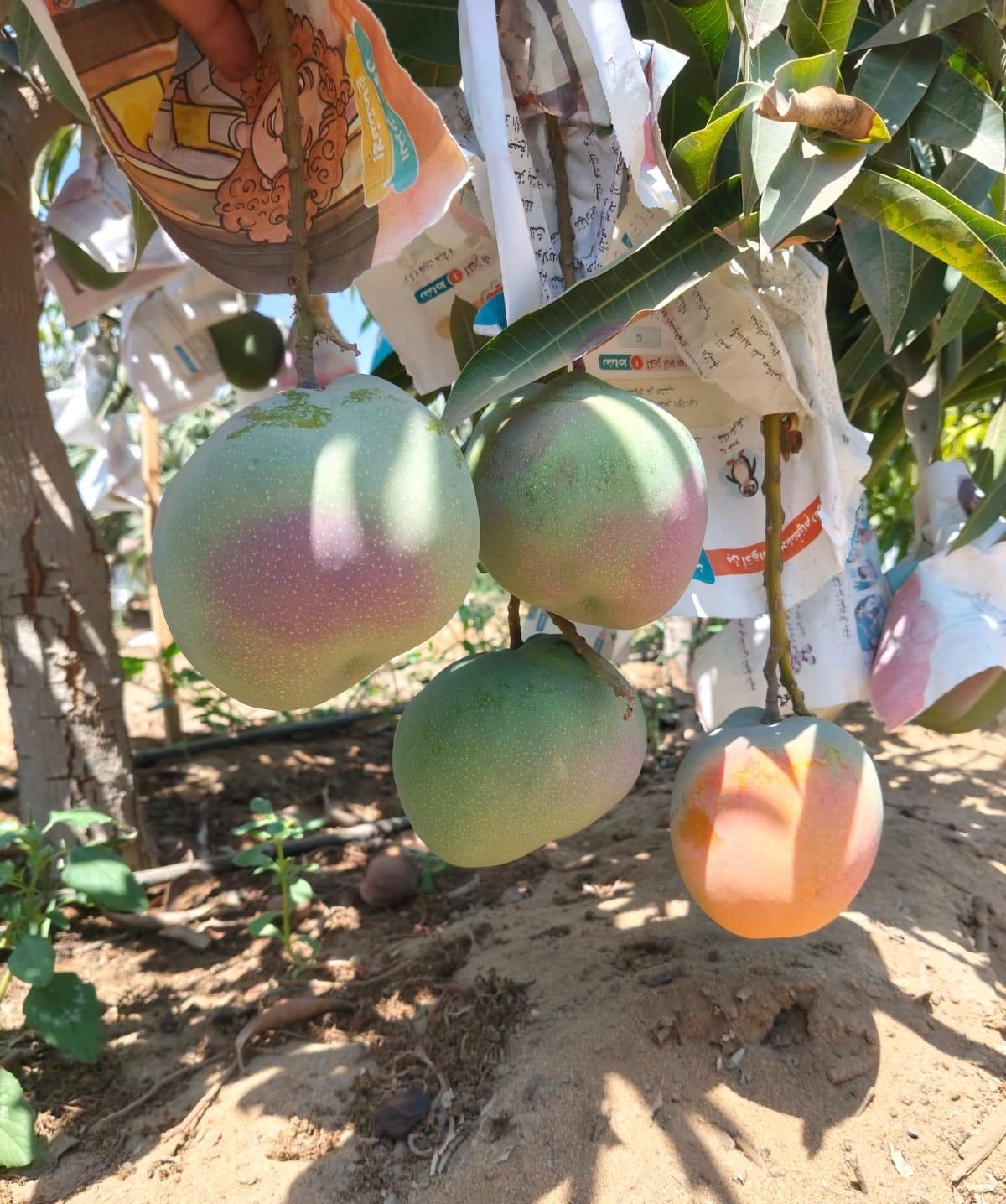
Buyers who take Egyptian mango year after year notice that the size curve is not stable. A season that delivered mostly 400 to 500 gram Keitt can be followed by one where the same orchards produce 300 to 400 gram fruit, or the reverse. The causes are agronomic and largely settled by March, months before anyone quotes a price. Understanding them is the difference between a buyer who is surprised in August and one who contracted for the right counts in April.
What sets the size curve in the first place?
Fruit size is mostly a function of how many fruit the tree is carrying. A mango tree partitions a roughly fixed amount of assimilate across whatever fruit set successfully. Heavy set means more fruit, each one smaller. Light set means fewer fruit, each one larger. This is why a big crop year and a large size curve almost never happen together, and why a short crop often arrives with unusually good sizing.
How does flowering weather in February and March decide it?
Egyptian mango flowers between late January and March depending on region and variety. Three conditions during that window do most of the work. Cool nights encourage strong panicle emergence. Warm dry days during anthesis favour pollination and fruit set. Rain, dew or high humidity at flowering encourages powdery mildew and anthracnose on the panicle, which reduces set. A khamaseen wind event during flowering can strip panicles outright. By the time fruitlets are the size of a walnut in April, the season’s fruit load, and therefore its size curve, is broadly fixed.
What is alternate bearing and how much does it matter?
Mango tends toward alternate bearing, meaning a heavy crop one year is often followed by a lighter one. A tree that carries a large fruit load exhausts reserves and produces fewer flowering shoots the following season. Growers manage this with pruning, nutrition and in some cases fruit thinning, but the tendency persists at block level. It is one reason a buyer should not assume last season’s count distribution repeats.
What role do orchard age and planting density play?
| Orchard stage | Approximate age | Typical effect on size curve |
|---|---|---|
| Young, coming into bearing | 4 to 7 years | Light load, larger individual fruit, small total volume |
| Full bearing | 8 to 20 years | Highest volume, size curve most sensitive to set and irrigation |
| Mature, dense canopy | Over 20 years | Shading inside the canopy, more small and off-colour fruit unless pruned |
Egypt has planted substantial new mango area in the desert reclamation zones over the last decade, so a rising share of national volume now comes from orchards moving from the young stage into full bearing. That shift alone changes the national size curve from season to season, independent of weather. See where Egyptian mango grows for how the production areas differ.
Does irrigation change fruit size?
Yes, in the last six to eight weeks before harvest. Water stress during the cell expansion phase reduces final fruit weight, sometimes by a full count. Most export orchards run drip irrigation and can hold size, but blocks on older flood irrigation in the Delta are more exposed in a hot May and June. Growers also stop irrigation shortly before picking to protect dry matter and eating quality, which is a deliberate trade against a small amount of weight.
What can a buyer actually do about it?
Three things. Ask for an indication of set and expected size distribution in April rather than accepting a June estimate. Contract a count range, for example 8 to 10 fruit per 4 kg carton, rather than a single count, so a shifted curve does not break the order. And build the fallback into the specification, stating what you will accept if the curve moves one count in either direction. Our note on Egyptian mango sizing and carton counts sets out how counts map to channel.
Nile Prime packs Keitt, Kent and Naomi for export through Alexandria, Damietta and Sokhna on Incoterms 2020 terms. For an early read on 2027 sizing and allocation, message our export desk on WhatsApp at +20 10 9911 1918.