
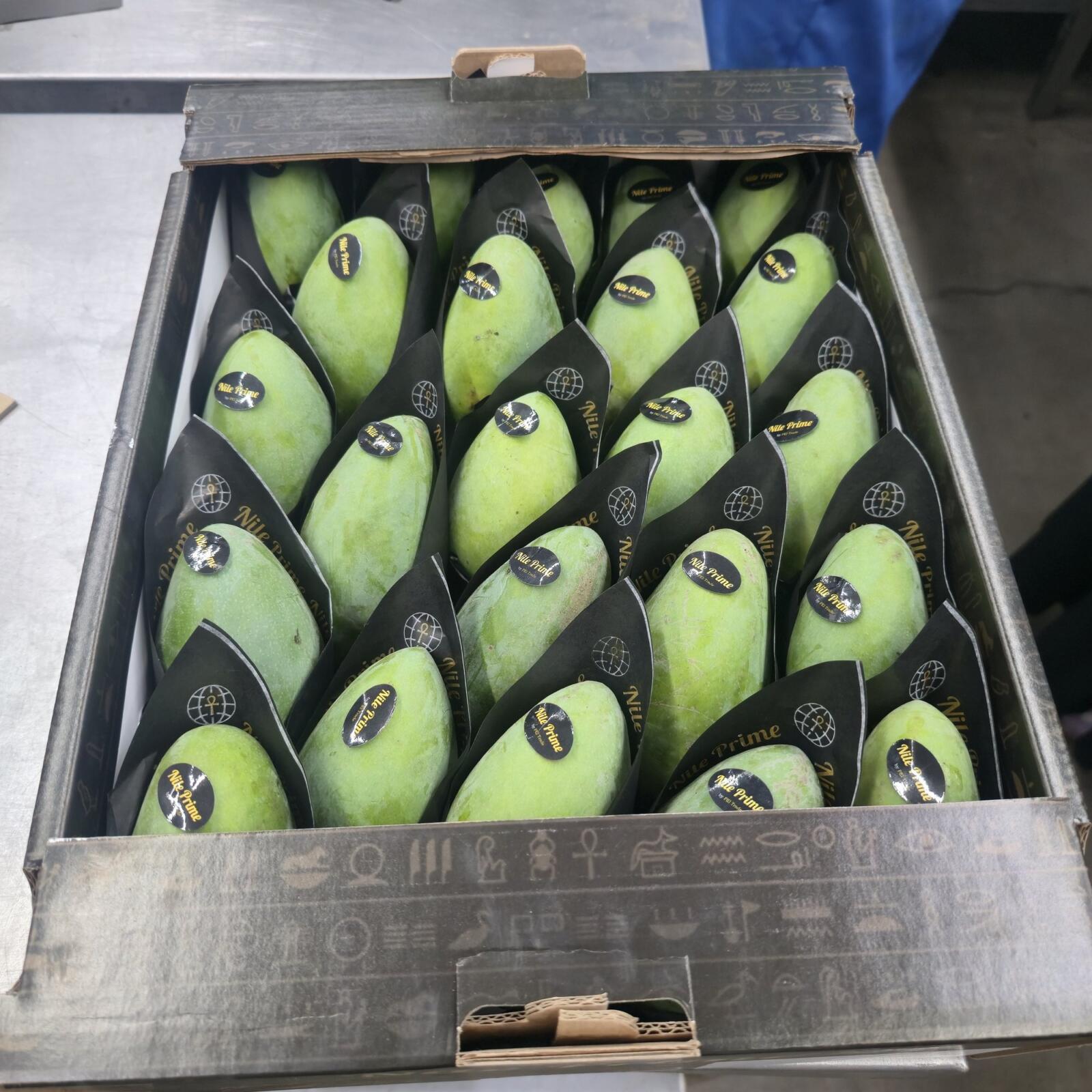
Two containers can leave Damietta with the same variety, the same count and the same set point, and arrive in different condition. The difference is often the packaging. A mango carton has to do three jobs at once. It has to carry the stack above it for the whole voyage, let cold air pass through the fruit, and stop individual fruit from bruising against each other. Those three jobs pull in opposite directions, and every packing decision is a trade between them.
Board grade and compression strength
Export mango cartons are normally double wall corrugated, commonly BC flute, with a wet strength treatment on the liner. The reason is humidity. A reefer running at high relative humidity strips a meaningful share of the compression strength out of untreated board over a three week voyage, and the bottom two layers of a pallet carry the whole stack. A carton that tests well dry and has no moisture resistance will start to settle by the second week, and settled cartons transfer load onto the fruit rather than the walls.
Ask the packhouse for the edge crush test value and confirm the board is specified for reefer conditions rather than for dry ambient transport. On tall pallet builds, corner posts running the full height take load off the cartons and hold the stack square through handling. They cost little and they are the single cheapest insurance on a long transit.
Vent area and where the holes sit
Total vent area on a mango carton typically lands around five percent of the face. Below that, pulp temperature lags behind the delivery air and the fruit continues ripening in the top layers. Above it, compression strength drops away. Placement matters as much as area. Vents on the long faces need to line up vertically from carton to carton once the pallet is built, or the airflow path closes at every layer. This is why changing a pallet pattern without checking vent alignment can undo a good carton specification. Our note on reefer loading and stowage covers how the stack itself directs air.
Trays, foam nets and liners
Single layer trays hold each fruit in a moulded cavity and are the standard for retail programmes in the EU, the UK and the Gulf. They protect against contact bruising and they let the carton be opened and merchandised without repacking. The cost is fewer kilos per pallet, since a tray pack in a 4kg format uses more volume per kilo than a bulk pack.
Foam net sleeves on individual fruit are the common alternative on 6kg and larger formats going to wholesale. They absorb contact pressure and cost less than trays, but they do nothing for stack rigidity, so the carton has to carry the load alone. Choose the format against the channel rather than the price, and read it alongside mango sizing and carton counts.
Perforated polyethylene liners are used on some late season Keitt to slow moisture loss over long transits. They help with shrivel and stem end drying. They also slow the cooling rate, so fruit under a liner has to be fully pre-cooled before the carton is closed, not cooled inside the container.
What to specify in the order
A workable packaging line in a purchase order names the net weight, the pack type, the board specification, the vent arrangement, the pallet pattern and the carton print requirement. Left unspecified, these default to whatever the packhouse is running that week, and the container that arrives may not match the one before it.
Nile Prime packs Keitt, Kent and Naomi in 4kg tray and 6kg net formats from Alexandria, Damietta and Sokhna, on Incoterms 2020 terms agreed before booking. To request the current carton specification sheet or discuss a private label print run, message us on WhatsApp at +20 10 9911 1918.