
Almost every mango buyer asks about air freight at some point, usually after a sea shipment arrives softer than expected or when a promotion needs fruit in a hurry. Air freight is a legitimate tool on Egyptian mango, but it solves a narrow problem at a high price, and the decision is easier once the two modes are compared on the things that actually differ.
Transit time
Air freight from Cairo International Airport reaches most European gateways within a day, and the Gulf within hours. Add ground handling, customs clearance and inland delivery and the realistic door-to-door figure is two to three days from packhouse to buyer’s cold store.
Sea freight from Alexandria or Damietta to Northern European ports runs roughly eight to twelve days port to port depending on service and transhipment, with total door-to-door time closer to fourteen to eighteen days once inland trucking, gate-in, sailing, discharge and clearance are counted. Gulf destinations via Ain Sokhna or the Mediterranean ports are shorter, generally five to nine days port to port.
Cost per kilo
This is where the two modes separate decisively. A 40 foot high cube reefer carries approximately twenty pallets and twenty to twenty two tonnes of packed mango. Divided across that payload, ocean freight lands at a small fraction of a dollar per kilogram on most lanes. Air freight from Cairo to Europe is quoted per kilogram and typically sits an order of magnitude higher, with a further gap between general cargo rates and the guaranteed capacity you need for perishables during peak weeks.
Rates move with fuel, season and available belly capacity, so treat any figure quoted in an article as indicative and ask for a live rate. The structural point holds regardless of the week: air freight will usually cost several times the value of the fruit inside a low-value carton, and a fraction of it inside a high-value one.
Packing formats
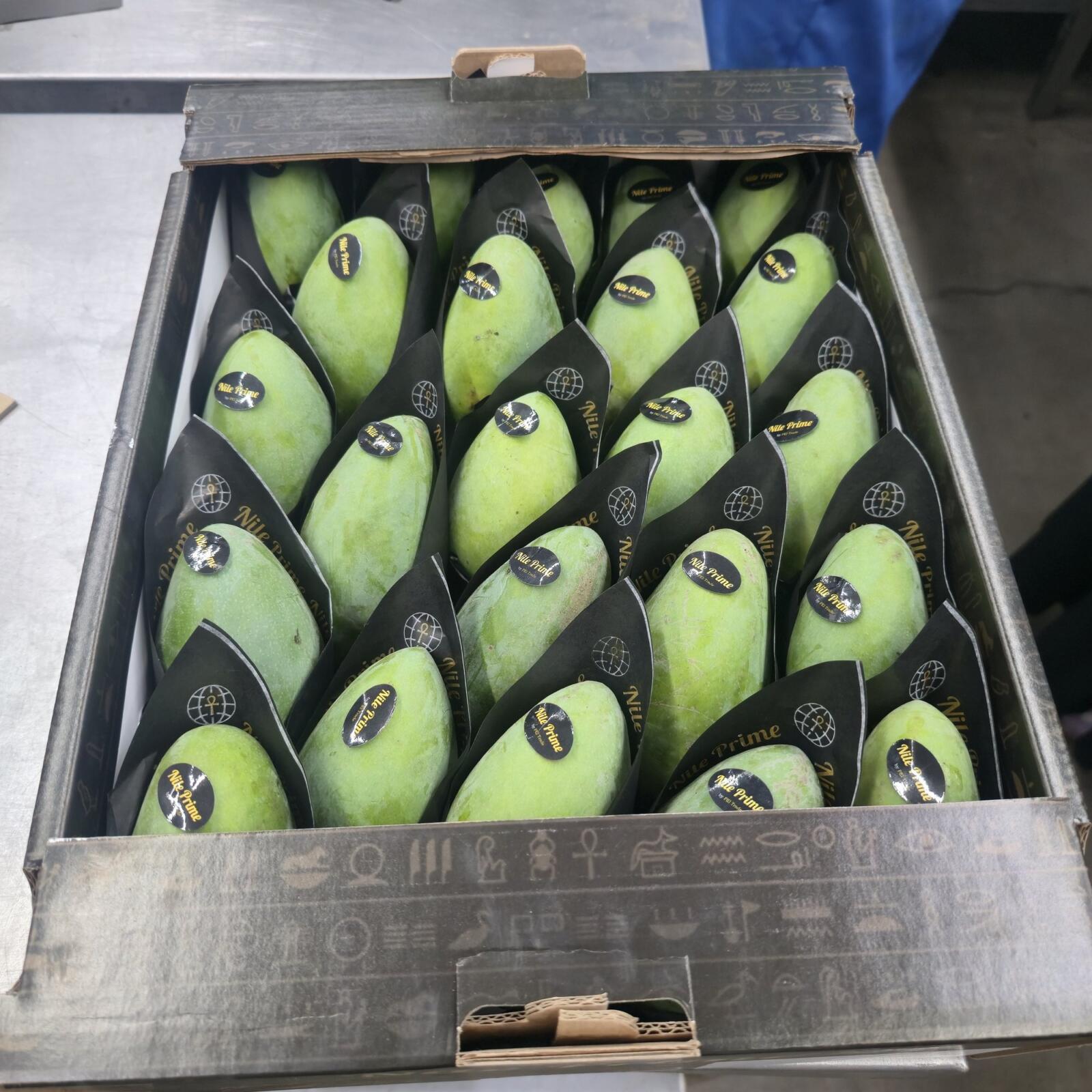
Sea shipments use 4 kg or 6 kg corrugated cartons, palletised to 100 by 120 centimetre pallets, corner-posted and strapped, with vent alignment maintained through the stack. Air shipments use lighter cartons because every kilogram of packaging is paid for at the freight rate, and they are built onto AKE containers or PMC pallets to airline dimensions rather than to sea pallet patterns. If you are switching a programme from sea to air, the carton and pallet specification changes with it, and so does the labelling.
Harvest maturity and eating quality
This is the argument that is often overlooked. Sea-freighted Keitt is picked at a firm, mature-green stage so it survives a two week cold transit and arrives with shelf life left. Air-freighted fruit can be picked at a more advanced physiological stage because it is in the buyer’s hands within days, and that difference shows in the fruit. For a premium retail listing or a specialist channel selling on flavour, air freight buys eating quality that a sea container cannot match.
Where the requirement is simply volume with a reliable arrival condition, sea freight plus proper cold chain discipline does the job. Where transit is unusually long, controlled atmosphere is the cheaper answer to the same problem, which we set out in controlled atmosphere shipping for Egyptian mango.
Choosing between them
Air freight makes sense for sample and trial consignments, for opening a new listing before the sea programme starts, for high-value speciality retail, and for covering a gap when a sea container has been delayed. Sea freight makes sense for anything resembling a regular programme, for wholesale and food service volume, and for any product where the freight cost has to disappear inside the carton price.
A useful pattern for new buyers is to run a small air consignment to assess the fruit and confirm the specification, then move the committed volume onto sea once the programme is agreed. That approach also pairs well with the pre-cooling routine described in pre-cooling and inland transport on Egyptian mango.
Tell us the destination airport or seaport, the quantity, the count you need and your target arrival week, and we will price both modes side by side so the comparison is on your own numbers. WhatsApp the export desk on +20 10 9911 1918.