
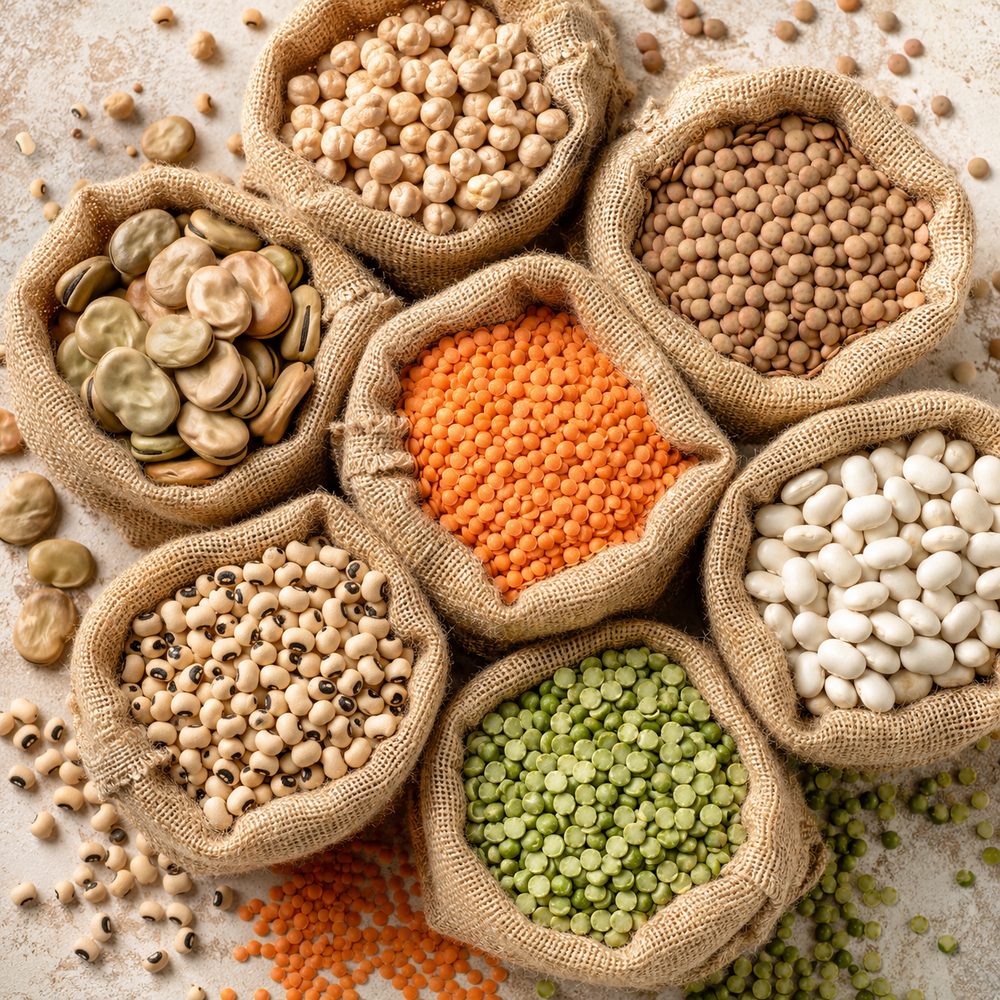
Egyptian legumes export serves a trade older than any fresh-produce lane out of this origin: dried beans and pulses — fava beans, chickpeas, lentils, white beans, black-eyed beans — cleaned, sorted, and packed for wholesale and retail buyers across the Gulf, Africa, Europe, and the diaspora markets that cook Egyptian at home. Pulses forgive logistics that fresh produce never would, which makes them the easiest first order many importers place. This guide covers the range, specs, packing, and what separates a professional pulse supplier. It anchors our legumes hub.
Last updated: July 2026 · By the Nile Prime export team
Table of Contents
- The Legume Range
- Quality Specs That Matter in Pulses
- Packing & Logistics
- What Separates Pulse Suppliers
- Egyptian Legumes Export — FAQ
- Start With a Pulse Order
- Worked Example: Mixed-Container Program
- Grades That Matter
The Legume Range
| Product | Grades & Notes | Main Demand | Details |
|---|---|---|---|
| Fava beans | Whole, split; sized per spec — the heart of Egyptian cuisine | Gulf, diaspora retail, food service | Product page |
| Chickpeas | 8–12 mm calibers | Gulf, Europe, hummus industry | Product page |
| Lentils | Red split & whole | Gulf, Africa, retail packs | Product page |
| White beans | Uniform dry white, machine sorted | Europe, North Africa | Product page |
| Black-eyed beans | Clean, bright hilum | Africa, Gulf, diaspora | Product page |
Quality Specs That Matter in Pulses
| Parameter | Professional Standard |
|---|---|
| Purity | 99%+ machine-cleaned; optical sorting in leading operations |
| Moisture | ≤14% — the line between safe storage and spoilage |
| Foreign matter | ≤0.5–1% per contract grade |
| Broken/split (whole grades) | ≤2–3% |
| Caliber consistency | Sized per spec — chickpea caliber drives price |
| Fumigation & safety | Documented fumigation; aflatoxin/pesticide tests per destination |
Packing & Logistics
The pulse trade runs dry: 25 kg or 50 kg polypropylene bags for wholesale, 500 g–1 kg retail packs (private label standard), and big bags for industry — loaded in standard dry containers at around 24–26 tonnes per 40-ft. No cold chain, 12–24 months shelf life in dry storage, and consolidation-friendly: pulses regularly top up mixed containers alongside onions and the wider legume range. That logistics simplicity is exactly why a pulse order is the classic low-risk first shipment with a new Egyptian supplier.
What Separates Pulse Suppliers
- Sorting technology: optical sorting and gravity tables — ask what the cleaning line actually is.
- Moisture discipline: a moisture certificate per lot, not per season.
- Honest grading: caliber and purity stated per contract and verifiable on arrival.
- Documentation: fumigation certificates, phytosanitary, and lab tests matching your market’s rules.
Worked Example: A Dubai Trader’s Mixed-Container Legume Program
A hypothetical Dubai dry-goods trader supplies groceries across the UAE and re-exports to East Africa. His problem is classic mid-size: he needs five legume SKUs but none at full-container volume. The Egyptian solution: one consolidated 20-foot container monthly — 8 tonnes of split fava beans, 6 of white beans, 4 of lentils, 3 of chickpeas, 3 of black-eyed beans — each line cleaned, sorted, and bagged (25 kg PP plus a retail share in 1 kg printed bags under his brand) by one Egyptian processor. The economics in this sketch: buying five origins separately would mean five suppliers, five minimums, five document sets, and warehouse cash tied up for months; the consolidated Egyptian box turns that into one supplier, one payment, one clearance — and the processor’s margin for the service is smaller than the working-capital cost it eliminates. The catch he manages: Egypt grows some legumes and processes others from imported raw material, so his spec sheet states origin per line and he verifies the processing plant rather than pretending every bean is Nile-grown. Fictional trader; the consolidation logic is why Egyptian legume processors hold the Middle East’s re-export trade.
Quality Grades That Actually Matter in Legumes
- Purity percentage: 99%+ machine-sorted is standard; 99.9% color-sorted commands the retail premium. Ask which sorters (optical vs gravity) the plant runs.
- Caliber: per-millimeter sizing on fava (8+ mm premium) and chickpeas (counts per ounce: 40/42, 44/46…)
- Moisture: under ~14% for container safety — the number that prevents caking, mold, and heat damage in transit.
- Admixture and damage: broken, bitten, and foreign-matter percentages capped in writing per line.
- Crop year: current-crop declared; old-crop blending is the category’s classic corner-cut.
- Fumigation certificates: standard for destination quarantine — phosphine treatment documented with dates.
Egyptian Legumes Export — FAQ
Which legumes does Egypt export?
Fava beans (whole and split), chickpeas in calibers 8–12 mm, red and whole lentils, dry white beans, and black-eyed beans — cleaned, sorted, and packed for wholesale and private-label retail.
How are Egyptian legumes packed and shipped?
25–50 kg PP bags for wholesale, 500 g–1 kg retail packs, and big bags for industry — in standard dry containers (≈24–26 t per 40-ft), no cold chain, with 12–24 months shelf life.
What quality specs should I demand in a pulse contract?
Purity 99%+, moisture ≤14%, foreign matter ≤0.5–1%, broken ≤2–3% for whole grades, stated caliber, and documented fumigation with lab tests per your destination’s rules.
Why are legumes a good first order from an Egyptian exporter?
Dry logistics forgive everything fresh produce punishes: no cold chain, long shelf life, easy consolidation — letting a new buyer test a supplier’s grading honesty and documentation at minimal risk.
Start With a Pulse Order
Nile Prime — the premium brand of PEI Trade — supplies the full legume range, wholesale bags to private-label retail packs: WhatsApp +20 109 911 1918 · [email protected].
Sources: Tridge — Egypt pulses intelligence · PEI Trade.