
Egyptian mangoes in Russia are no longer a niche experiment — they ride the same reefer lanes, payment relationships, and importer networks that made Egyptian citrus a fixture in every Russian supermarket. For buyers in Moscow, St. Petersburg, and the regions, Egypt offers what few mango origins can: robust varieties that survive the 12–14 day transit in strong condition, an August–November window with thin competition, and an origin their logistics teams already know how to work with. This guide covers varieties, lanes, compliance, and program design for the Russian and EAEU market. Part of the complete Egyptian mango export guide.
Last updated: July 2026 · By the Nile Prime export team
Table of Contents
- Why Russia Works for Egyptian Mangoes
- The Right Varieties for the Russian Market
- Lanes, Transit & Arrival Condition
- EAEU Compliance Essentials
- Egyptian Mangoes in Russia — FAQ
- Build Your Russia Program
- Worked Example: Moscow Mango Test
- Lane Practicalities
Why Russia Works for Egyptian Mangoes
- The citrus rails are already built. Egypt is one of Russia’s largest citrus suppliers; the same exporters, forwarders, banks, and receivers handle mango with no learning curve.
- Robust varieties travel well. Kent, Keitt, and Tommy Atkins arrive after two weeks at sea with shelf life to spare — the deciding factor on this lane.
- The window is open. August–November Egyptian supply lands when Central Asian fruit is finished and Latin American arrivals are still far away and expensive.
- Freight economics. Direct services from Alexandria and Damietta to Novorossiysk and St. Petersburg keep landed costs well below any competing origin in the same weeks.
The Right Varieties for the Russian Market
| Variety | Why It Works in Russia | Peak |
|---|---|---|
| Kent | Sweet, near-fibreless, attractive blush — the retail favorite | Aug–Oct |
| Keitt | Longest shelf life of any variety; ideal for regional distribution beyond the ports | Sep–Nov |
| Tommy Atkins | Toughest handling tolerance; value programs and wholesale markets | Jul–Sep |
| Shelly | Late-season premium alternative with excellent sizing consistency | Sep–Oct |
Indigenous premiums (Owaisi, Zebda) play a smaller role here than in the Gulf — they suit air-freighted niche programs for premium Moscow retail rather than volume lanes. Full profiles in the varieties guide.
Lanes, Transit & Arrival Condition
| Route | Transit | Notes |
|---|---|---|
| Alexandria / Damietta → Novorossiysk | ~12 days | Southern gateway; strong for Moscow and the Volga region |
| Alexandria → St. Petersburg | 12–14 days | Northern retail programs; book space early in peak weeks |
| Reefer settings | 10–12°C, 90% RH | Pre-cooled fruit only; pulp temperature logged at loading |
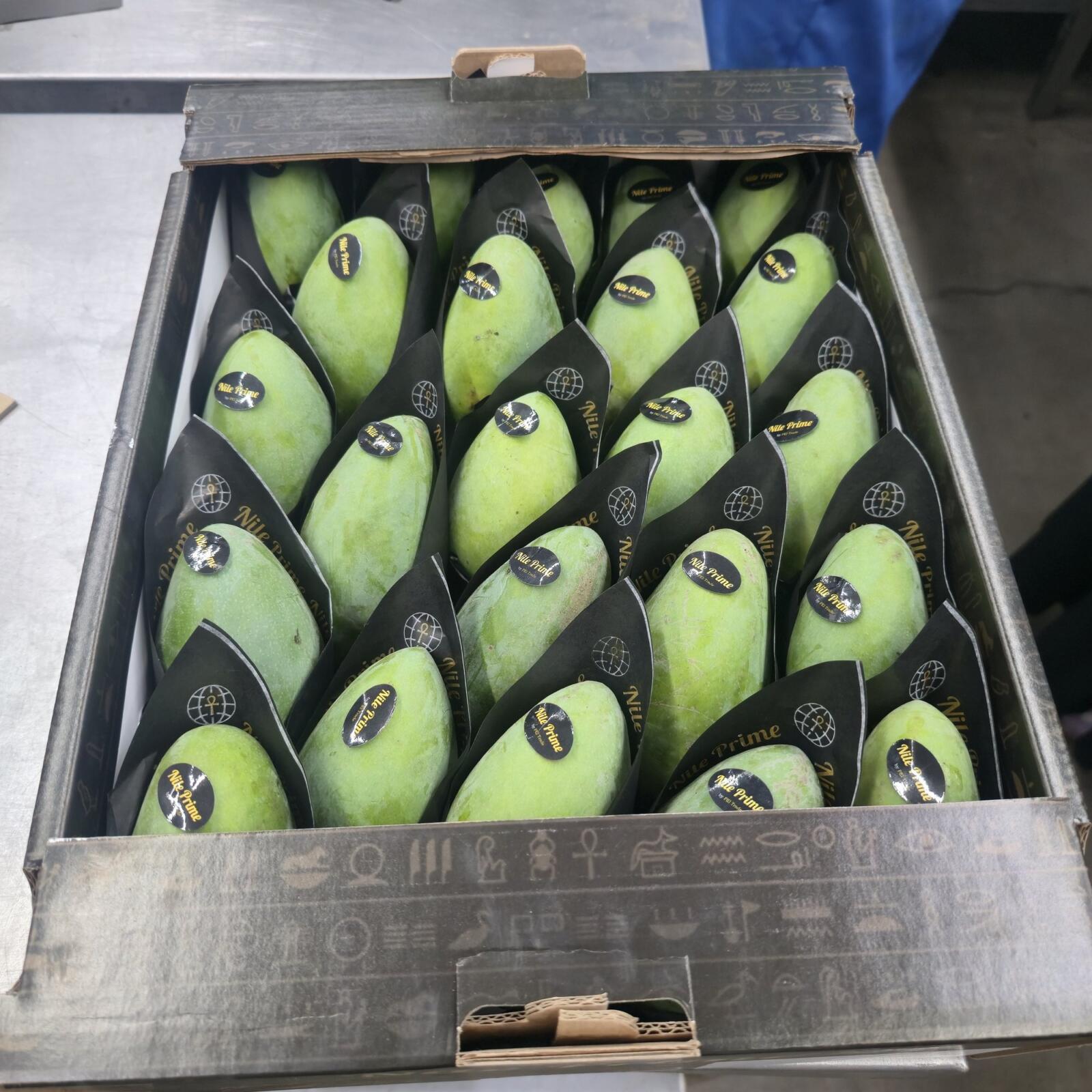
On a two-week lane, harvest maturity and cold-chain discipline decide everything. Fruit picked firm-mature, pre-cooled within hours, and loaded at correct pulp temperature ripens gently in transit and arrives retail-ready. The packing standard that supports this — single-layer 4.5 kg cartons, wrapped fruit, disciplined palletization — is detailed in the packing specifications guide.
EAEU Compliance Essentials
- Phytosanitary certificate from Egyptian quarantine, HWT referenced — inspected closely at Russian ports.
- EAEU conformity declaration arranged importer-side; your exporter’s document set must match it exactly.
- Labeling: product, origin, weight, packer, and dates — consistent across carton, packing list, and invoice.
- MRL testing against EAEU limits per lot — ask for the lab report with the pre-shipment documents. The full document set is covered in the export requirements guide.
Worked Example: A Moscow Distributor Tests the Mango Lane
Russia’s mango market — long dominated by air-freighted Latin American fruit at boutique prices — is exactly the kind of lane a hypothetical Moscow tropical-fruit distributor probes with Egyptian sea freight. July: two trial containers of Keitt via Novorossiysk, booked against the citrus-season relationships he already runs with Egyptian exporters (the lane infrastructure — banking workarounds, ruble settlement mechanics, clearing agents — transfers wholesale from oranges to mangoes; that reuse is the quiet enabler). August: arrival scoring: firm, green-shouldered Keitt lands in ripening-ready condition; his ripening room — built for bananas — handles the ethylene cycle without modification. Retail response surprises upward: Egyptian fruit undercuts air-freight Peruvian by a wide margin in this sketch while eating better than expected. September–October: six more containers close his season as the Egyptian window tapers. The scenario’s lesson mirrors the real lane’s trajectory: Russia rewards origins that pair aggressive pricing with existing logistics trust — and Egyptian mangoes ride into Russia on rails the citrus trade already laid. The full winter-citrus playbook on this lane sits in the Russia oranges guide.
Lane Practicalities — Mangoes vs the Citrus Template
- Setpoint discipline: +10 to +12°C for mangoes — a different reefer regime from citrus; chilling injury below ~10°C is the lane’s costliest rookie error.
- Variety choice: Keitt’s thick skin and late window fit the 12–16 day Novorossiysk transit; delicate premium varieties stay in air freight.
- Ripening capacity decides scale: distributors with banana rooms convert instantly; those without should start with small volumes ripened by service providers.
- Documents: same EAC-zone customs template as citrus; phyto plus quality certificates in the standard set.
- Season fit: July–October Egyptian supply meets Russian late-summer retail — no competition from the winter citrus rush for reefer space on the lane.
Egyptian Mangoes in Russia — FAQ
How long does shipping take from Egypt to Russia?
About 12 days to Novorossiysk and 12–14 days to St. Petersburg in reefer containers at 10–12°C. Robust varieties like Kent, Keitt, and Tommy Atkins arrive with 2–3 weeks of remaining shelf life.
Which Egyptian mango varieties are best for the Russian market?
Kent for retail flavor and appearance, Keitt for maximum shelf life and regional distribution, Tommy Atkins for value programs, and Shelly as a late-season premium. All four handle the two-week transit in strong condition.
When are Egyptian mangoes available for Russia?
July through November, with the strongest volumes and best pricing August–October and late Keitt extending programs into November — precisely the window when competing origins are scarce in the Russian market.
What documents are required to import Egyptian mangoes into Russia?
Phytosanitary certificate with HWT reference, certificate of origin, commercial invoice and packing list, bill of lading with reefer settings, MRL lab report against EAEU limits, and the importer-side EAEU conformity declaration.
Build Your Russia Program
Nile Prime runs Kent–Keitt sequenced programs to Novorossiysk and St. Petersburg with EAEU-ready documentation on every container. Send your volumes and target weeks: WhatsApp +20 109 911 1918 · [email protected] · Egyptian mangoes — specifications. Time your bookings with the season calendar.
Sources: PEI Trade — Egyptian Mango Export Report 2026 · Tridge — Egypt mango export intelligence.